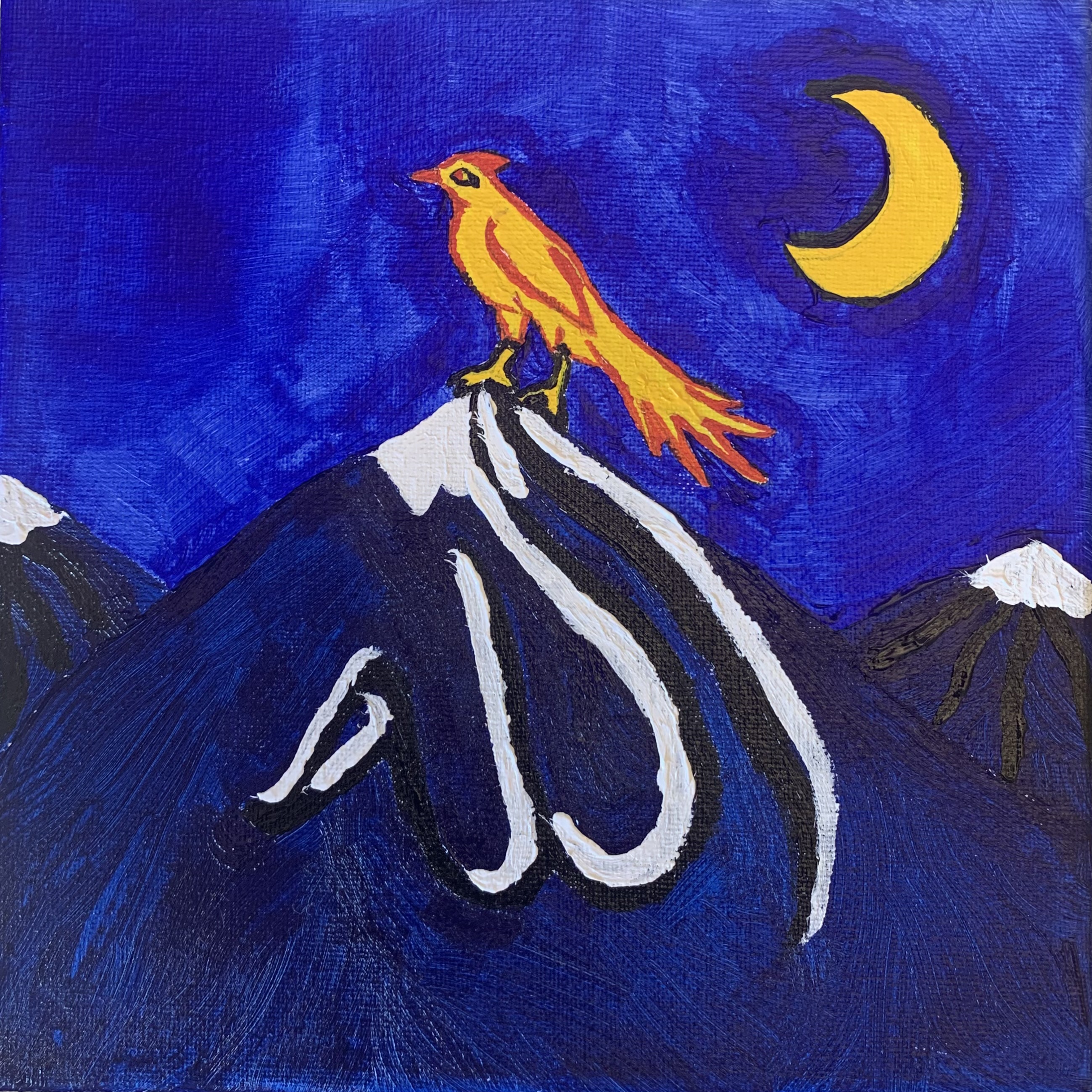
12023-01-29T20:05:05-05:00Kevin Guiney27284d5e9164c09945238f77330779abea1b73ab1984plain2023-02-21T13:10:05-05:00Darius Atefat-Peckhamf0986a9a2c83aa189f471379af7799221b9eb0e0For my calligram project, I decided to work with a Sufi interpretation of God, but also one that cohered with the naturalist interpretation of Allah that we spoke about in class—that implicit scripture that surrounds us all. I painted Mount Damavand, the highest peak of the Alborz mountains in Iran, a place ripe with the story and mythology surrounding Allah in poetry. Growing up, I’ve heard it said that the Alborz mountains were like the wings of the mythical Simorgh, stretching all around Iran with its mothering embrace. In Persian mythology, specifically in the Shahnameh, the Simorgh is an all-knowing and nurturing being that looks after the hero Zal and his son, the famous hero Rostam. In later Sufi poetry, especially in Attar’s Conference of the Birds and often referenced in Rumi’s work, including in the Masnavi, the Simorgh becomes a symbol for God and the journey we make (akin to Muhammad’s mi’raj) to find that divine spirit that dwells within us. Mount Damavand is storied to be the place that the Simorgh calls home, imbuing this mountain’s peak with divinity and magic. By incorporating the word Allah both in the dark grooves of the mountain, and in the bright snow that sits unmelting atop it, I’ve tried to create a sense of the implicit and lasting scripture of nature and of the distance between God and the yearning soul, the journey one must make to discover divinity within themselves, perhaps encountering the Simorgh’s nurturing light at their heart’s peak.