Rohan Rajeev
I chose to represent the calligram of Allah through music. Music resonates with me on a deeply personal level, and I also believe that Islam has a strong history that is intertwined with music, as the Qur’an is not merely a text but passed down through oral recitation and interpretation.
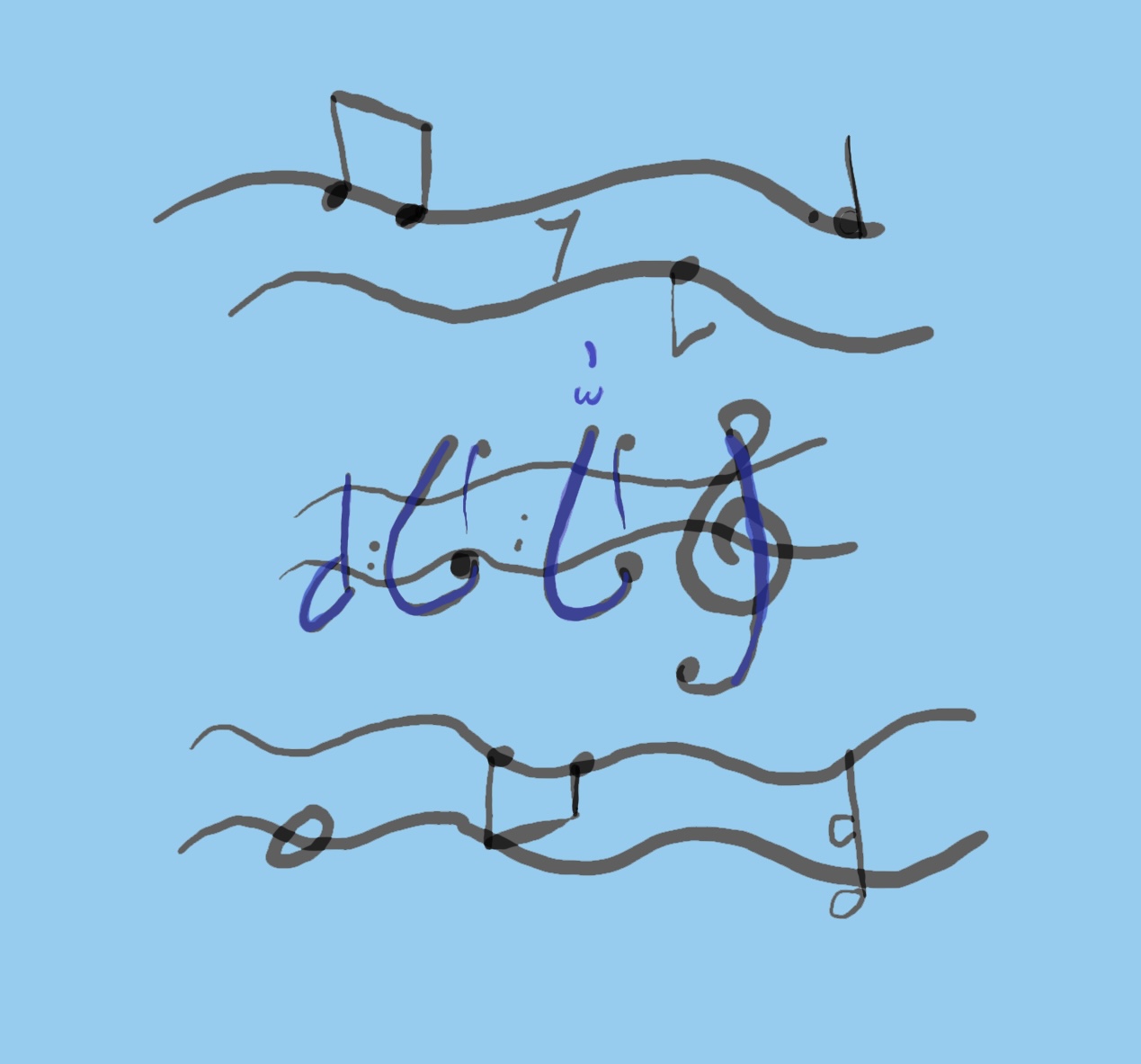
In the middle two bars is my actual calligram of ‘Allah.’ The theme for my work is Tawhid—the oneness of God and reality, and this is represented on several levels in my work. There are many names of Allah, and the collection of musical notes and symbols represents the various manifestations of God. For example, two seemingly opposite symbols representing higher notes and lower notes, the treble and bass clefs, respectively, are equally important figures in the calligram because without them the calligram of Allah would be incomplete. Similarly, God is an entity that is both beautiful as well as held to be feared—seemingly contradictory ideals but nonetheless in coexistence.
The writing of Allah is meant to be subtle, and might be missed without the dark blue overlay that I’ve highlighted it with. This was purposeful, as it was meant to demonstrate that in the grand scheme of the work (which includes the bars below and above the actual calligram), God makes Himself known in subtle ways, but if sought out diligently, can be found. The overall flow of musical notes is meant to represent the grand scheme of space/time that God makes Himself known through. There is no clear beginning or end to this “piece,” but the presence of God in the story that the piece tells is undeniable. Disparate parts of musical brilliance come together and represent the oneness of reality—thus, music is a way for us to access God and understand this reality.
FINAL EXAM REFLECTION
The Danger of Labels
Labels. The idea of labels is something the west is enamored with. Who are you with, what do you support? By that response, who are you against, and what do you hate? Labels can be good, but for every good thing that labels produce there are perhaps just as equal or greater a number of harmful things produced as a result of labels. Perhaps in the least harmless context, such obsessions are seen in sports.
If you support FC Barcelona for example, you have a shared experience in a way with fans of the same club. You may have never met another fan, but instantly you can relate to the triumphs and failures of that club—when Barcelona were at their heights of the Champions League but also at the lows of missing getting eliminated from competitions earlier than expected.
I’ve seen it in cultural settings. As you all know, at a place like Harvard, affinity groups exist where members of groups like South Asians, Albanians, African Americans, and any other group of individuals sharing similar cultural roots can come together. Whether it’s over food, a conversation, or a performance, organizations of this type allow people to share in the common cultural traditions of their family and their past. For many of us, it’s in groups like these from which our closest friendships are formed.
These labels have proved to foster positive relationships, good memories, and favorable interactions. Why do labels work in these contexts? Because we all, whether subconsciously or consciously, have the understanding that even if one is a fan of the same team, or in the same affinity group, that everyone’s experience is different. The reason I might have become a fan of Barcelona may have been because my first soccer coach was a fan, while yours may have been in admiration of a certain player like Messi. In affinity groups, my reason for being a member might be because I want to lead events on campus having felt already connected well with my culture, while your reason might be a desire to reconnect with that same culture because you feel distanced from it.
But where labels are dangerous is when heterogeneity in shared beliefs or experiences is not recognized. In reality, things like sports and student groups often have a built-in understanding of this, at least at a place like Harvard—yet, there is one realm in which I believe there is still a severe lack of this understanding, even here at the College: religion.
How can something like this be dangerous? Let’s step back and look into history and beyond religion.
In the Scramble for Africa, people groups were split up via negligible borders into nation states that did not encapsulate the true identity of those peoples. This initiated conflict for years to come, some of which we bear witness to in the modern day. The consequences of labels in the context of imperialism was one that has had evident and severe consequences.
Religion suffers from the same type of labeling that results in generations-long consequences. With the aftermath of 9/11, “us vs them” narratives permeated American society and have resulted in the Islamophobic rhetoric that exists today, whether it’s in political spheres or in day to day conversation. So, how did we get here—here, being a world that sees religion as incredibly one-dimensional?
In the west, our obsession with labels has caused us to mentally group different experiences as one. The extremists responsible for the 9/11 attacks have become representative of the singular Muslim experience in the US. In reality, there is no such thing as THE Muslim experience. Islam is not a person—it can’t speak on behalf of people, endorse a certain practice. Islam lives through people, and each person expresses Islam differently.
Even here at Harvard, religious traditions are often seen as monolithic. How do we go about changing this? I don’t have an answer, but asking ourselves about our own constructions of religion and the role of labels as applied to all of our constructions of reality is a good start.
Section C (500 words): Offer reflections on Section B. What venue and medium did you choose and why? Who is your audience and why did you select them for your focus? How does your piece represent the idea you highlighted in A?
I selected my venue/medium as a TED Talk at Harvard. One of my favorite things about Harvard is the intellectual vitality and openness that people have here, and I believe that stems from diversity of backgrounds and experiences. Having come from a place with little diversity of thought, there is definitely a high level of ignorance at home in comparison to here at the College. At the same time, I believe it leads some students to think they have it “all figured out” in terms of their stances on society at large, and I believe that that is a dangerous way of thinking. Everyone, even here, has room for growth, and religious illiteracy is an area in which many people can grow—yet it receives little attention even at such highly esteemed academic institutions like Harvard.
I additionally hoped to contextualize the problem I was addressing by making it more relatable, as not every student may be an active participant in a religious space. I personally am an avid watcher of sports, and many of my own and my friends’ conversations are dominated by what is going on in this world. I also think many more students are involved in cultural groups than in religious groups.
My concept of labels is especially relevant because I think society is becoming increasingly judgmental. Religious expressions can often bear the brunt of such judgment—seeing someone wear a hijab, pray before eating, or fast are all actions that most likely elicit more responses now than ever, whether these responses be positive or negative. Social media in an increasingly globalizing and connected world is a catalyst for this.
My point in Section A was on the existence of transcultural religion using Chinese Muslims as an example. How does this relate to the dangers of labels? Incorrectly, many would assume that being Chinese and Muslim are mutually exclusive. This is problematic in, say the US, because of how Chinese Muslims may be misattributed to being solely a part of one community and not another. But this bears more dangerous consequences in China itself, where Uighurs are being placed in the equivalent of concentration camps. It will never gain the traction in western media as it should, because the west is obsessed with using pre-existing labels and never going outside those labels. Perhaps through the eyes of western media, such a thing as the persecution of Uighur Muslims doesn’t exist because we can never associate being Chinese and being Muslim in the first place.