Sahar Maisha
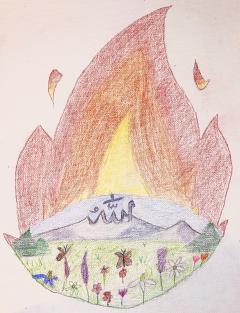
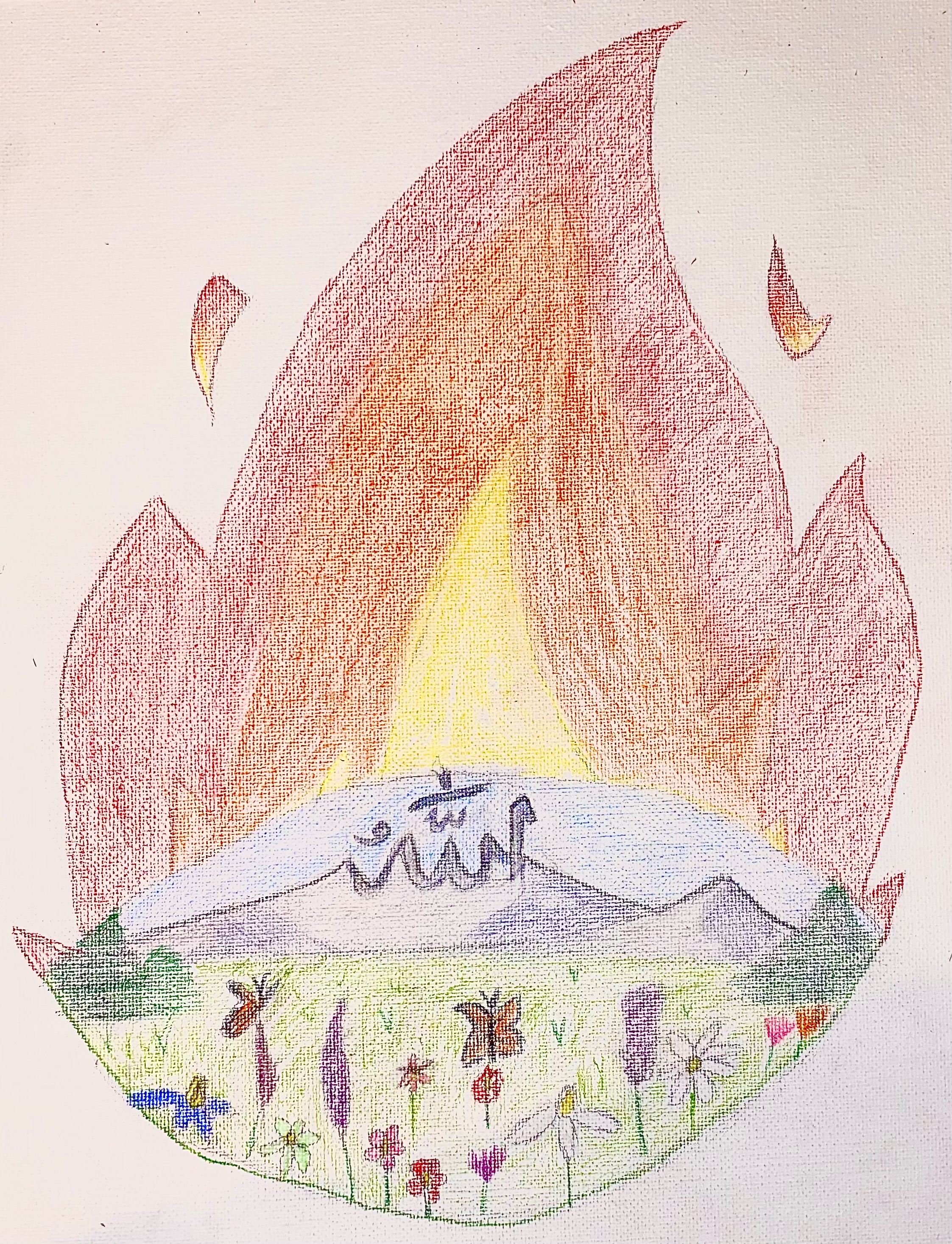
For this assignment, I chose to illustrate the story of Prophet Ibrahim being thrown into a big fire by idol worshippers, an attempt to put an end to his teachings. This story, like many others in Islam, highlights the struggle of Prophets to spread the word of Allah, often facing punishment and persecution from those who disbelieve. However, what stood out to me the most about this particular story was the way in which Allah protected Prophet Ibrahim.
“O fire! Be cool and safe for Ibrahim!” (Surah Al-Anbiyaa)
Instead of ordering people to protect him, Allah commanded the fire itself to be cool and safe for Ibrahim to survive. This demonstrates the immense power of Allah, and how everything in the world, including objects in nature and other beings, submit to His will.
In my drawing, I depicted a large fire with roaring flames, emphasizing how big and intimidating it must have been to Prophet Ibrahim. However, I also included a garden within the fire, symbolizing the beautiful, cool protection that Allah provided for him. This contrast highlights the difference between the cruel intentions of the idol worshippers and the mercy and love of Allah.
To demonstrate Allah's assistance, I wrote the name of Allah as if it were the peak of the mountains, signifying that Allah is above and with us at all times. It is a powerful message that even when things seem impossible, Allah is capable of providing solutions and saving us from harm.
This story serves as a reminder of the power of faith and protection that Allah provides for His believers. It is a lesson that Muslims should always keep in mind, especially during difficult times, and strive to follow the path of the Prophets in spreading the word of Allah.
Section B/C of Final Exam:
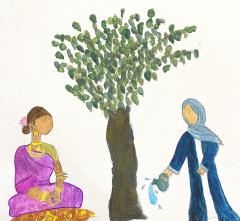
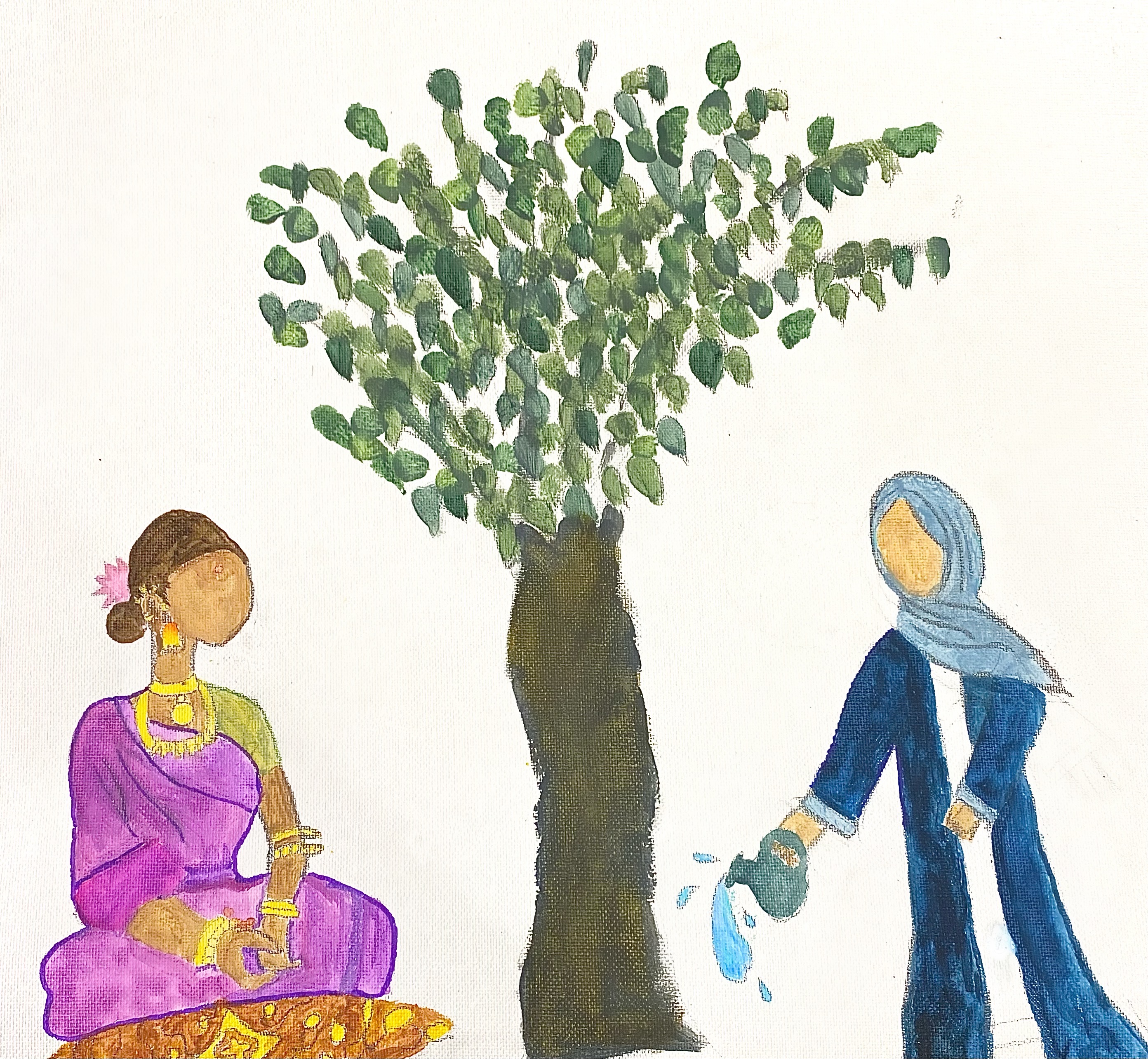
For my painting, I decided to illustrate a key idea from my second example, “Living together with diverse identities, not limited to religion”. In my painting, I illustrated a Bangladeshi-Hindu woman in front of a Peepal tree. Peepal trees are considered sacred in Hinduism as Lord Vishnu was said to be born under a Peepal tree and Lord Buddha meditated under a Peepal tree (1). Therefore, many Hindus use the Peepal tree and its leaves in rituals and for healing properties. On the other side of the tree is a Bangladeshi-Muslim woman watering the tree to signify that she planted it. In Islam, there is a hadith in Sahih Bukhari: “There is none amongst the Muslims who plants a tree or sows seeds, and then a bird, or a person or an animal eats from it, but is regarded as a charitable gift for him” (2). Therefore, planting trees is considered Sunnah and a form of Sadaqah Jariyah, or charity. Because both women are benefitting from the tree, this demonstrates that they are able to practice their respective religions alongside each other. For this painting, I decided to use watercolors to blend colors seamlessly for the stunning sari that the Hindu woman is wearing, symbolizing Bangladeshi culture and the vibrant hues of their attire. Furthermore, I used acrylic paints for the tree, as they are more long-lasting, similar to the tree that will benefit both Bangladeshi Hindus and Muslims for a long time.
More broadly, this painting represents that both Hindus and Muslims can coexist peacefully in Bangladesh. It also demonstrates that one should not forget their culture in response to disagreement towards religion. It’s important for individuals to find similarities in their identities and build connections from them. The essential aspects of a state include its "music, dress, popular beliefs, and cultural outlook" (3), which are crucial in defining its identity, and should not be disregarded. Neglecting these factors can lead to a fundamental alteration of the state's core. Therefore, the two Bangladeshi women can peacefully coexist by sharing their culture and ethnicity, and supporting each other through the Peepal tree. By growing the tree, the Muslim woman is supplementing the religious rituals of the Hindu woman. This way, both the Muslim woman, who is earning good deeds for planting the Peepal tree, and the Hindu woman, who is earning good deeds from praying in honor of it, are benefiting in their respective religions. This illustrates how people of diverse backgrounds, in faith specifically though this is not limited, have the potential to develop camaraderie.
This piece is intended for individuals living in nations with diverse backgrounds, like Palestine, India, Bangladesh, Pakistan, and others. To foster peaceful coexistence, it is essential to identify commonalities between different religious, ethnic, or other distinct groups and find compromises based on those shared values. We cannot change the fundamental aspects that define us, but we can strive to live alongside each other harmoniously, complementing one another in ways that promote understanding and unity.
Sources:
- “Importance of Peepal Tree: The Tree of Life.” GaneshaSpeaks, 20 Mar. 2023, https://www.ganeshaspeaks.com/predictions/astrology/significance-of-peepal-tree/#:~:text=The%20peepal%20tree's%20spiritual%20significance,to%20be%20good%20every%20Saturday.
- Empowering people through planting..., https://islamic-relief.org/news/empowering-people-through-planting/#:~:text=%E2%80%9CThere%20is%20none%20amongst%20the,for%20him.%E2%80%9D%20(Bukhari).
- V. Nasr, "European Colonialism and the Emergence of Modern Muslim States”, Page 560
*Note: For sources (1) and (2), I used sources outside the classroom in order to provide reason and proof for the Hindu and Muslim traditions I mentioned above.