Matthew Miyasaka
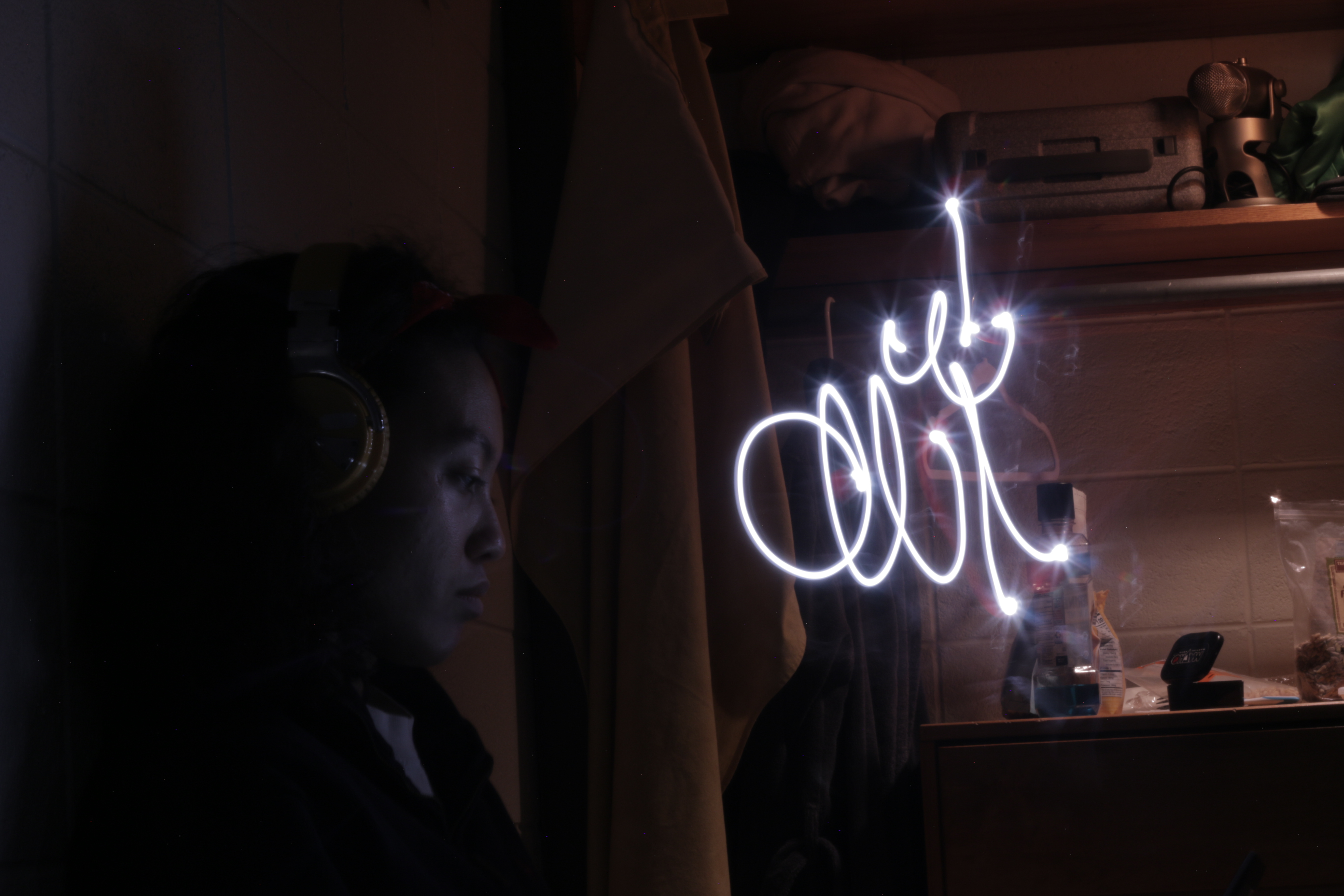
With these ideas in mind, for my calligraphy assignment, I have made a light painting of Allah in Arabic (achieved by keeping the camera shutter open for 30 seconds and "drawing" with my phone's flashlight). One of the original motivations was to use the world rather than the paper as the "canvas" for my calligraphy; the same can perhaps be said of the Quran itself, as it was repeated aloud long before it was transcribed onto paper. Also notice that in the photo the word itself is lighting the subject's face, which symbolizes Allah as the Light of the earth. It is unclear whether "Allah" as it appears in the photo is meant to be spiritually present or physically present, as while it illuminates the subject's face, the subject does not seem to notice it. This is meant to demonstrate the heaven/earth duality of Allah's being Light. Finally, the subject herself has headphones on, which I instructed her to do to reflect the original auditory nature of the Quran.
FINAL EXAM: COLLAGE CALLIGRAPHY
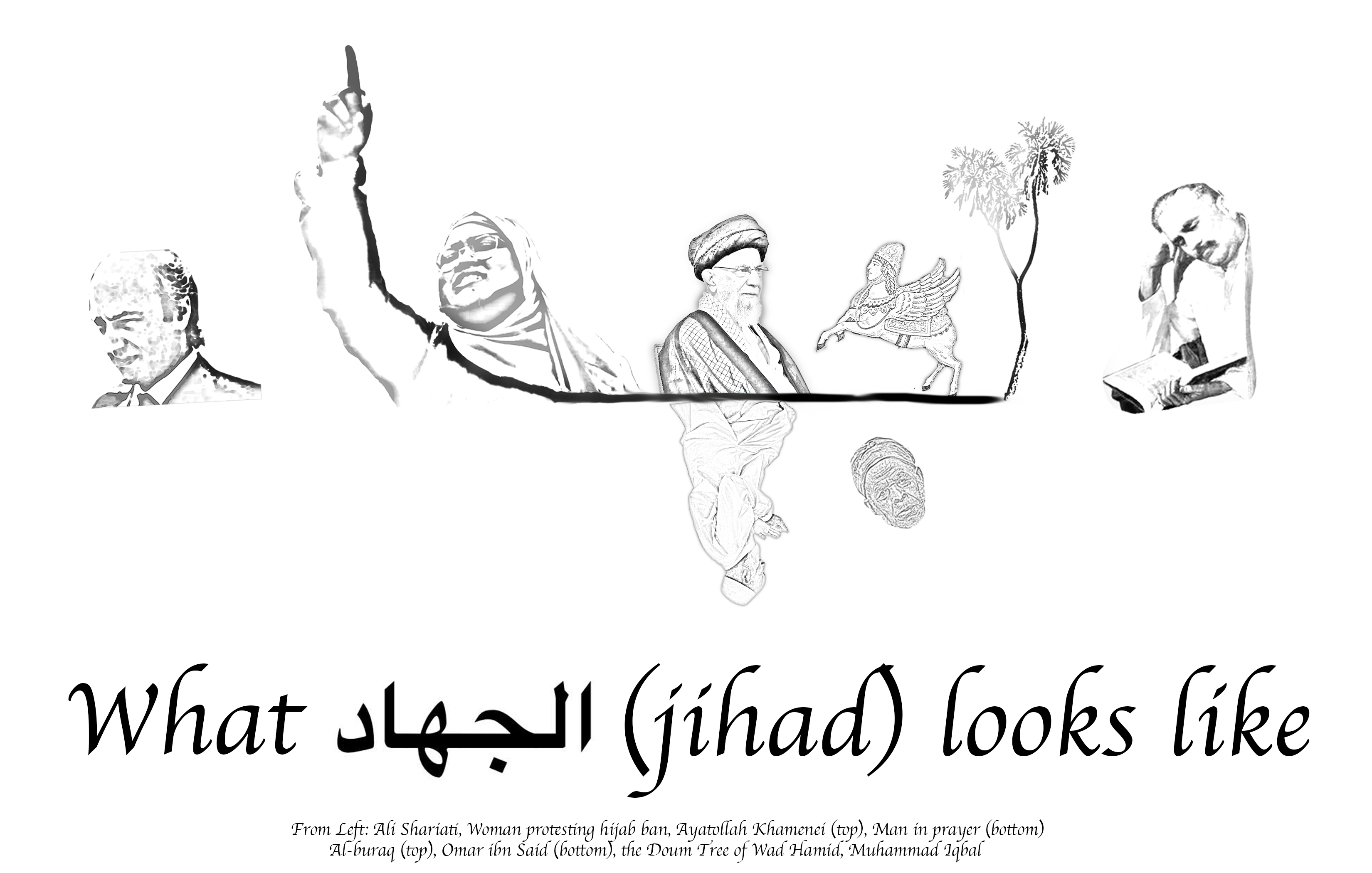
Jihad is seen as ugly and alien by many Westerners. By arranging a collage of people/symbols from the course to loosely spell out aljihad (see note) in Arabic, I hope to humanize jihad to show its diverse meanings. I also hope to show the kinds of struggles that Muslim people wrestle with, as many of these struggles are not apparent to the West.
Since this is for the West to see, I’ll go from left to right. First, Ali Shariati reflects Muslim people’s ideological struggle in the face of Western ideas. Shariati decries both Democracy and Communism for being at the whim of capricious agents like economic firms and powerhungry autocrats respectively. So while the West would like to believe that Western ideology is necessary to liberate or modernize Muslim people, this ideological imperialism can actually engender more struggles.
Next, the woman in the hijab is from a news article about women in India protesting a ban on hijabs in schools. Because the West mostly sees hijabs as oppressive, they don’t notice Muslim women’s struggle to express their faith or autonomy by wearing a hijab.
The Ayatollah Khamenei and the man in prayer are placed across from each other to represent political and religious manifestations of Islam respectively. This is not to say that the Ayatollah is not a religious figure (he 100% is). It is simply meant to represent the often-clashing religious and political interests that have helped shape Islam. It is important to recognize this complex interplay, as unresolved conflicts between the two can engender struggles for millions.
Al-Buraq, the horse that the Prophet rode through the heavens, symbolizes that spiritual journey (mi’raj). It is therefore a reflection of the personal struggle many Muslims go through with their faith. For example, some Sufis will try to undergo an inner transformation similar to the Prophet’s.
Omar ibn Said reflects the struggle of Muslim minorities. We learned that ~10% of the slaves brought to America were Muslim, yet their history is seldom told. Omar’s autobiography begins to tell us what struggles Muslim slaves went through. The struggles of Muslim slaves are an integral part of Western history and ought to be recognized.
The Doum Tree of Wad Hamid is taken from the short story we read in class. It represents the struggle to maintain traditional identity in a modernized world. Indeed, efforts to “modernize” groups of people can be incredibly destructive. It is difficult enough to maintain tradition in today’s globalized world, so we should be careful not to intensify that struggle through attempts to “educate.”
Finally, Muhammad Iqbal also represents Muslim people’s personal struggle, albeit a different one from Al-Buraq. Iqbal’s poem “The Complaint” explores a character struggling to maintain their faith, as their faith does not seem to earn them God’s favor. This is an existential struggle that I imagine most, if not all, people of faith experience at some point or another. It therefore speaks to a shared religious struggle between Muslims and non-Muslims.
(NOTE: Google Translate gave me “aljihad,” which I used here instead of just “jihad” for the sake of including more figures in my collage. I do not know if this is correct, but I hope any translation errors don’t detract from my overall message.)
(Too many references to list here; see my actual exam for photo and factual citations)