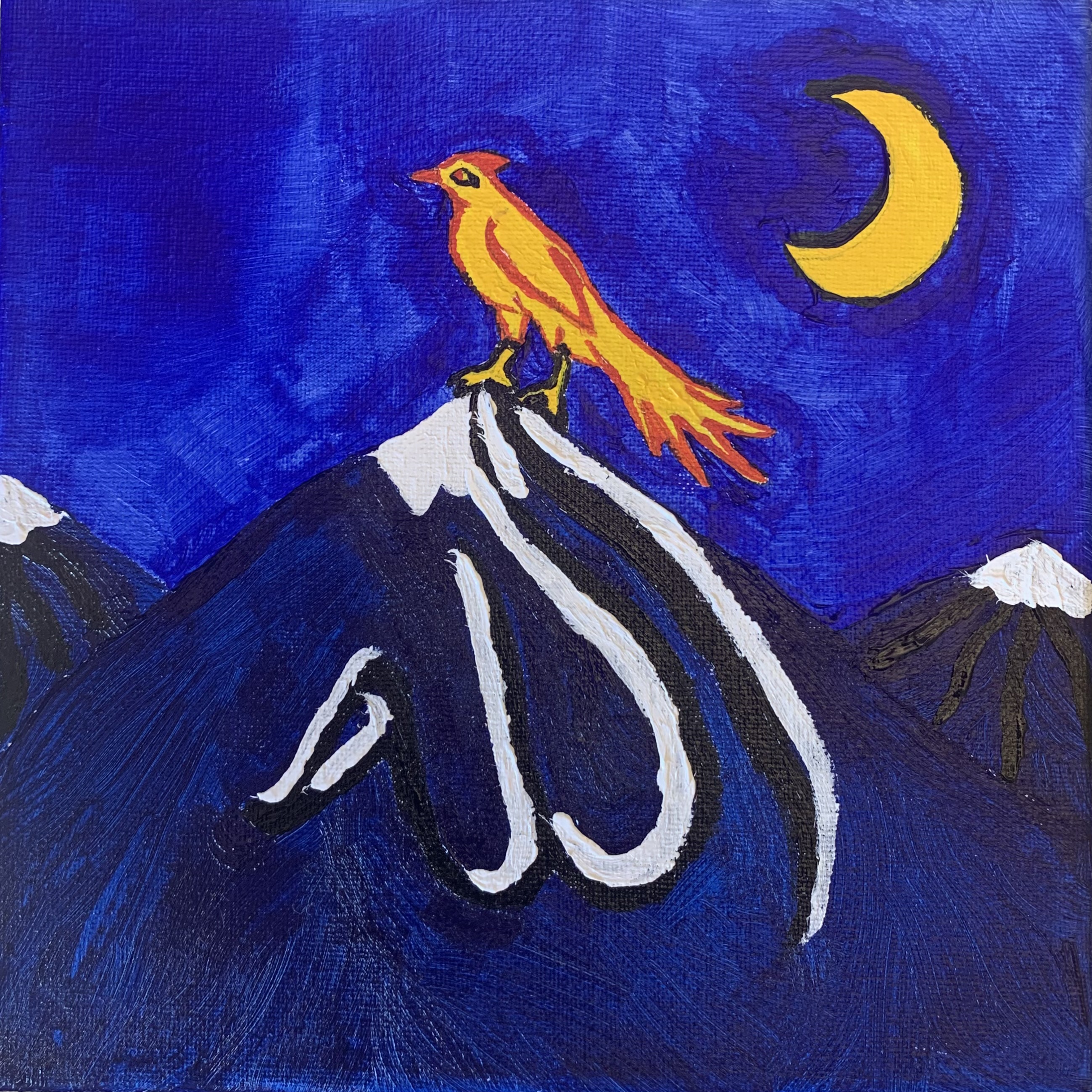
Mount Damavand and the Divine
1 2023-02-21T13:05:44-05:00 Darius Atefat-Peckham f0986a9a2c83aa189f471379af7799221b9eb0e0 198 1 plain 2023-02-21T13:05:44-05:00 Darius Atefat-Peckham f0986a9a2c83aa189f471379af7799221b9eb0e0This page is referenced by:
-
1
2023-01-29T20:05:05-05:00
Darius Atefat-Peckham
5
plain
2023-05-04T17:58:49-04:00
For my calligram project, I decided to work with a Sufi interpretation of God, but also one that cohered with the naturalist interpretation of Allah that we spoke about in class—that implicit scripture that surrounds us all. I painted Mount Damavand, the highest peak of the Alborz mountains in Iran, a place ripe with the story and mythology surrounding Allah in poetry. Growing up, I’ve heard it said that the Alborz mountains were like the wings of the mythical Simorgh, stretching all around Iran with its mothering embrace. In Persian mythology, specifically in the Shahnameh, the Simorgh is an all-knowing and nurturing being that looks after the hero Zal and his son, the famous hero Rostam. In later Sufi poetry, especially in Attar’s Conference of the Birds and often referenced in Rumi’s work, including in the Masnavi, the Simorgh becomes a symbol for God and the journey we make (akin to Muhammad’s mi’raj) to find that divine spirit that dwells within us. Mount Damavand is storied to be the place that the Simorgh calls home, imbuing this mountain’s peak with divinity and magic. By incorporating the word Allah both in the dark grooves of the mountain, and in the bright snow that sits unmelting atop it, I’ve tried to create a sense of the implicit and lasting scripture of nature and of the distance between God and the yearning soul, the journey one must make to discover divinity within themselves, perhaps encountering the Simorgh’s nurturing light at their heart’s peak.
Section B:
The Sound that Silence Makes
Mother, I am not meant
for this. I stand
in the rain, dumbfounded
and searching, wiping my self
from my eyes. No matter
how still I become, I am still
spinning. I see my self
in every thing. Crawling, yawning,
swimming, digging. Knowing
I have a before, only after.
I have learned this much: the lake
is a mother. I am
feathered, buoyant in
its swell. If you long for time
enough, absence becomes
a kind of presence. Distance
taut as a line between
us. No cord is
broken. My ears carry this
still beating heart
like a breath. What we secret in
these bodies—threaded
prehistory, grooves of
silence, bone-ridden and
weary, ancient—is
not called weeping.
Section C:
I chose the medium of poetry because I wanted to incorporate the arc of understanding or knowledge that is represented in Iqbal’s “The Complaint”—this idea of co-creation between God and humanity. In a more compressed space, and putting pressure on the language I’m employing, I wanted to enact the “radical bridging” of the human soul with that of the divine. This poem, inspired by Iqbal, also takes cues from the nature of revelation in Rumi’s poems (by speaking from, out of, and within silence) and incorporates cross-cultural knowledge that I think compliments the Islamic poetic tradition, specifically Taoist philosophy, as the speaker of the piece makes a return through the vehicle language to the divine source (the Mother) within an imaginitive and liminal/post-colonial poetic realm. It just so happens that the speaker’s mother is also a literal and once-physical mother who was lost to the speaker, and so the devotional poem becomes elegiac in its aims. “Mother, I am not meant / for this. I stand // in the rain, dumbfounded / and searching…” The Sufi aim of carrying forth divine presence in the living body mimics the elegist’s aim of carrying forth ancestral memory in order to commune with the human soul after death in language, and assert its lastingness. As I write in the poem, “If you long for time // enough, absence becomes / a kind of presence.” I’m not as certain about what venue or audience I imagine for this poem, but I think I could see it existing in a sonic or visual medium, spoken or sung, housed in ambient color or music. Many of the images in the poem are drawn from various sea-creatures (specifically sea turtles: their “weeping”/secretion of salt on the shore, their ability to hold breath for long periods of time, the aging that can be seen in the “growth” rings in their bones) so I think having the language “swim” in a kind of sonic rendering would be interesting and fitting. I imagine, then, that the poem could be shared with listeners of music and with musicians, and have a broader and less specific audience. Otherwise, maybe it could share space with the images of a mural? I’m really not too sure.