Emma MacKenzie
Calligram Project:
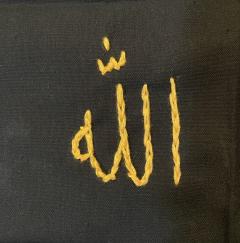
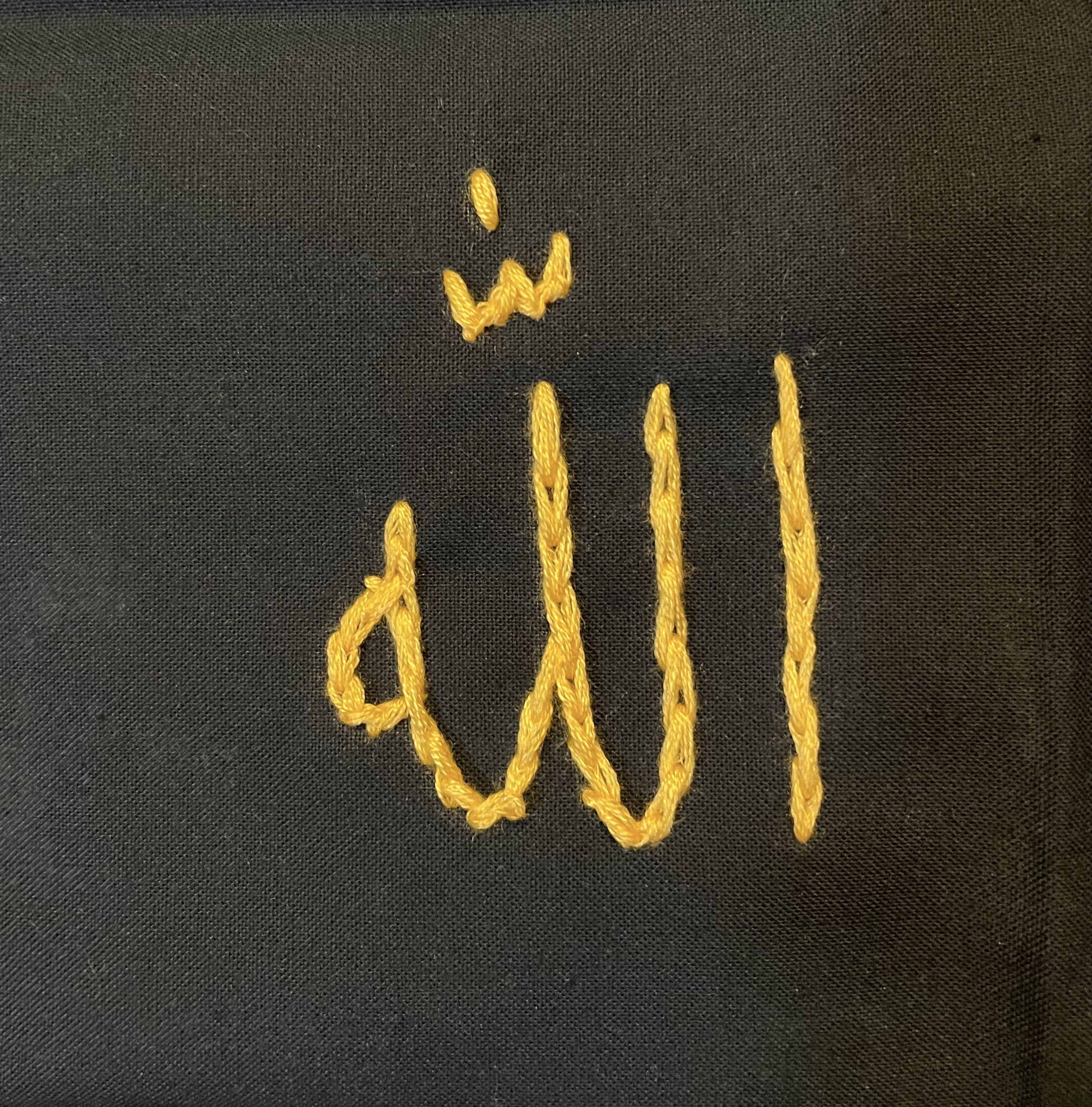
For my calligram, I chose to embroider the word Allah using yellow thread on a dark blue/black cloth. One of the 99 names used to describe Allah in the Quran is “the Fashioner,” and I was interested in exploring the idea of creation through needlework and textiles. Divine creation is a very different scale from human craftsmanship; however, I am interested in how we can think about Allah both being present in all materials – thread, needles, fabric – and also present in the creative process itself, the human act of sewing, or weaving, or embroidering.
In lecture, we learned about the different ways that Quranic scripts were integrated into common objects, such as lamps or water jugs. One such object was clothing, such as cloaks, which reference Quranic verses related to protection (as well as calling upon the Prophet Muhammad’s cloak, which is a key symbol in the Quran and hadith). Another such object was carpets, where verses were stitched into the material on a miniature scale to create beautiful patterns.
To me, embroidery represents the literal weaving of devotion and prayer into everyday life. When made into a physical object, the calligraphy becomes a type of talisman. Sewing can be a devotional act, where the methodology of stitching verses into the fabric is like prayer. But additionally, the robe or carpet that is produced from this labor of love becomes infused with religious significance. By embroidering the word Allah into a piece of cloth, I hoped to show how Allah is not just an abstract, worldly concept; Allah is present everywhere, but especially in domestic spheres. Just as faith can be a form of support, the goal of textiles is also to provide warmth and envelop one in comfort.
Final Exam (part B):
To access my project, please click this link: https://www.google.com/maps/d/u/0/viewer?mid=1CXCAAbJgShgIxyWH6f8CsPE2DUAA_ZI&ll=41.24896549556234%2C3.4742760999999973&z=2
Final Exam (part C):
For my project, I made an interactive map of mosques around the world. Using the Google Maps interface, I plotted 10 mosques that were made in a variety of cities using different materials and architectural styles. I chose a map because it allows one to take both a local and global perspective of Islam. Since the map is interactive, users can zoom into different cities to see how expressions of Islam differ depending on local contexts and geographies. The addition of photographs and descriptions adds allows the user to contextualize each site in its surrounding cultural context, while also comparing it with styles from around the world.
The map is an attempt to visually display my point from part A about Islam not being a monolith. All the mosques are connected because they share a common layout and purpose, but they have each been influenced by their local environment in ways that make them different. For example, the Huaisheng mosque in China incorporates pagoda architecture that was common in the area at the time the mosque was built in 627, whereas the Great Mosque of Djenne in Mali built in 1907 uses the Sudano-Sahelian style of adobe towers buffeted by wooden stakes. This map therefore questions assumptions about what makes a mosque "Islamic" and shows how Islam is internally diverse and influenced by both global traditions and the local cultures where it is introduced.
My audience is middle or high-school aged children who would be learning about Islam in a social studies or global religions class. These would likely be students living in non-muslim-majority countries, who don’t have much exposure to Islam and its internal diversity. The goal of this map, therefore, is to be a teaching tool that will provide such exposure in a fun, interactive way. I can easily imagine a lesson plan where a teacher asks their students to explore the map and record things they learned or were surprised to see. Additionally, students could be inspired to create their own maps that plot expressions of Islamic art, architecture, traditions, food, etc. around the world, as a hands-on way of learning about the diversity of the tradition. I have greatly enjoyed the pedagogical methods employed in this class, particularly those that have engaged us more deeply with the material, such as singing along to the Mevlid-i Sherif or creating our own calligrams. Because I knew very little about Islam before this class, I wanted to pass along the knowledge I have gained in a way that might educate or inspire others who were similarly in my position.