Maryan Adan
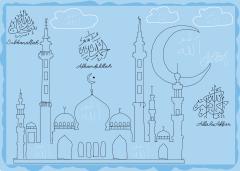
For this assignment, I chose draw a Mosque (Masjid) which is known as a house of Allah SWT. The central element of the design is a mosque because it is a powerful symbol of faith and the worship of only Allah SWT. It demonstrates the beauty that is the world with the blue blue sky and clouds surrounding it, all of which are Allah's creation. If you closely the work "Allah" is written in white to portray the compassion and mercy of Allah. White usually symbolized purity. This is important because in the Islamic faith it is important to attend a Masjid with clean clothes in order to perfect purification especially when praying. To add on to this, the word Allah written in white, draws the viewer's attention to the importance of Allah SWT in Islam and serves as reminder of the centrality of prayer to Allah. This is important because the Masjid is seen as the heart of the community and there is a Hadith from the Prophet Muhammad (SAW) that states “ مَنْ بَنَى مَسْجِدًا لِلَّهِ كَمَفْحَصِ قَطَاةٍ أَوْ أَصْغَرَ بَنَى اللَّهُ لَهُ بَيْتًا فِي الْجَنَّةِ”: "Whoever builds a Masjid for Allah, Allah will build a home for them in paradise." The significance of a Masjid is not understated by this Hadith. The Masjid is known as one of the homes of Allah SWT, so by building one and having people fill the mosque for prayer is important.
Continuing the notion of Allah's SWT centrality in Islam, I sued the words "Subhanallah," "Alhamdulillah,"and "Allahu Akbar" to add further depth to the design. These are all well-known sayings that are repeated by Muslims throughout the day to express devotion to Allah SWT. For example, "Subhanallah" means "Glory to God," "Alhamdulillah" means "Praise be to God," and "Allahu Akbar" means "God is great." By adding these sayings around the Masjid in the sky it reinforces the central theme of the design, which is the beauty and importance of expressing one's loyalty and devotion to Allah SWT.
Overall, my design is a representation of the importance of Allah SWT in Islam and helps reinforce the importance of worshiping and expressing devotion to Allah SWT.
References: Yazīd Ibn Mājah Muḥammad ibn and Mohammad Mahdi al-Sharif, “The Book of Mosques and Groups,” in Sunan Ibn Majah: The Sixth Correct Tradition of the Prophetic Sunna, English - Arabic Text (Beirut: Dar Al-Kotob Al-ilmiyah, 2008), p. 298.
I chose to use a poem to express the most important topic to me which is the reality of living in a Western non-Muslim country as a Muslim. My audience is for the general public but specifically young children or immigrants who are struggling with their Muslim identity in America. I chose poetry because it has a deep connection to Islam. It has been used in many Islamic traditions like Rumi. It has been used to express devotion, teach Islamic lessons, and to convey the word of Allah SWT. Poetry has the ability to inspire and convey specific messages.
This is important because the idea of being western and Muslim for many seems unorthodox. As Professor Ali Asani states in his book, there is a “flawed conception that Western and Muslim societies are monolithic, whereas in reality they are marked by immense racial, religious, and ethnic diversity, not to mention diversity in thought and opinions.” This connects directly to my life. Growing up as the only girl in a religious Somali household, there were very different expectations for me compared to my eight brothers. I was to become an “acceptable lady,” the classic misconception that women are meant to be nurturers and domestic caretakers. As the second child born in America, I also had to live within two cultures that are completely different. I am Somali and American: on the one hand, I enjoy going to the movies and playing board games, but on the other hand, I enjoy reading the Quran and drinking tea. This balancing act was challenging. I often rebelled, refusing to cook and clean; no one else in my class at school knew how to do those tasks at age nine, which made me feel left out. I wanted to fit in at school and not worry about what I had to do when I got home. Yet the more I rebelled, the more I felt disconnected from my culture. However, I was able to find who I wanted to be: not a traditional Muslim girl, but a Somali (Muslim)-American girl who can pray and worship Allah SWT but also succeed in school and in life.
Continuing this notion I believe that the poem highlights the idea of Islam not being one size fits all notions of Islam. However, in America, Muslims are well-integrated into the country while also keeping their religion strong. I think something important to note is that when many people, especially politicians, say “Islam hates us,” what do they mean? To answer this if we look at it from the perspective of Muslims around the world it is not the American people that some Muslim people are angry with, it is the American government. The anger is limited and centered around political conflicts. Muslims and Americans are not mutually exclusive. The US has around 10 million muslims many of whom have integrated very well into American culture and lifestyle. Overall, it is an important lesson to learn because these identities are not mutually exclusive.
References: Asani, Ali. “How do you know what you know about Islam?” Essay. In Infidel of Love: Exploring Muslim Understandings of Islam, 1–16. Cambridge: Harvard University Press, 2009.