Artea Brahaj
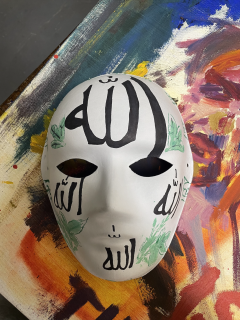
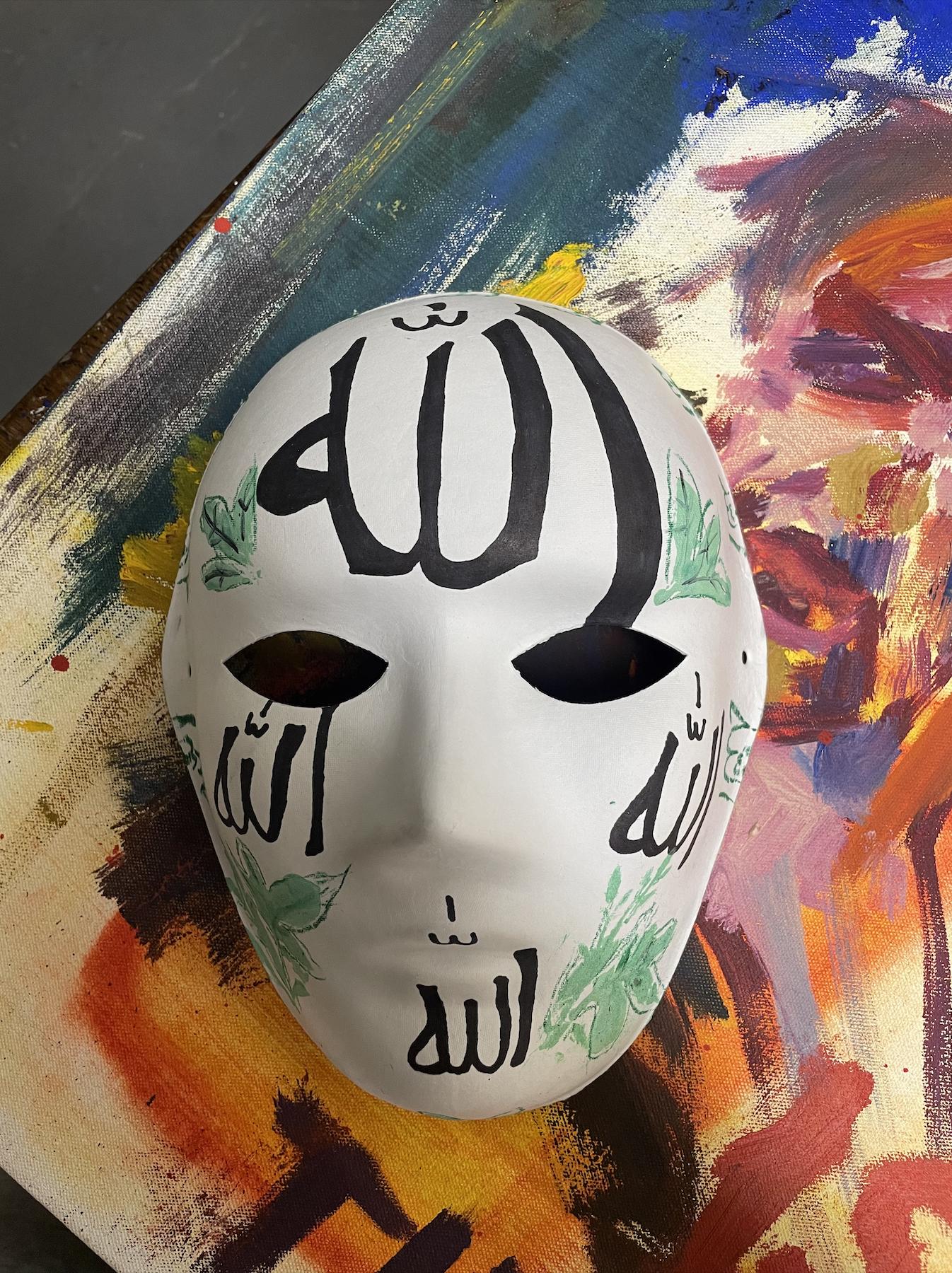
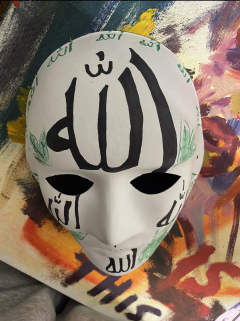
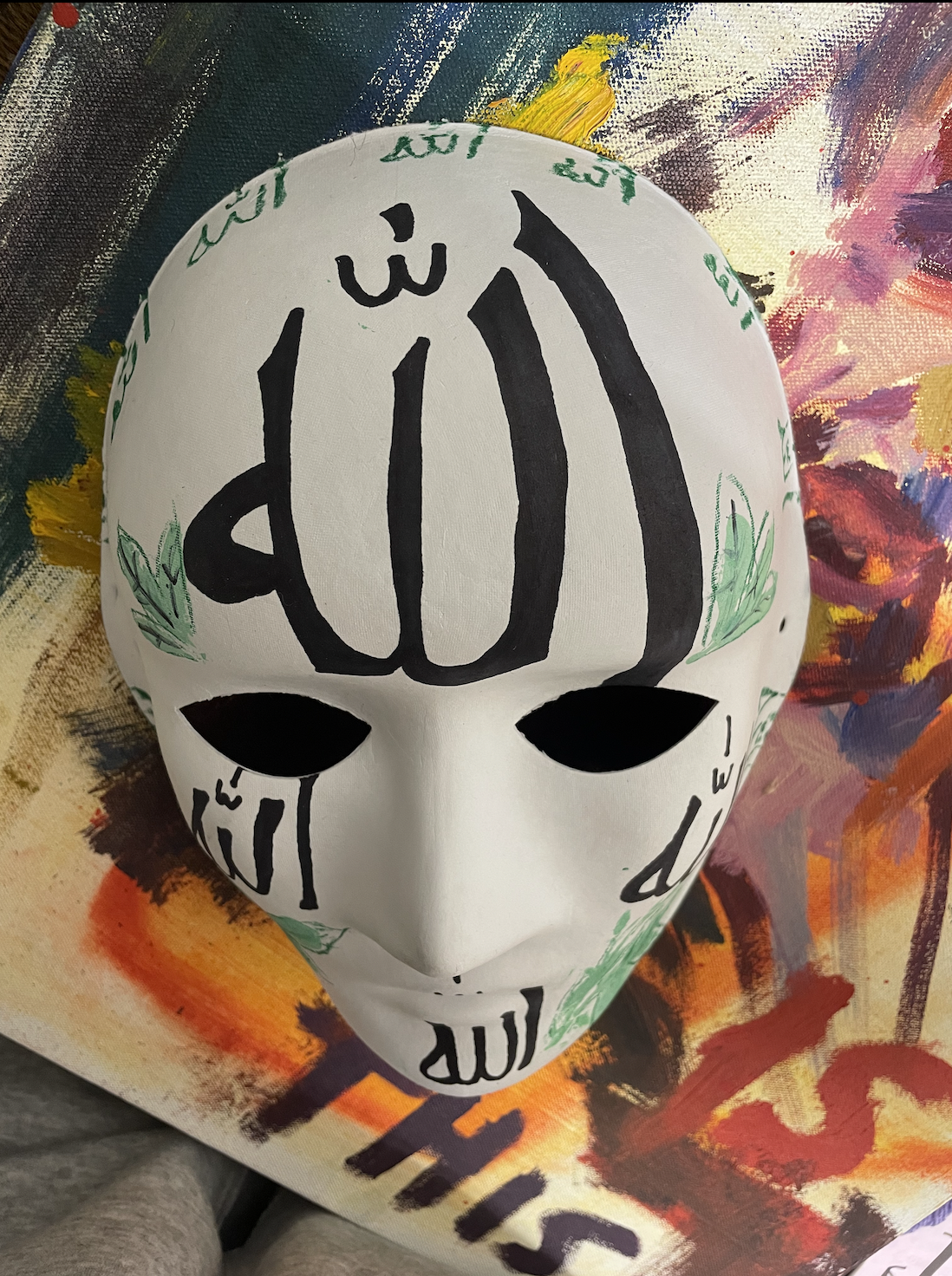
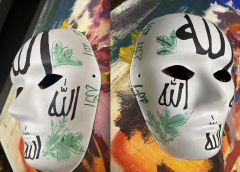
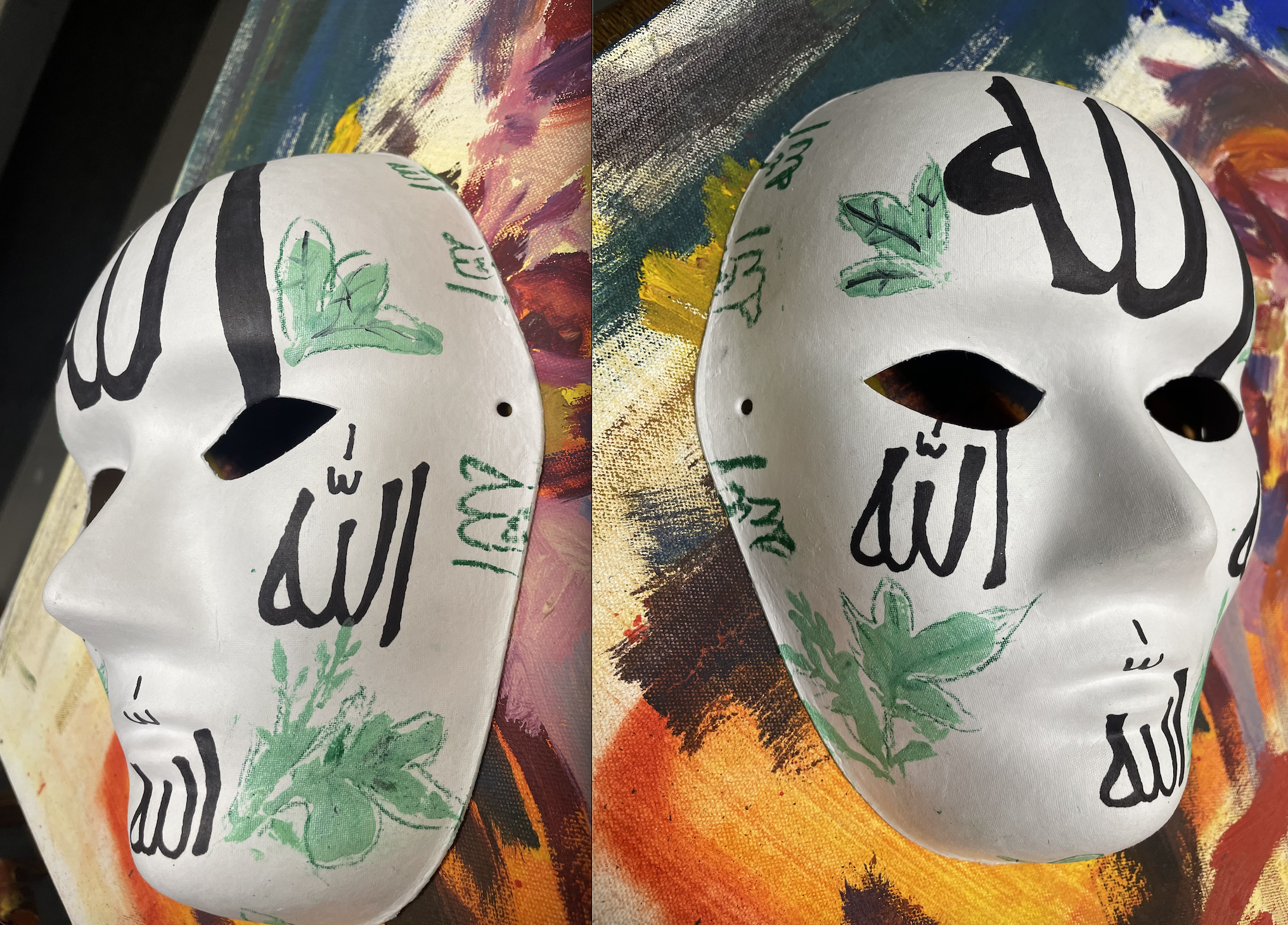
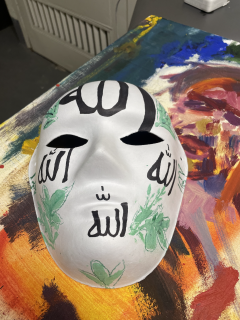
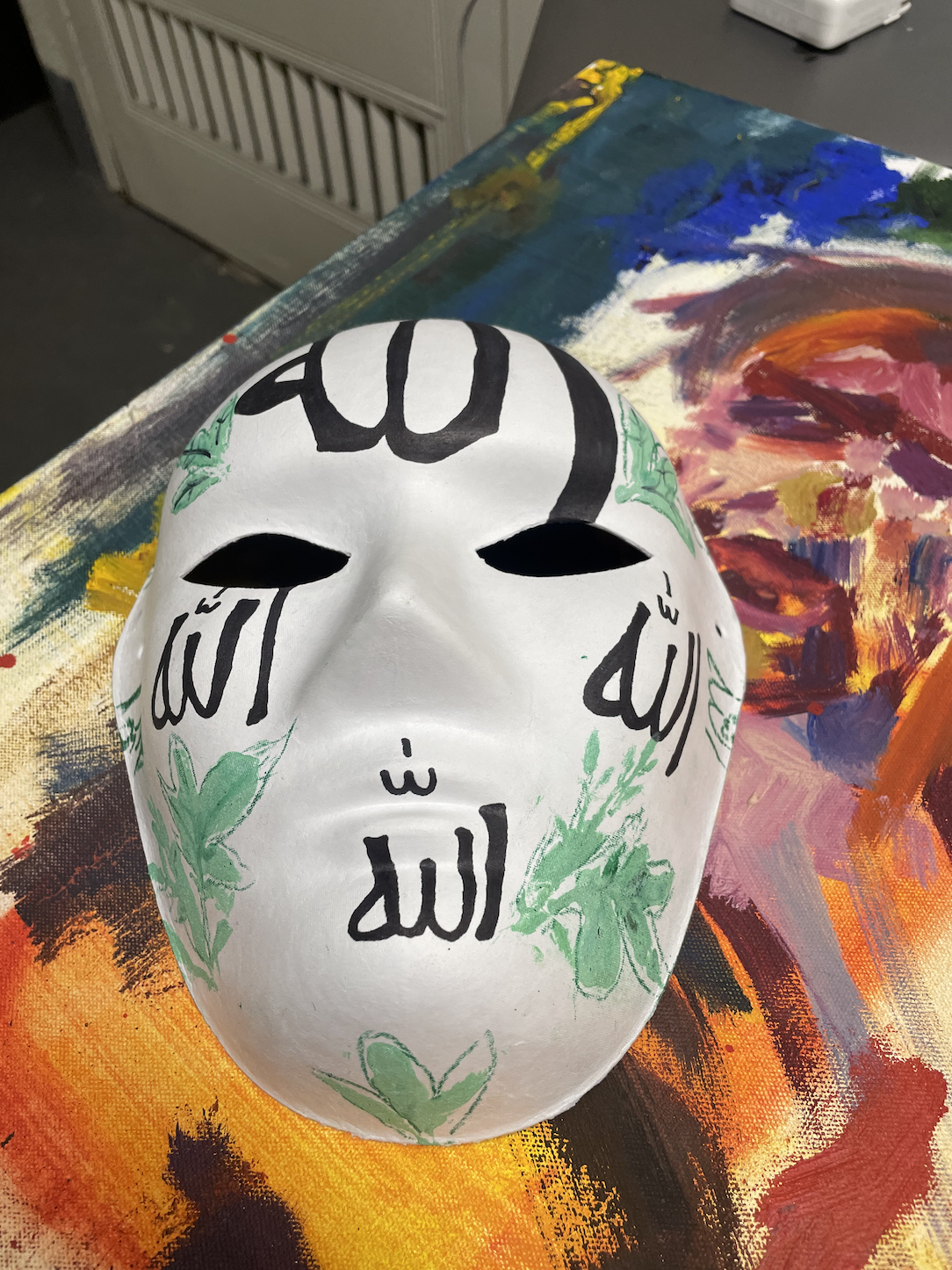
This full face mask encapsulates the idea that Allah is the Only Reality and it is He who manifests Himself into all realities. This Sufi interpretation of Tawhid informed every artistic decision of the piece. I specifically look at the belief that God is immanent, meaning He is within all things. The leaves painted and drawn throughout the face represent not only nature but life, the idea that God is found in everything. Nature itself is scripture as one can find the signs of God in something as simple as a leaf. The use of mixed mediums (black marker, cardboard, metallic paint, and oil crayons) point to how Allah can be found in every and all natural elements. The word "Allah" is positioned throughout the face such that no matter one's vantage point, "Allah" is visible; such artistic choice represents how everywhere you turn is the face of God. The following Quranic verse was informing my drawing: "To God belong the East and the West; wherever you turn, there is the face of God." [2:115] If listening to the recitation of the Quran, the words of Allah, through one's ears reaches the person's heart, this piece represents the ultimate aim of the Sufi which is communion with God through spiritual realization. I too was inspired by Ibn alʿArabī's [d.1240] Unity of Being in which he speaks about the relationship between God and his creation. If God is the object and the human being is the mirror, then God's essence is always within the individual. The individual I am portraying with the face mask has begun a path to oneness. The notes of green throughout hints that this individual could be the al-insān al-kāmil (the ‘Perfect Human’) as there are linkages between Prophet Muhammad (as the Perfect Human that in some ways embodies the Quran) and the the color green.
Final
Section B.
Warm yellow light flooded the living room, casting a glow across the already vibrant orange walls that my grandmother had painted the morning prior. The walls were mostly barren except for a picture of Dervish Luzha that hung above the television set. Positioned right at the center, it is the first image a guest sees when they enter the room. As a child, I never quite understood who this figure with a great white beard and headdress was. I only heard the way my parents spoke his name with pride, and I saw the way they would kiss their hand and then the picture when they passed it. My grandmother's room would have a Dervish Luzha picture of her own, sitting right at her bedside table along with a garlic clove, an evil eye ornament, and candles. In my mind, he was peace, he was forgiveness, and he was guidance. He was a holy man, a good man (njeri i mirë) and an enlightened man (njeri i mbrrimë).
Rexhep Tarçuku, known as Dervish Luzha, was born in Tropojë––my mother’s birthplace––on July 15th, 1904.[1] He was born during a time in which the Halveti[2] Sufi order was gaining momentum in Tropojë. It is said that from an early age, Tarçuku showed signs of extraordinary behavior that aligned with that of a dervish and as such, his uncle traveled 100 kilometers to Kukës––my father’s birthplace––to enroll him in the Tekke (Khanqah), a place for the religious education and training of a Sufi dervish. As a dervish, he practiced asceticism, which seeks to uproot all that may remain of man’s attachment to the material world. He was under the tutelage of Baba Rexheb who would go on to be the founder of the first Albanian Bektashi Sufi tekke in the United States. While Halvetis are Sunni and Bektashis are Shia and the two are often portrayed in Western media and politics as diametrically opposed to each other, the teachings of the Halvetis and the Bektashis are quite similar and each order respects and learns from the other. As I detail my personal relationship with Islam and the way it is situated in Albania, I hope you consider the ways in which your understanding of Islam has been shaped by such portrayals.
Upon returning to his hometown, he became known as a healer and miracle worker, blessed with both the gift of foresight and the ability to heal the paralyzed. He is said to have fought against Naszi-Facists in both Kosovo and Albania as part of the National Liberation Movement, unarmed of course, having taken a stance against violence. As the oral tradition goes, he returned from war carrying a bag with three items of meaning: a pickaxe to represent work, a teber (sword) to represent endurance, and a mandolin to represent art. He returned to service his community and provide spiritual guidance until his death on November 3rd, 1985. Many, including my family and I, have visited his mausoleum.
The life that Dervish Luzha led, one that is in service to others and led with benevolence, has informed the way many Albanian Muslims understand Islam. During the Second World War, Albania Muslims housed and provided refuge to Jewish people facing Nazi persecution. While no official numbers exist, it is estimated that anywhere from 600 to 1,800 Jewish refugees entered Albania from Germany, Austria, Serbia, Greece and Yugoslavia.[3] The Prime Minister at the time, Medi Frasheri, was a member of the Bektashi and had refused to release the names of Jewish people to Nazi occupiers, organized an underground network to shelter Albanian Jews and Jewish refugees, and had given a secret order that “all Jewish children will sleep with your children, all will eat the same food, all will live as one family.”[4] Baba Haxhi Dede Reshat Bardhi, an Albanian who served as the seventh Dedebaba (religious leader) of the worldwide Bektashi order, explained how the political decision to shelter Jewish people in Albania was religiously motivated: “We Bektashi see God everywhere, in everyone God is in every pore and every cell, therefore all are God’s children. There cannot be infidels.” The ideals of hospitality and providing for those less fortunate are not exclusive to the Sufi order; they are imbued throughout Qur’anic teachings that guide the practice of Muslims everywhere. Such teachings have deeply informed Besa, an honor code deeply rooted in Albanian culture such that it is an oath one makes to one another, and nonadherence is a source of shame to oneself and one’s family. “Simply stated, it demands that one take responsibility for the lives of others in their time of need.”[5] Albanian Muslims who housed Jewish people in hiding explained that doing so was both a practice of their Islamic faith and an extension of Besa. In the words of Hamdi Mece, an Albanian Muslim, “To save a life is God’s gift.”[6]
The Islam I have come to know cannot be divorced from the cultural commandments that tether me to Albania and guide how we treat one another. In my neighborhood in Tirana, everyone knows each other’s business, kids play with each other on the street, and you are greeted by kisses on the cheek. Hospitality to strangers, three-day weddings, and waking up the Fajr prayer I have come to associate with being in Albania because the majority of Albanians are Muslim.[7] The Islam I have come to know informs the praxis of peace, benevolence, and social justice. My bedtime stories were that of the mystical healing powers of Dervish Luzha and the quiet bravery in the Islam I have come to know has its roots in European history such that it is just as European as it is Middle Eastern, African, Asian, and North and South American. Islam was introduced to Albania as early as the 15th century after the Ottoman conquest of the region. Even following the fall of the Ottoman Empire in which many Muslims either fled or were expelled from Ottoman lands in Europe, about 1.5 million Muslims (accounting for roughly 12 percent of the population) lived in Yugoslavia and Albania remained predominantly Muslim.[8]
[1] “Përshëndetje Mistikës Patriotike Të Dervish Luzhës,” Bota Sot, accessed March 8, 2023, https://www.botasot.info/kultura/604507/pershendetje-mistikes-patriotike-te-dervish-luzhes/.
[2] The Halveti order is also known as Khalwati , Khalwatim, Khalwatiyya.
[3] “Honoring The People Of Albania, Who Stood Up To Hate During The Holocaust,” You are being redirected... (Anti-Defamation League | Florida), accessed March 8, 2023, https://florida.adl.org/honoring-the-people-of-albania-who-stood-up-to-hate-during-the-holocaust/.
[4] Norman H. Gershman, Bes: Muslims Who Saved Jews in World War II (Syracuse, N.Y., Syracuse University Press, 2008).
[5] Ibid.
[6] Ibid.
[7] “Table: Muslim Population by Country,” Pew Research Center's Religion & Public Life Project (Pew Research Center, December 31, 2019), https://www.pewresearch.org/religion/2011/01/27/table-muslim-population-by-country/.
[8] Emily Greble, Muslims and the Making of Modern Europe, (Oxford University Press, 2021), p. 6.
Section C.
I chose personal narrative and historical writing to explain the relationship that I have to Islam as an Albanian national. It was important for me to talk about how deeply embedded my understanding of Islam is to my culture and sense of national belonging. Doing so, highlights a theme throughout the course regarding religion’s positionality within the cultural fabric of the nation in which it is situated. I do not write this to suggest that my understanding of Islam is the right one, but rather to point toward the way Islam, or any religion, is constantly being shaped by and shaping all aspects of the geography of its believers. As such, there are many Islams, as Edward Said writes, and each nation carries its own interpretation of what it means to be Muslim. While this concept can seem abstract, I hoped that by explaining my personal and national history, I could provide an example of how Islam is constantly shaped by its believers. Such a story also highlights another theme, the idea of silent Islam, as the Islam that I have come to know centers around charity, hospitality and honor to one another. Yet, this is the Islam that is seldom discussed by Western power brokers who also refuse to consider Albanian Muslims because they paint an image of Islam as antithetical to Europe. In my case, Islam is too indigenous to Europe.