Polina Galouchko
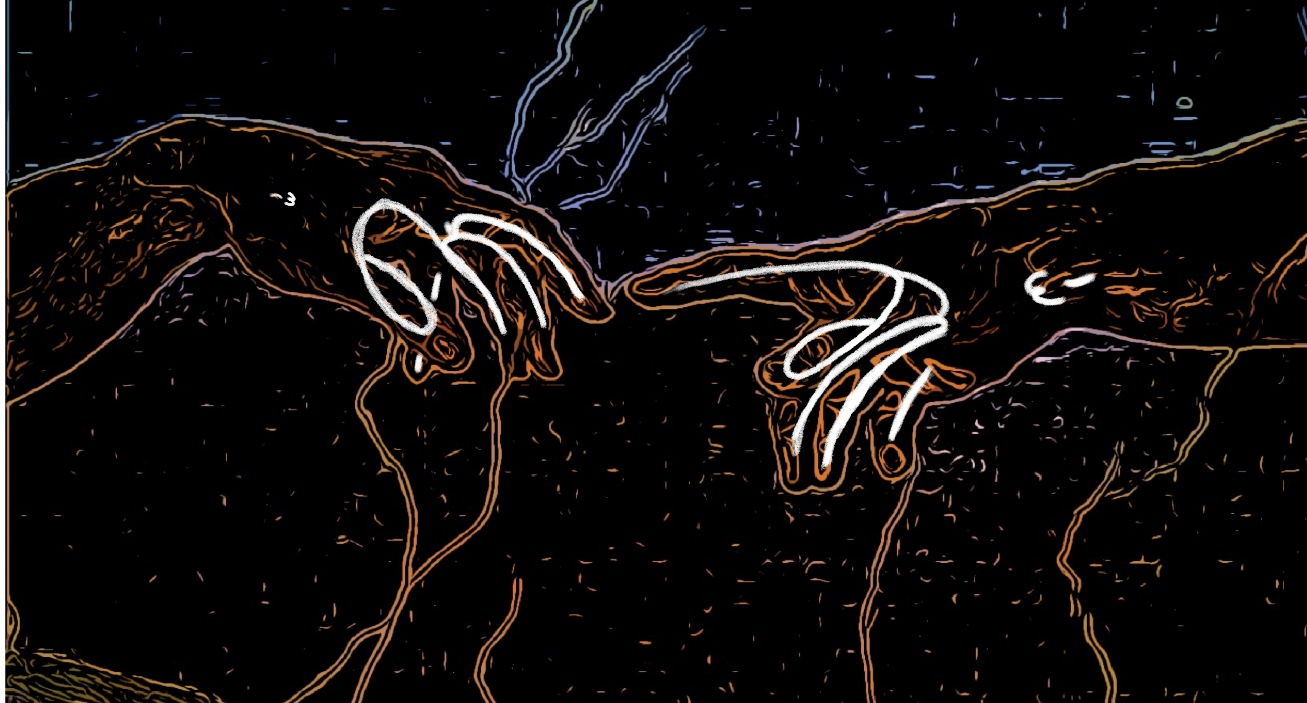
This digital artwork that I’ve created has several sources of inspiration.
First one is the motive of creation, in particular, the fact that God singled out Adam to create him with His hands – and did not create any other animate being with His hands.
“Allah asked: “O Iblis! What prevented you from prostrating to what I created with My Own hands? Were you arrogant [then], or were you [already] among the haughty?”” [Saad 38:75]
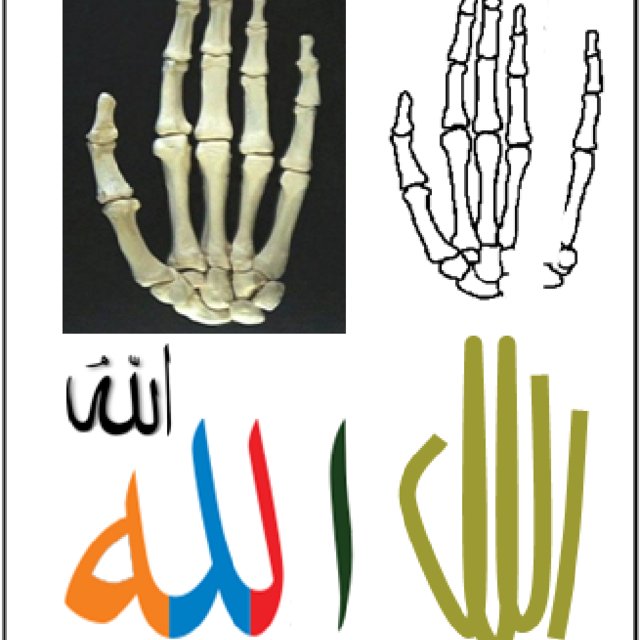
God created Adam with His hands and with an imprint of divine – possibly, with humans being the apex of His creation: “Indeed, We created humans in the best form” [At-Tin 95:4]. This is interestingly reflected in the idea that the anatomy of the human hand resembles the name of God written in Arabic [see picture below]. Thus, the name of God is visible to a human being every day – one just has to look at one’s own hand.
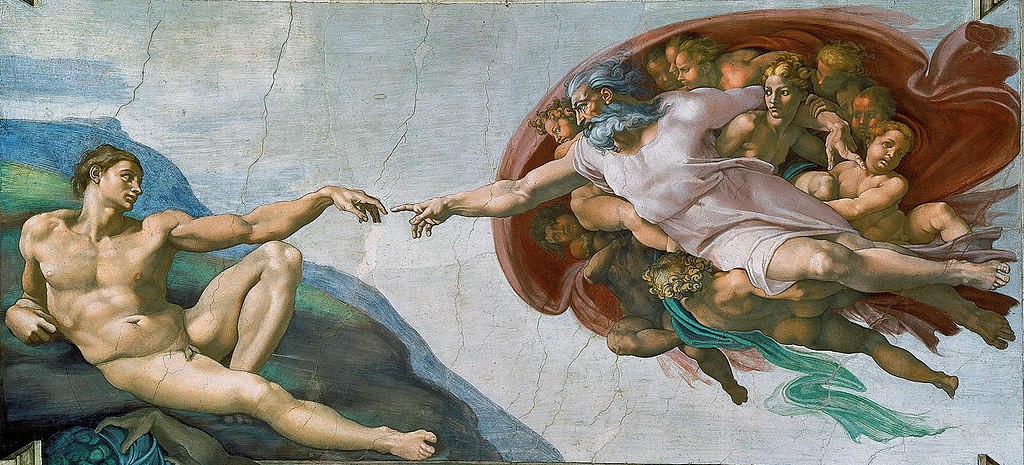
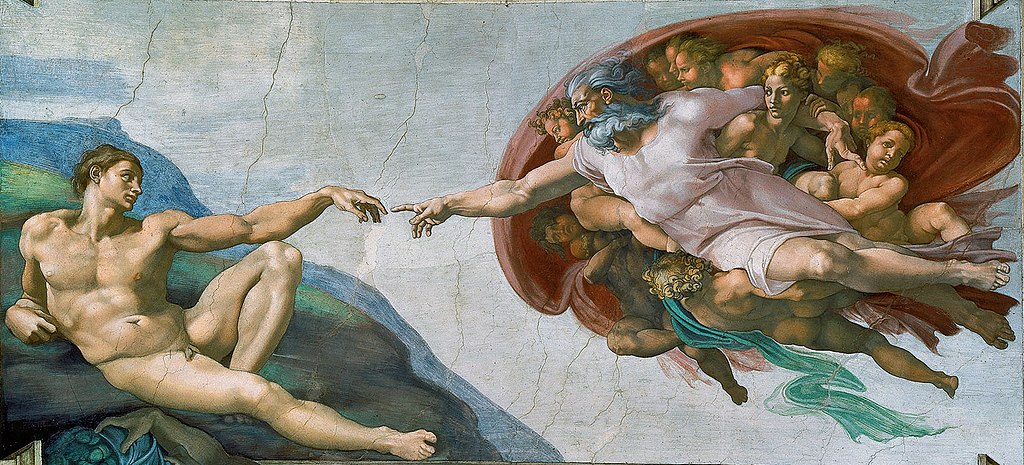
The second source of inspiration was Michelangelo's famous fresco painting The Creation of Adam (c. 1512). Even though God is not usually depicted in Islam so as to not anthropomorphize Him, this famous painting -- in particular, the part of it which includes God's hand, stretched out, giving life to Adam, and Adam's hand right next to God's hand -- resonated with me as I was thinking about the creation of man by the hand of God and the name of God imprinted on the human hand.
My calligram project aims to bring those several ideas together.
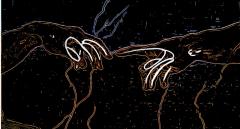
The two hands depicted -- one of God and another of man -- resemble the hands from Michelangelo's painting, and the name of God in Arabic -- Allah -- is written on their hands, signifying both the act of creation and the elevated status of humans among all other creation, which is represented as cosmos -- stars and galaxies -- in the background.
"He is the One who made perfectly everything He has created: He began the creation of human beings with clay, and made His progeny from a quintessence of the nature of a fluid despised: but He fashioned him in due proportion, and breathed into him something of His spirit..." [Qur'an 32:7-9].
Part I (B)
Excerpt from an interview with one of the Chechen women:
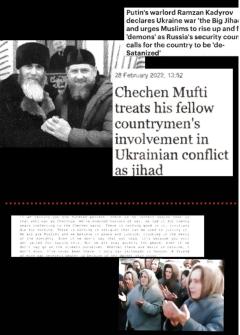
“I am telling you one hundred percent: there is no [other] region that is that anti-war as Chechnya. We’ve endured horrors of war, we had it for twenty years [referring to the Chechen wars]. There is nothing good in it, civilians die for nothing. There is nothing in religion that can be used to justify it. We all are Muslims and we believe in peace and justice, trusting in the mercy of the Almighty. Even if we don’t say that out loud, it’s because you will get jailed for saying this. But we all pray quietly for peace, even if we don’t say go on the streets ourselves. Whether there are Nazis in Ukraine, I don’t know, I’ve never been there. I only saw skinheads in Moscow. A friend of mine was severely beaten up because of her darker skin color.”
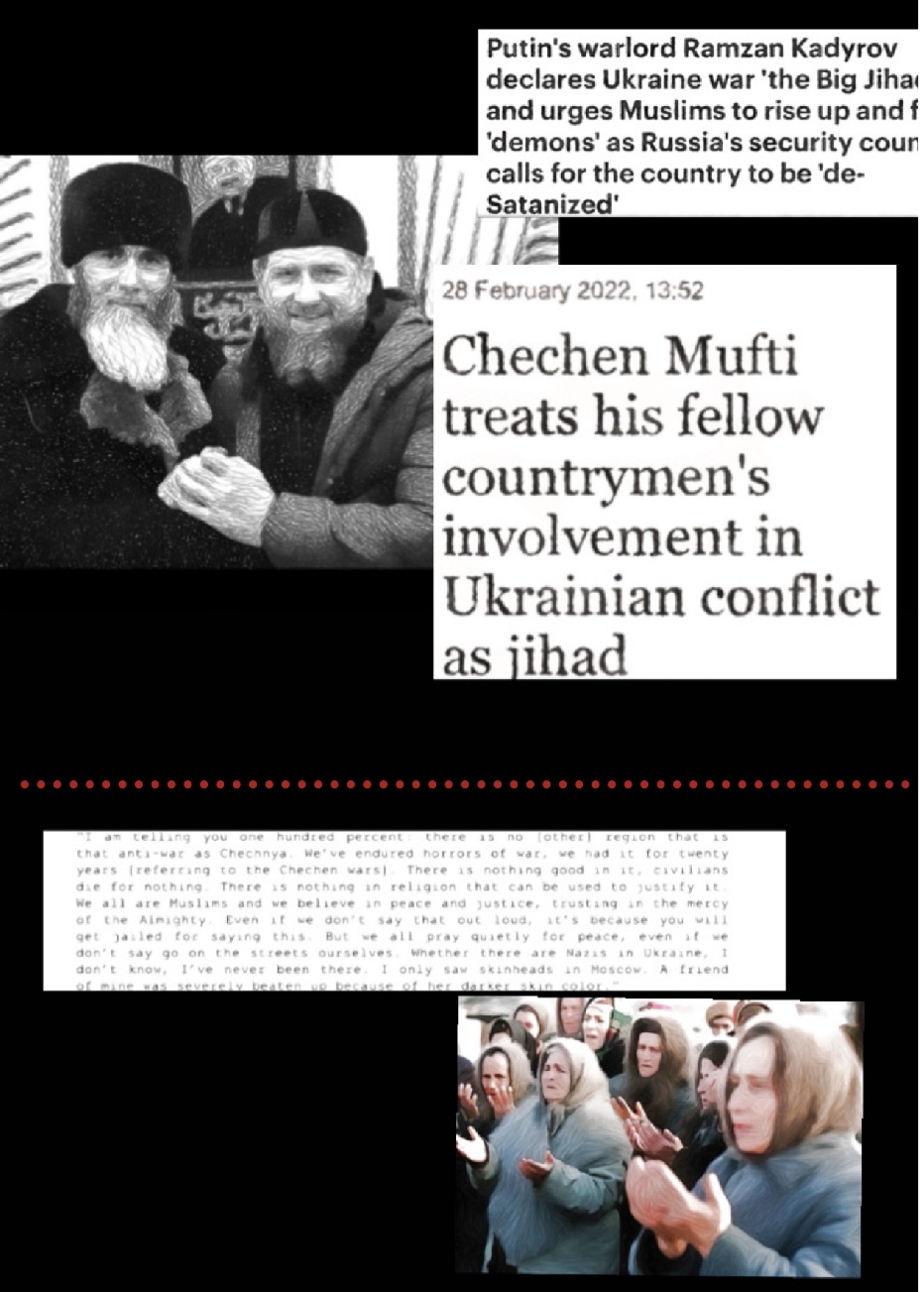
Since the start of Russia’s invasion of Ukraine in February of 2022, news headlines have brought attention of the public to a high number of Russians supporting the ‘special military operation’. Among the loudest of those voices is Ramzan Kadyrov – head of the Chechen Republic, biggest Muslim-majority republic of Russia. In his statements, Kadyrov uses a lot of religious language: he has repeatedly declared “Big Jihad'' against Ukraine and urged Russian Muslims to fight Ukraine’s “satanic democracy.” Analogously, Chechen Mufti Salakh Mazhiev has stated that Russian soldiers in Ukraine ``have gone to jihad”, because NATO will bring “all the dirt” and everything that is contrary to Islam into Russia. The Mufti explained that it is a duty for Muslims to participate in war against Ukraine to “preserve and protect Islamic freedoms and practices” and protect themselves from “insults on the Prophet and the Qur’an” and “promotion of gay lifestyle.”
Media outlets neither in Russia (not surprising due to Kremlin’s full control of media space), nor outside of Russia have reported on any Russian Muslims opposing the war. One of the most prominent acts of resistance was a silent demonstration in Chechnya of mothers and wives of men that are being drafted to fight. Several hundreds of women gathered near the biggest mosque in Grozny: their sons and husbands were sent to die, and they could not stay at home despite all the dangers of protesting. All were arrested and pronounced to be “enemies of the people”; 30 were jailed. Several were able to escape the country and spoke with journalists abroad. The artwork above includes one of their quotes.
This story to me illustrates the distinction between loud and silent Islam: Islam as a political ideology striving for power – one that is being widely covered in the media through the pronouncements of Kadyrov and Mazhiev (depicted in the artwork) -- and what Naim calls “Islam of women”: gentle, yet courageous and devout. Even though the stories of Muslims in Russia who do not support the war do not get a lot of public attention, they illustrate how important it is to avoid generalizations based on media headlines and to amplify quieter voices.
I used a visual medium to illustrate this concept, since I thought that would be the most straightforward way of putting those two paradigms in the same physical space: one of the ‘loud Islam’, the Islam of religious and political authorities with their aggressive militarist rhetoric, and the other of the ‘silent Islam’ – of Chechen women praying for peace. I chose to depict ‘loud Islam’ in black-and-white and ‘silent Islam’ in color: even though one attracts more public attention, the other is more of a lived, authentic faith experience. My target audience is the Western public broadly interested in understanding events in Eastern Europe today, but who might not have sufficient regional expertise to understand ethnic and religious diversity in Russia. Therefore, the ideal venue might be an exhibition in some center for international affairs dedicated to war in Ukraine.