Alex Guh-Siesel
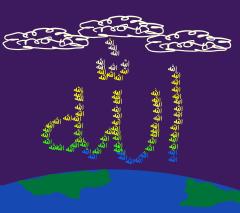
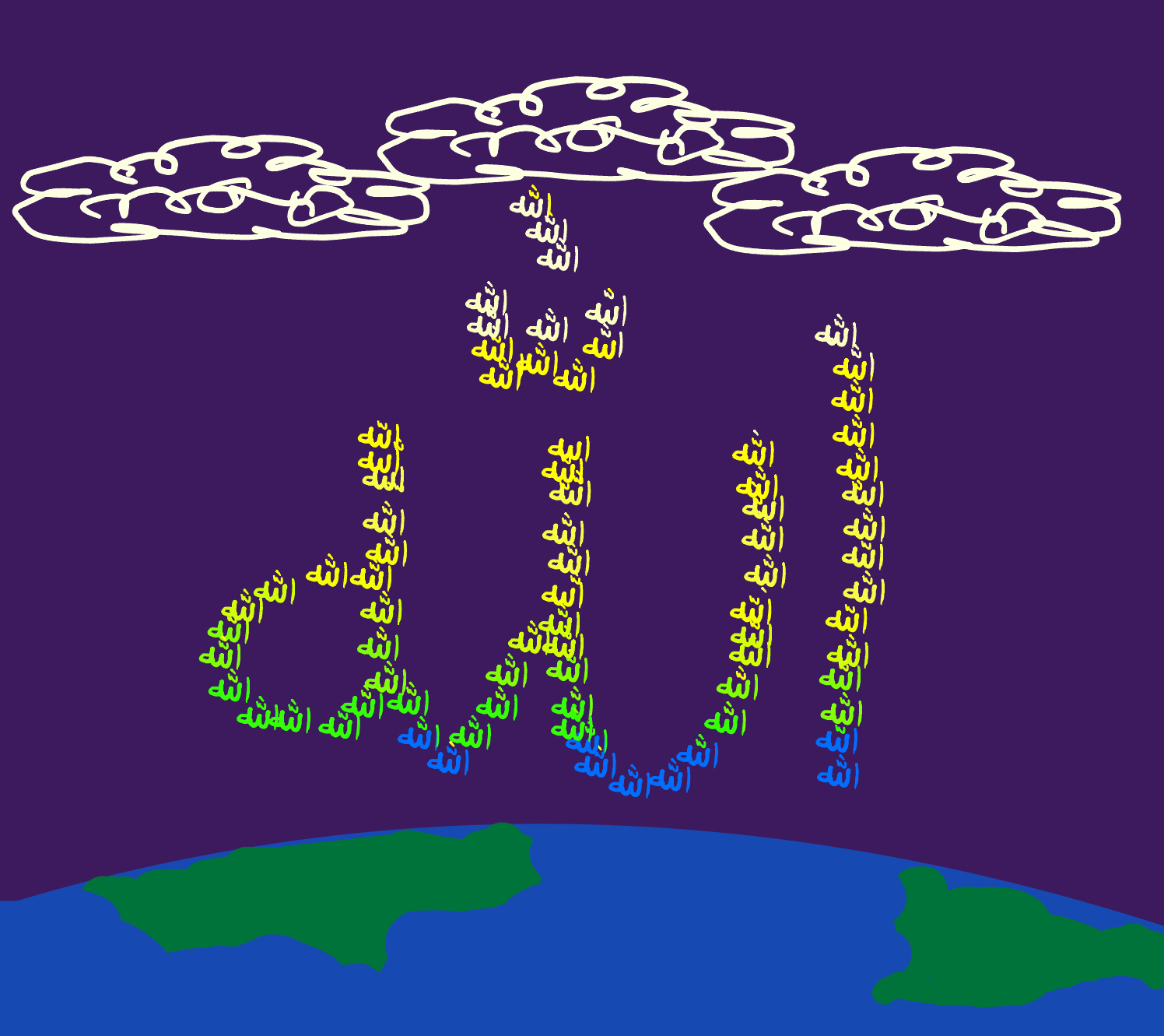
For my calligram project I wanted to represent two fundamental concepts of Islam and Allah, tawhid (the “oneness or unicity of God”) and Allah being the “Light of the Heavens and Earth.” This concept of Tawhid is repeatedly represented and emphasized in the Quran, such as in Quran 4:171 which says, “So believe in God and His Messengers and say not ‘Three!’ Cease it is better for you. God is only one God.” We see this idea additionally in the Turkish poem Mevlid-i-Sherif which celebrates the birth of Muhammed. Throughout the poem Allah’s oneness or tawhid is repeatedly represented, even as early as before the introduction section where one line reads “He’s one!” (Chelebi 17). To incorporate tawhid in my calligram, I choose to make the center “Allah” in large arabic script, and then fill it in with multiple Allahs to show the singleness and oneness of God and how there is just one “Allah”. The next concept I wanted to represent was from Quran 24:35 where Allah is described as being “the Light of the Heavens and the Earth.” To represent this in my calligram, I drew Allah as being centered between the clouds of the heavens and earth below, and for the “Allah” written to compose the larger Allah, I used a gradient of color where the top Allahs were colored lighter colors like yellow and white/tan to represent the light from the Heavens, and as you move down the calligram the Allahs are colored blue and green to represent the light and color of the oceans and water (blue) and the grass and trees (green) on Earth.
Final Exam:
Section B: 690 words
In the United States since 9/11, Islam has frequently been discussed and misconstrued by the public, the government, and the media. By focusing on very narrow aspects of the religion and certain racial groups and governments, they make claims about the religion as a whole which are frequently misguided and uninformed. We have seen this when Michael Flynn, the former National Security Adviser for President Donald J. Trump said that he believes Islam isn’t a religion and is rather a “political ideology,” or when CNN anchor Don Lemon pushed religious scholar and author Reza Aslan if Islam restricts women’s rights and promotes violence. In his response, Aslan explained how some countries with Muslim majorities have poor human rights’ records, but others also are more progressive than the US. As of 2014, 7 majority Muslim countries had elected women to be their leaders whereas the US still has yet to elect a woman president.
This demonstrates the importance of being religiously literate about Islam, especially in the US where the discourse in the media and foreign policy decisions are being decided by those that might not fully understand the religion. While learning about Islam may seem overwhelming, it is necessary to be able to understand and speak on topics pertaining to religion both in the US and abroad, and vote on positions and representatives that are knowledgeable and able to make proper and informed decisions relating to religious freedom and responses to religious groups.
To fully understand Islam would take many hours of learning and research, but to help you begin your journey toward religious literacy and provide a starting point for you to learn more about specific aspects of Islam, I have provided the following brief overview of Islam with links to sources to learn more about specific aspects you’re interested in:
GUIDE
Islam is the name of the religion that Muslims follow, who are commonly defined as those who recite the shahadah, or believe that there is only one God and Muhammed is the messenger of God. Christianity, Judaism, and Islam are all Abrahamic religions, which means that they all believe in the same God and that Abraham was the first prophet. However Christians believe Jesus is part of the trinity of God, Jewish people believe Jesus was an ordinary Jew, and Muslims believe that Jesus was a prophet of God, but Muhammed was the final and absolute prophet.
Sources to learn more:
After Muhammed passed away, two primary groups and schools of thought began to form centered on their beliefs of who had the right and authority to succeed Muhammed. These respective groups are Sunni and Shi'a, where Sunnis believe that his followers should be guided by the prophet’s sayings and traditions, and that the leader or the caliph for the group should be selected by representatives of the community. Shias on the other hand believe that Muhammed had appointed his son-in-law Ali to be his successor called the Imam, and that the future Imams should be the direct descendent of the previous one, meaning that they are all descendents of Muhammed.
Sources to learn more:
In addition to the two major branches of Islam, it is important to understand the role Sufism plays in Islam. Sufism emphasizes the mystical dimensions of religious expression,” and often has an associated spiritual leader, called either the Sufi Sheikh or Pir, and in North and West Africa the Marabout (Asani chapter 4 page 42). Sufism spans across Sunni, Shii, or neither branch, and can take many forms of expression, whether it be through dance, poetry, music, or another form that enlightens and promotes spiritual growth.
Sources to learn more:
To learn more about each of these individual components, click on one of the links above. Remember that Islam, like any religion, is an ever-evolving religion based on the contexts of the followers of their religion, and Islam doesn’t “say” or “do” anything. Rather, it is a vehicle for expression for each individual and group.
Section C: 484 words
My audience for my article is those who are unfamiliar with Islam and might be overwhelmed by the complexity and terms within the religion, but they want an overview of the religion and to know how to learn more about specific aspects in detail. I chose this audience because it applies to many Americans and people abroad, and helping give them a basic understanding of the fundamentals of the religion will help with elections and future policy decisions that affect all of us. Additionally, by providing links to learn more about certain aspects of Islam allows them to expand their own knowledge, and pass those sources onto their friends, family, and peers to improve religious literacy in their own social circles, slowly but surely making a difference in the overall religious literacy.
My message is that being religiously literate about Islam is extremely important, especially in the US where foreign policy decisions and responses to religious extremism acts of terror are being decided by those that might not fully understand the religion. Therefore, while learning about Islam may seem overwhelming, it is necessary to be able to think, speak, and vote on topics relating to religious freedom and responses to religious groups. My piece represents this message by first providing anecdotes on how religiously illiterate some members of our government and media are, and explaining how that illiteracy on both their part as well as their own part, can lead to misguided policy actions that increase islamophobia. This connection in my piece solidifies the relationship between religious illiteracy and policy consequences, and helps set the stage for the second part of my piece with the opportunity to learn more about Islam to help combat this issue. I decided to provide my audience with an overview of Islam and a guide on how to learn more and engage with the religion. In this sense, it is a “guide” or “crash course” to Islam on a blog site. I chose this venue and medium because I believe that it would be easy accessible, informative, and engaging. As illustrated by the course from the very beginning, religious illiteracy is a serious problem, and one of the barriers to improving literacy among the general population is that religions are extremely complex and sources frequently focus on one aspect of the religion. A guide and framework on a blog post would help address these issues by providing an overview of the different aspects of the religion so that one can get an general sense of all the different aspects, and then a framework and the resources to learn more about specific aspects of the religion they want to explore in greater detail. The second part of my piece represents the message from part A of explaining what I think some of the most important fundamental aspects of Islam are when trying to gain an elementary understanding of the basics.