Meredith Johns
"There is no moving creature on earth whose provision is not guaranteed by Allah. And He knows where it lives and where it is laid to rest." (Qur'an 11:6)
"Even then your hearts became hardened like a rock or even harder, for some rocks gush rivers; others split, spilling water; while others are humbled in awe of Allah. And Allah is never unaware of what you do." (Qur'an 2:74)
In my calligram project, I wanted to focus on the notion of "tawḥīd," or the oneness or unity of God, which is manifest in many Muslim rituals and the foundation of many Islamic doctrines. I was interested, in part, because of my questions about the development of "oneness" in the English language, and our course's discussions of the problems of translating the Qur'an, or other Islamic texts, from Arabic into other languages. In my previous research, I have focused on Christian Middle English devotional texts, and the emergence of God's ability to, in nascent English, "one" as a verb, meaning something close to "to join." God, in this power, is able to accept and enclose entities that might be considered outside of Himself, within Himself. While this is an interest that began outside of this course, I am particularly interested in the Islamic relationship to tawḥīd, and its praxis through the shahādah. What can this unified nature of God, so essential as to be the first of Five (or Seven) Pillars of Islam, teach us about the relationship between the human and the divine in Islam?
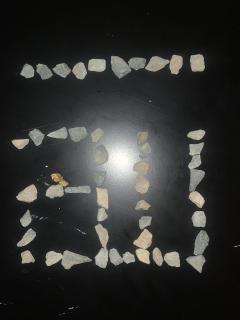
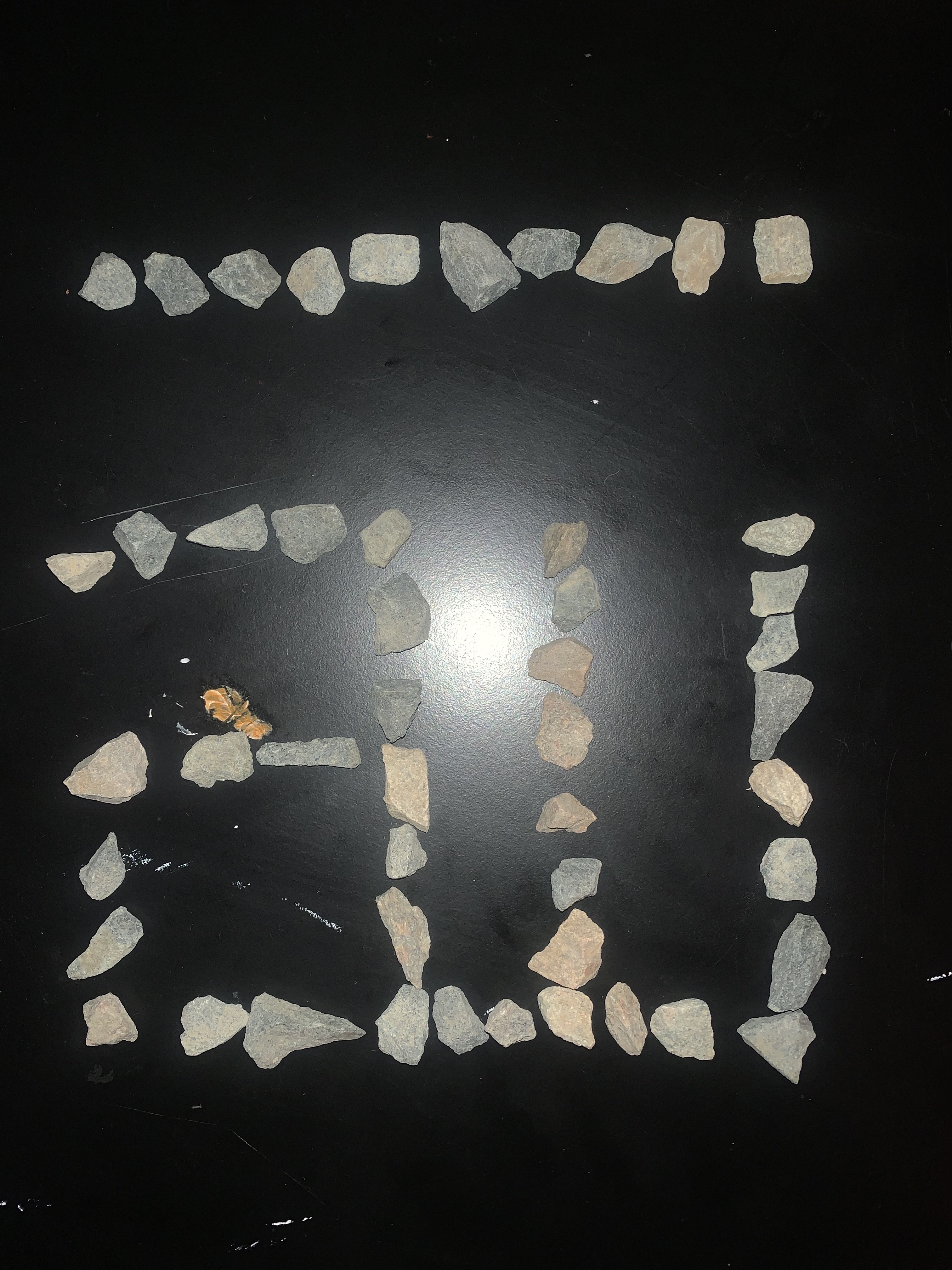
For my artistic representation, or calligram, of "Allah," I turned to nature, because of the all-encompassing unity of Allah, and the lesson, from the Qur'an (11:6) that earth itself, all "moving creatures," are connected to God. I collected these rocks on several contemplative walks, since this past August, around Cambridge—usually starting where I live in Winthrop House, along the Charles River. I am inspired by the creative potential which the Qur'an locates in rocks (2:74). Even these non-moving, non-breathing, famously-non-emotive entities find animation in, and devotion to, Allah. I was struck by calligrams of "Allah," which were highly geometric—all straight lines and black and white, which seem to introduce order, making a kind of easily identifiable oneness out of the chaos of life. I wanted to explore that possibility in my own representation. I placed my calligram against a black stone background, to harness some of this contrast, simplicity, and uniformity. When deciding how to photograph my calligram, I experimented with "flash" photography lighting, and I found this bright center to evoke Allah's presence of light—and one of Allah's names, "an-Nur." On another level, it is only possible to see the rocks, for them to be recognizable as one design or name of "Allah," when the light is present, reflecting the necessity of, and the inextricable majesty and beauty, of the oneness of Allah.
Final Project — Illustration of Sharia
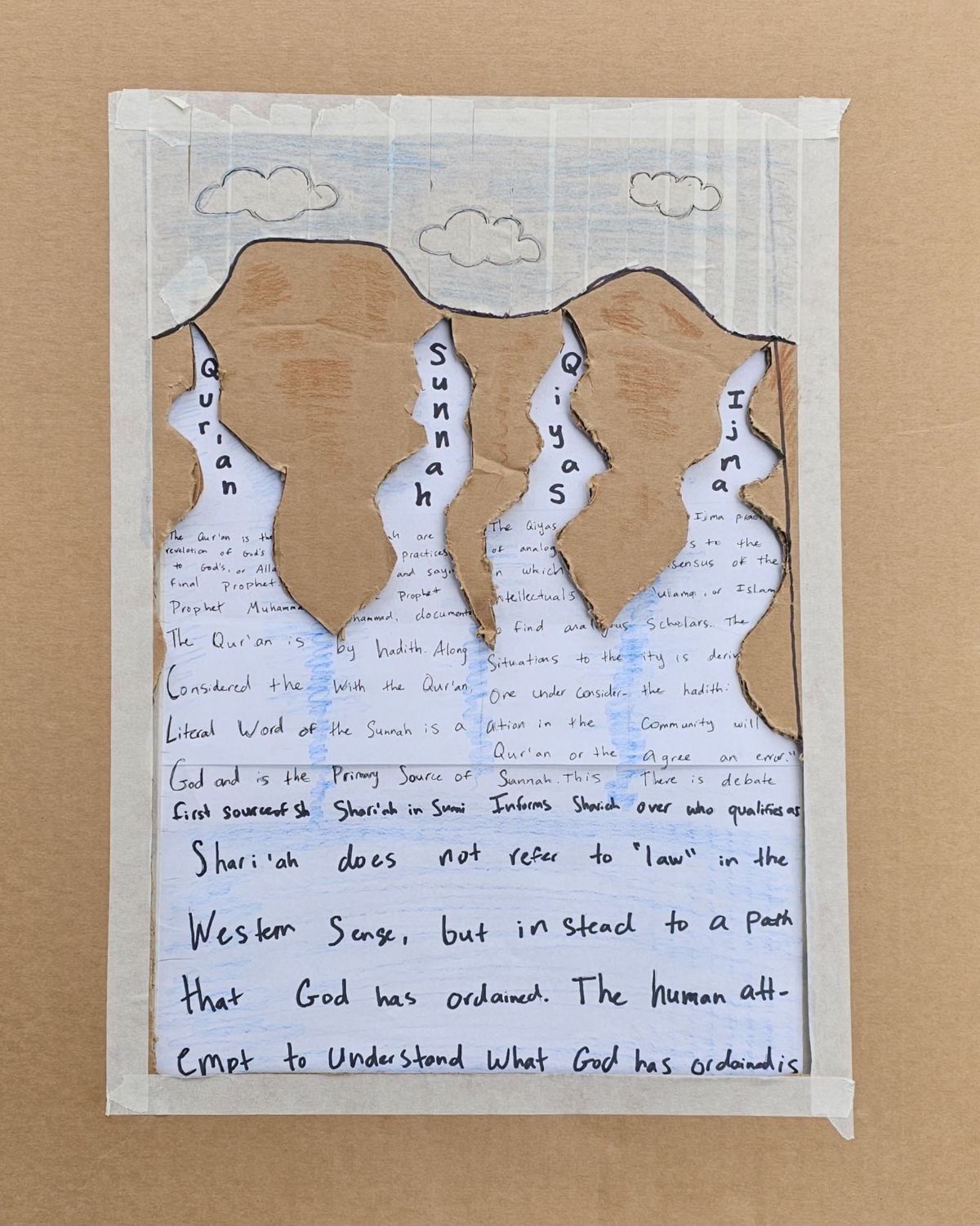
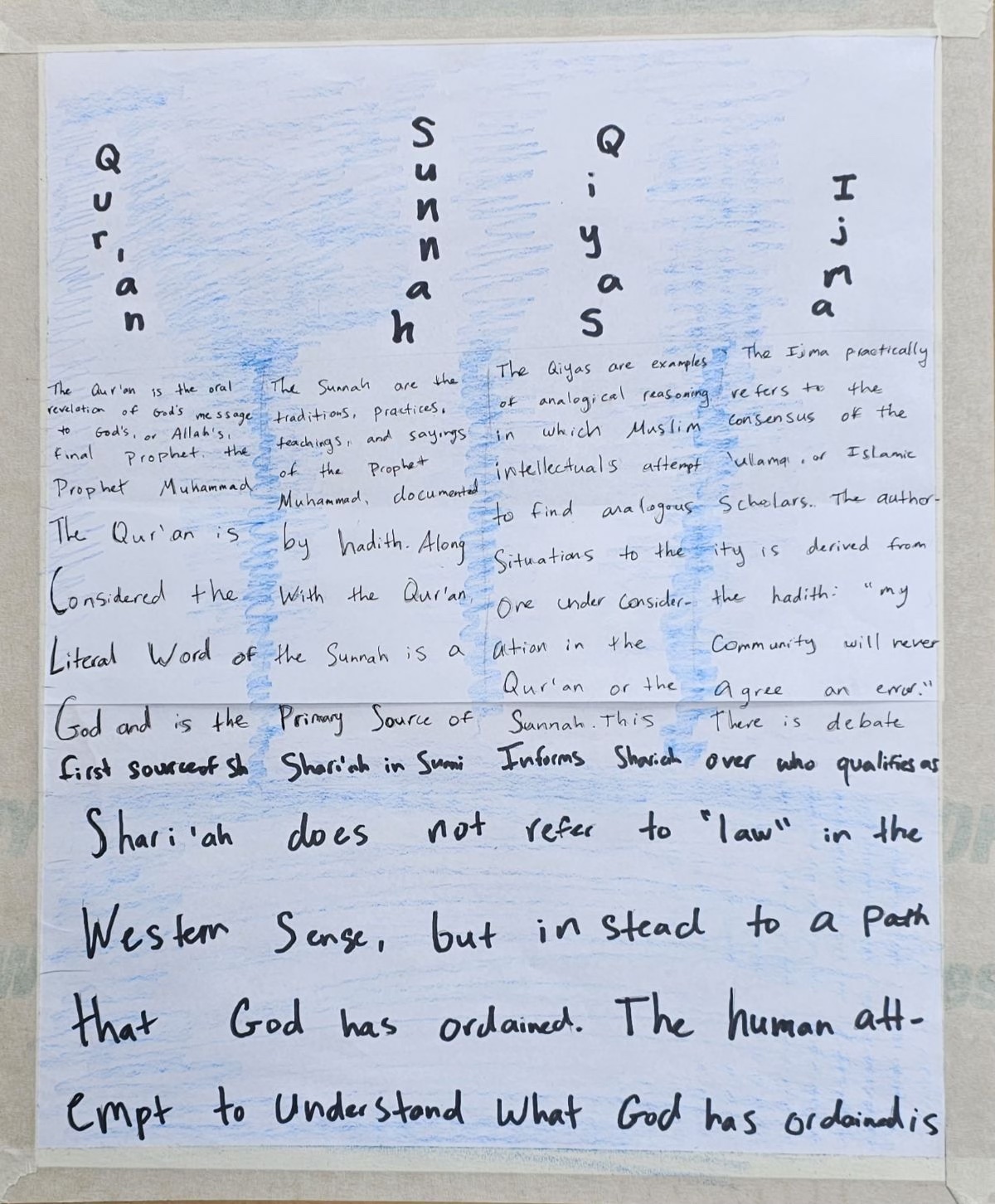
I chose this venue and medium because I wanted to render the related concepts of the Qur’an, the Sunnah, qiyas, ijma, sharia, and fiqh in a more visually integrated way, which honors the additive relationship which each of these first four sources of wisdom have to each other, and in the human attempt to understand what God has ordained (fiqh), or the search toward sharia.
I wrote the descriptions of each concept using simple language, with an audience of young students, late elementary school, in mind. In my discussion section with Adnan and my peers, as well as later in this final exam, I was able to address my hometown’s lack of fluency around religious pluralism, and especially Islam. I wanted to create something easy to understand and interactive, which would allow adolescents to begin understanding the complex process by which Islamic intellectuals and practitioners try to discern God’s will. The materials are cardboard, pen, pencil colored pencil, sharpie, and tape, and the cardboard which shows that the wisdom comes from four distinct sources, or rivers, can be lifted (seen in the video on scalar, though I am not able to attach a video to this document), representing the appearance of these sources as separate, but the ultimate one-ness (tahwid) of this natural creation and human wisdom in God. The rivers flowing from mountain tops was purposeful, as well, and I had in mind the Prophet Muhammad receiving his first revelation, delivered by God, atop Jabal an-Nour, or “the Mountain of the Light.”
I was inspired by the four major sources of input in Sunni legal decisions and reminded of the Qur’anic verse (47:15) about paradise’s four rivers. From A.J. Arberry’s English translation: “This is the similitude of Paradise which the godfearing have been promised: therein are rivers of water unstalling, rivers of milk unchanging in flavour, and rivers of wine -- a delight to the drinkers, rivers, too, of honey purified; and therein for them is every fruit, and forgiveness from their Lord…”
This artistic expression represents the first concept that I detailed in Part 1A by presenting each source in deciding the legal status of an act in Sunni Islam as coming together in sharia. I convey these as separate bodies of water, which ultimately flow into one body of water, aiming at understanding God’s true intent. The Qur’an is the primary source of wisdom, and therefore the first river, and then the Sunnah, qiyas, and ijma follow. The writing is, nearer the source, or higher in the visual, smaller and harder to read, but as it approaches the human interpretation of sharia, the writing becomes larger and clearer to represent the way that analogical reasoning, or qiyas, comes together with the Qur’an or the Sunnah, to foster clarity on some specific issue. As the rivers come closer to flowing together, the legal decision and the righteous path ordained by God should become clearer.