Jeromel Dela Rosa Lara
For Muslims, reality is about Allah. God is everywhere. Our lives and the world are a reminder of God’s creation, mercy, and compassion.
During my Spring Semester study abroad program in Jordan, I had the honor of living with a Palestinian Muslim host family. As a Christian, I specifically indicated to my study abroad program that I want to be in a Muslim-practicing family. I embrace an interfaith life where we value people’s religious and spiritual experiences. With my host family, we’ve had many conversations on these topics. And I had the honor of celebrating Ramadan with them.
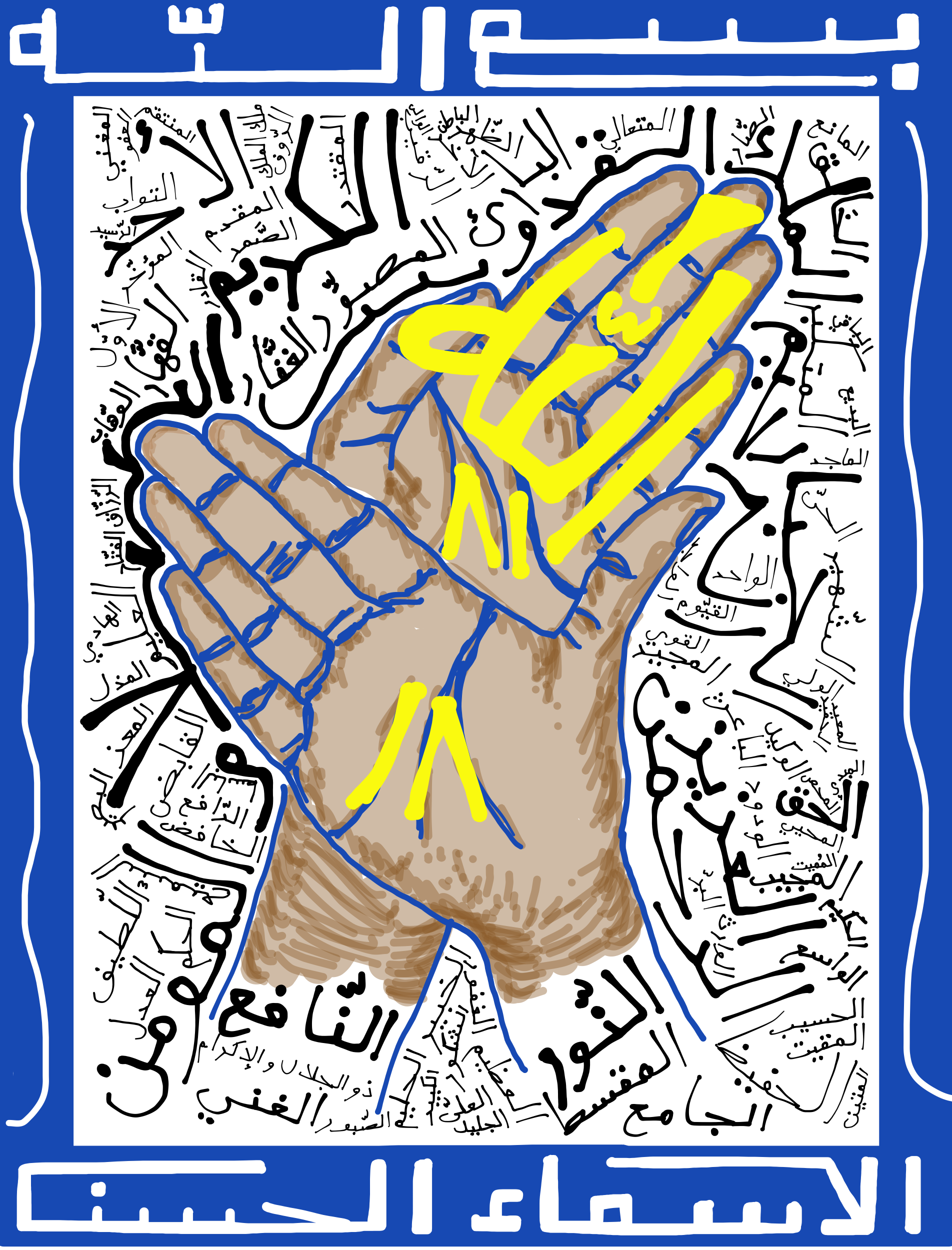
This calligram was inspired by a story that my host family shared with me during Ramadan 2022. Talking about Allah, my host family shared with me how God is present everywhere and that Muslims engage in ritual practices like fasting and prayer to remind themselves about this. They told me to look at the palm of my hands, how the left hand has the marks ٨١ and the right hand has the marks ١٨. Those are Arabic numbers that stand for 81 and 18. If you add them together, you get 99, which stands for the 99 names of God, the Al-Asma Al Husna الأسماء الحسنى. Reminders about God’s presence is everywhere in nature, including our own hands. And even those hands bear with them the resemblance of the word Allah. This is what I am depicting in my calligram where nature such as the human hand reveals the presence of God.
I extend this further by including all the 99 names of God around the human hands in this calligram. There are verses in the Qur’an that talk about how God revealed these names to the first humans––Adam and Eve. This calligram depicts that moment of revelation for the primordial human being. The first humans looking at the palm of their hands, seeing the mark of their creator who then tells them all about the names and attributes of God. This revelation we can relate to today as Muslims and Christians believe that they inhabit a world that God has created. Hands don’t only symbolize humankind’s power but the ultimate source of power that, for Muslims and Christians, comes from Allah, God.
Final Exam Part 1 Section B:
Omar: Being a Black Muslim in America
Jeromel Dela Rosa Lara
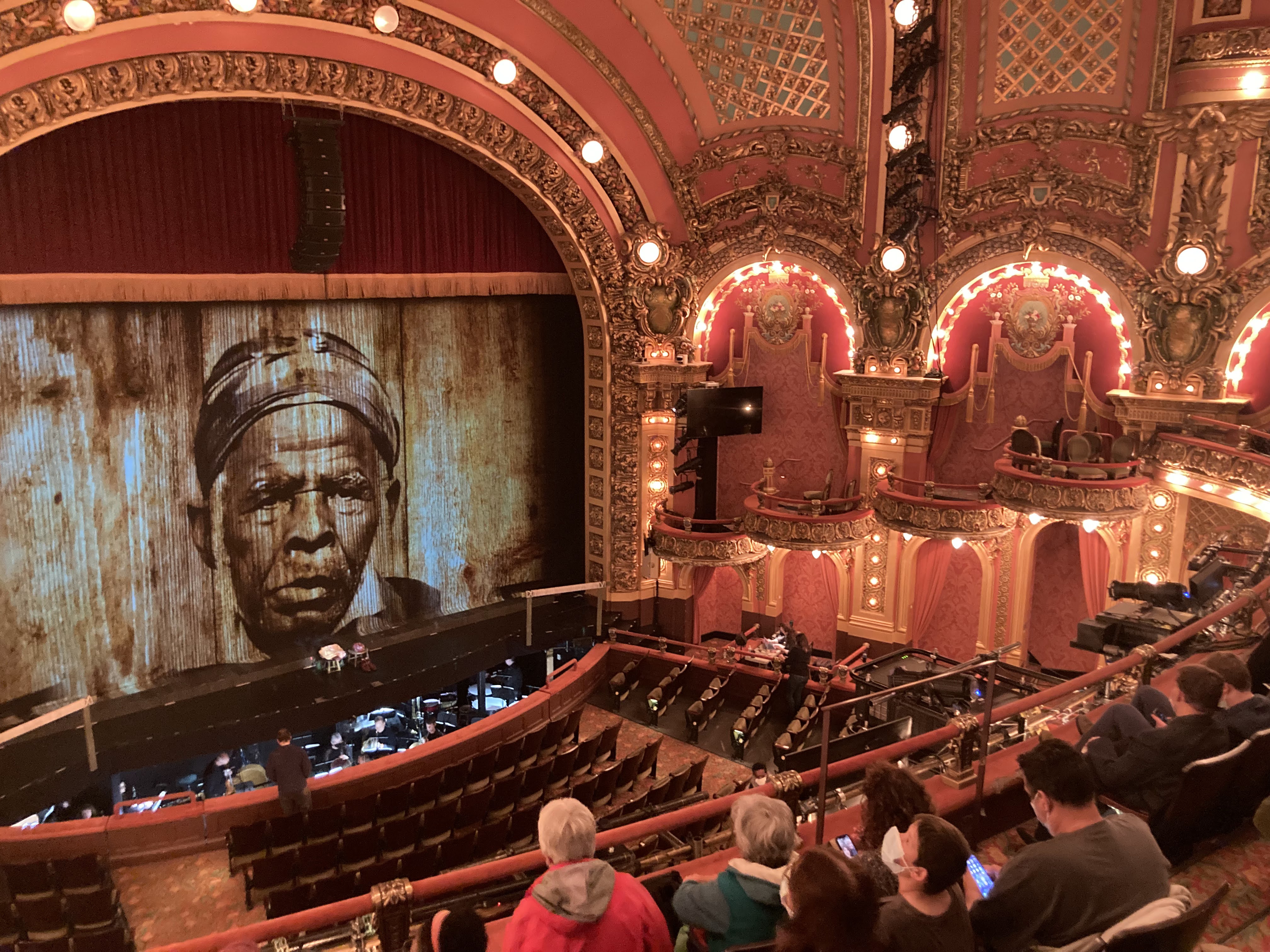
The May 2 dress rehearsal performance for the Boston Lyric Opera’s production of Omar, an opera based on the autobiography of Omar ibn Said. By Jeromel Dela Rosa Lara.
The Sudanese writer Tayeb Salih wrote about the fictional character of Wad Hamid, a revered spiritual guide and figure for a village in Africa. Wad Hamid “used to be the slave of a wicked man… When he could no longer bear his life with this infidel he called upon God to deliver him…” (Salih 1998, 14).
At least 10 percent of enslaved Africans who were forcibly brought to America were Muslim (Asani April 23, 2023, lecture video). Today, about 40 percent of Muslims in America are African American (ibid). It unsettles me that in the course of my schooling in this country that it is only now that I am learning about this history. And going beyond the numbers, I am troubled by the fact that I have not encountered the voices of Black Muslims.
I had the honor of seeing the New England premiere of Omar, an opera made in 2022 by Rhiannon Giddens and Michael Abels. The performance was done by the Boston Lyric Opera.
It is based on the autobiography of Omar ibn Said, an enslaved Black Muslim who wrote his story in Arabic in 1831. He is from Futa Toro located in Senegal (ibn Said 1831, 1). Just like in his autobiography, the opera starts off with the basmala, which is the beginning of every chapter in the Qur’an apart from the ninth (Asani February 5, 2023, lecture video; Said 1). Bismillahir rahmanir rahim. In the name of God, the compassionate, the merciful. In the face of the peril his own community faced under attack from those who would separate him from his mother and would put him under the chains of slavery, Omar invoked God further in his autobiography. His Muslim identity became pronounced, and the opera began with a progressing and repeated recitation of the basmala.
The basmala and the stories of Omar and his people reverberated through the Greco-Roman space of the Emerson Cutler Majestic Theater adorned with the Western embellishments of wealth and power. Power was reclaimed in the performance through the retelling of Omar’s life in the midst of a Western society that has long ignored the very people under whose backs supported their own sense of superiority.
Throughout the opera, Omar called on God. Omar called on God just like that of the character of Wad Hamid in Salih’s writings. God/Allah and the Islamic concept of tawhid––humanity's oneness with the one God––becomes a source of refuge for communities who have gone through the intergenerational trauma of being torn apart and conquered. His identity as a Muslim from West Africa and how he interpreted his faith are important considerations of Omar’s personhood that seemingly have been overlooked by even those who had the opportunity to experience the opera rendition of his life.
An NPR review of the production describes it as “a thoroughly American opera” that is a “broadly American story” (Tsioulcas 2022). Now this is an interesting take away especially when the opera vividly shows Omar lamenting his separation from his mother and his homeland. In one of its scenes, he writes in the face of his white slaveowners, “I want to go home.” It was the custom of slavery that propped up the American state that went against Omar’s Muslim principles of tawhid and the notion of the oneness of humanity in the shared reality of being in oneness in God. I find it very striking that this opera was praised more for being American than being African, than being Muslim, than being a story of African Muslims.
Throughout the performance, I find that everything in this opera from the stage design to the costumes to the musical styles to the script are deliberate and makes an attempt to bring out Omar’s West African Muslim story and that community that he constantly called onto even when he was separated from them. There is intentionality within the motifs that shows the intersectionality of religion and race.
One of the culminating scenes in the opera when Omar would eventually decide to write his story took place under the backdrop of a tree. It is under this tree that has some transcendental qualities where Omar engages in conversation with God and his ancestors, like his mother. The tree is depicted to radiate with light and colors. In seeing this, I was reminded of Salih’s story of the doum tree of Wad Hamid, whose relationship with Allah/God became pronounced in the face of slavery. And in that story, the village whose community links their ancestry to the sacredness of Wad Hamid sought to protect that tree from being desecrated and chopped down (Salih 1998, 17). Within these Muslim communities in Africa and to those who were enslaved and ended up far away from home, religion becomes a way of making a space of one’s humanity when this has been deprived of.
Omar is not just an American story. It is specifically a story of what being a Black Muslim in America is like. Let us pay greater care and attention to their presence and to the histories of how they survived this hostile land through Islam that emphasizes oneness.
Final Exam Part 1 Section C:
I decided to write a review of the opera Omar so that I can at least put into paper all of the things that I have noticed and observed in the experience of seeing it on May 2. If the opera had been performed earlier in the semester, it would be great to have a class discussion about it. I also decided to do this medium because I was unsettled by the reviews of the opera that I have read online. Many of them praise the opera for its American-ness and claim Omar’s story as American. But I think this can be harmful where it seemingly devalues Omar’s story and identity as a Muslim from what is now Senegal.
It is a generalization that seemingly ignores the profound Muslim religious experience that Omar had that shaped his life. Because of this, I decided to add some nuance to those reviews that I have read with a review of my own shaped by our class. I especially noted the notion of tawhid or oneness. This is something that Omar ibn Said calls onto repeatedly in his autobiography, which the opera also does. In this review, my intended audience are those who want to learn more about the opera and a brief glimpse of its contexts. In this review, I mentioned my own observations of how the opera production harks back to the practices of Muslims in Africa. The whole tree scene near the end of the opera reminded me a whole lot of the doum tree of Wad Hamid. And in that story, Tayeb Salih uses this experience and rituals of Muslims in Africa and likens it to the community’s anti-colonial struggle. The character of Wad Hamid has similarities to the real person of Omar ibn Said, which I did my best to convey in my review.
I am still taken aback by the reviews of Omar from supposedly people who have seen the opera. I felt that to only praise it as an American story misses out a whole lot on Omar’s life and his struggles.
Works Cited
Asani, Ali S., dir. 2023a. Fundamental Islamic Concepts: The Quran as Oral Scripture.
———, dir. 2023b. God’s Word: The Qur’an and the Arts of Calligraphy; the Qur’an as Scripture.
———, dir. 2023c. Islam in the West: Europe and the United States. Video.
Asani, Ali S. Forthcoming. Infidel of Love: Exploring Muslim Understandings of Islam. Cambridge, MA: Harvard University Press.
Moore, Diane L. 2006. “Overcoming Religious Illiteracy: A Cultural Studies Approach,” World History Connected, 4 (1).
Said, Omar ibn. 1831. “Oh Ye Americans”: The Autobiography of Omar Ibn Said. National Humanities Center. http://nationalhumanitiescenter.org/pds/maai/community/text3/religionomaribnsaid.pdf.
Tsioulcas, Anastasia. 2023. “The Debut of ‘Omar,’ A Thoroughly American Opera.” NPR, June 7, 2023. https://www.npr.org/2022/06/07/1102782509/the-debut-of-omar-a-thoroughly-american-opera.
X, Malcolm. 1992. The Autobiography of Malcolm X. New York: Ballantine Books.
Zia, Shaharyar, dir. 2023. Section 11.