Hamaad Mehal
The History of Islam in America is the History of Black America [NYT Op-Ed]
The 21st century has seen a lot of change in America’s relationship with Islam and Black America. As a child born around 9/11, I grew up at a time when discussions on Islam mostly shone it in a negative light - with an emphasis on its incompatibility with Western society and Western ideals like liberty and freedom. Islam is central to how I identified with myself and where I came from. Yet, when I listened to the news or heard public opinion in my childhood, I felt a deep sense of alienation from both identities as they were posited as being mutually exclusive. Islam was always constructed as a nefarious faith external to American society with the goal of destroying it. Yet, as I began to learn more about American history, specifically the slave trade and the civil rights movement, I began to see Muslim names appear scattered throughout America’s history. I started researching Islam’s history in America and found a surprising fact that was ignored by mainstream discourse: Islam has been a part of America since its inception.
Islam entered America through the slave trade during our colonial period as hundreds of thousands of Africans, many of whom were Muslim, were brought over. This makes it almost as old as Christianity in this country, countering the narrative that Islam is a nonnative religion incompatible with American society. This establishes the fact that Islam’s existence in these lands predates the existence of our country. Despite dying down as a result of forced conversions and tactics that alienated Black Americans from the religion, it managed to remain in practice within the Black community, albeit in a very limited manner. As the condition of Black people in America worsened as a result of segregation and racial violence in the 50 years after the Civil War, Islam re-emerged as a force for change. When we look at the Nation of Islam or Malcolm X, we see that Islam was adopted and then transformed into a faith that specifically established a framework for achieving racial justice. These organizations and people leveraged Islam’s historic positionality as a faith exclusively practiced by Black Americans to establish a Black identity that subverted the dialectical relationship of Black Americans’ existence as subordinates to White America. Their identity as Black Muslims provided them the historical backing and understanding to assert their power as a sovereign community by removing them from the Christian framework weaponized by White Americans to assert racial supremacy. This framework that Islam provided influenced everyone in the civil rights movement, from the aforementioned prominent Muslims to civil rights activists like Martin Luther King, as it allowed Black Americans to assert a separate identity of power that moved beyond the position prescribed to them by White society. Islam’s other contributions to the civil rights movement, specifically its ability to mobilize the Black population in Northern cities, were critical to advancing racial equality in America, and even after the civil rights movement, we have seen that Islam remains prominent in the Black community for whom it has constantly been used as a force for racial justice, especially in urban areas.
Ultimately, this history demonstrates that there is an American form of Islam - a form of Islam that is especially attuned to questions of race and justice and generated to fit America. This directly disproves narratives that establish Islam as fully exogenous of America as this demonstrates that not only is Islam compatible with America in the present but that it always has been present in a multiracial America. By ignoring the history of Islam in America, we tend to invalidate an integral component of the history of Black America. We ignore the role Islam played in liberating Black Americans from the cycles of White supremacy that remained pervasive around the country and in establishing liberty and freedom for them. Most importantly, by trying to reject Islam in America, we ignore the potentiality of using Islam and its framework to drive greater efforts toward racial equality and justice in this country.
Section C: I chose to write an Op-Ed in the New York Times. I chose this venue because the New York Times is amongst the most widely read newspaper in the United States, and it is probably the most appropriate for an Op-Ed on individual experiences with race and religion as it is not a specialized newspaper (unlike the Wall Street Journal). As a result, it would likely reach the most general audience of Americans, and the goal of this Op-Ed was to educate Americans on the history of Islam in America, specifically as it relates to Black America, through refutations of popular 21st-century narratives on Islam. I chose to write to the broadest American audience because the idea that Islam is completely foreign and ahistorical to America is one that remains dominant and is a particular by-product of the War on Terror. The War on Terror focused on forms of Islam that were foreign (e.g. the Islam of the Taliban), but it projected these forms onto Islam in America. By doing so, it constructed Islam as a monolith that was defined by these foreign forms, and this led to the erasure of other culturally-specific forms of Islam, including the Islam of America. Misconceptions of Islam based on these constructions are widespread in American society and are problematic because they ignore the fact that Islam has been in America for almost as long as America has existed. This point is important because it demonstrates how fundamental Islam is to the history of America, and it directly proves that America is a place in which Islam can compatibly exist, a fact that is necessary for America to accept to end discriminatory attitudes. My piece represents the idea I highlighted in A as it directly educates readers about the history of Islam in America, and it does so by explicitly constructing the history of Islam in the United States alongside the history of Black America. This is impactful for two reasons. Firstly, it presents the facts of Islam’s history in America as they are because Islam entered and remained in the United States solely through the Black American population for much of American history. Presenting this fact also allows for greater acceptance of Islam in the United States because the presence of Islam in the United States corresponds directly to the fight for freedom and liberty in the Black community. It is easier for Americans to accept Islam as a fundamental component of America when they realize this because the fabric of America has always consisted of a multi-racial population, and this tie demonstrates that Islam is a faith that upheld a multi-racial society through its role in the liberation of Black Americans from racial dominance. As it relates specifically to Part A, I specifically highlighted the role Islam played in the civil rights movement for Black liberation through discussion on its influences on the Nation of Islam and Malcolm X, two staples of the civil rights movement.
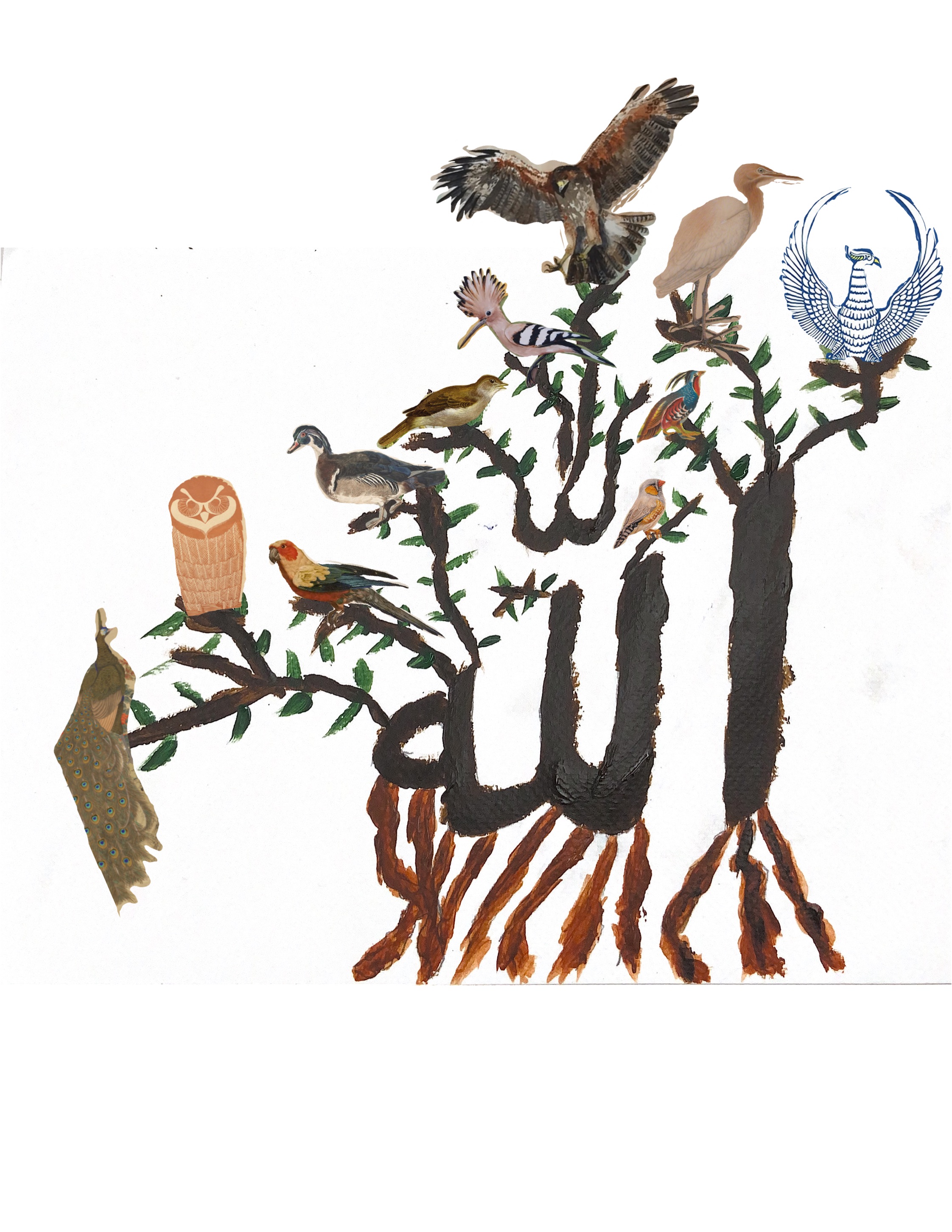
I decided to create a project with a painting and digital collage component. For the painting component, I painted Allah as a tree from which roots and branches emerge. I painted Allah as a tree because trees are generally used to symbolize life and sustenance, both of which arise from God. The tree’s roots provide everlasting sustenance, and the tree itself demonstrates the ways that Allah’s creative force sustains life and existence. For the digital collage portion, I perched eleven birds upon the branches, and these birds were all taken from The Conference of the Birds by Attar. I chose to make my project an allusion to Attar’s work because The Conference of the Birds is about how human fallibility hinders the journey to divine love. Each bird represents a different character weakness within humans that prevents us from reaching Allah’s love. They are perched upon Allah as, once each of these character weaknesses is overcome, an individual is able to achieve union with God through his divine love. The digital collage medium seemed to be the best one to employ because it allowed me to stay true to the representation of the birds in Attar’s work while providing the creative freedom to draw upon other works to express every bird. All of these birds were made into historical art pieces over the course of history - many of which were likely inspired by The Conference of the Birds; thus, I felt as if it were appropriate to add them via the digital collage medium. Ultimately, I feel as if this calligram engages with Allah as the eternal life force and source of divine love through a famous Islamic literary work that focuses on how humans can achieve a union with the divine, the force and love that sustains our existence.
Work Cited
TAOUJOUTI, A. (2021). Hoopoe (2021). artmajeur. Retrieved from
https://www.artmajeur.com/abdelmouhaimen-taoujouti-art-et-peinture/en/artworks/16024
654/hoopoe.
Pomata, A. M. (2016). Zebra Finch. Fine Art America. Retrieved from
https://fineartamerica.com/featured/zebra-finch-angeles-m-pomata.html.
Buncho, T. (1820). Peacocks and Peonies. The Metropolitan Museum of Art. Retrieved from
https://www.metmuseum.org/art/collection/search/49003.
Jessurun de Mesquita, S., & van Es Wassenaar, J. A. A. M. (1928). Birding at The Met: A
Selection of Drawings and Prints. The Metropolitan Museum of Art. Retrieved from
https://www.metmuseum.org/perspectives/articles/2022/9/birding-at-the-met-drawings-an
d-prints.
Fakes, D. (2018). Hawk Landing . Fine Art America. Retrieved from
https://fineartamerica.com/featured/hawk-landing-dennis-fakes.html.
Soreide, H. (2020). Nightingale - Luscinia philomela. Fine Art America. Retrieved from
https://fineartamerica.com/featured/nightingale-luscinia-philomela-hakon-soreide.html.
Levaillant, F., & Barraband, J. (1805). Female Golden Parakeet. Birding the Met Museum .
Susan Kirby. Retrieved from
https://www.pmsaga.com/blog-2-1/2019/11/24/birding-the-met-museum.
Schouman, A. (2004). A Duck. Wikimedia Commons. Retrieved from
https://commons.wikimedia.org/wiki/File:A_Duck_MET_DP800684.jpg.
Bequest of Minassian, A. (18 c.). A Heron. The Metropolitan Museum of Art. Retrieved from
https://www.metmuseum.org/art/collection/search/453397.
Issued by Allen & Ginter (American, Richmond, Virginia). (1889). Plumed Partridge, from the
Game Birds series (N13) for Allen & Ginter Cigarettes Brands. The Metropolitan
Museum of Art. Retrieved from
https://www.metmuseum.org/art/collection/search/407960.
Persian Huma Bird: Blank Lined Notebook, Journal or Diary. (2019). Amazon. Retrieved from
https://www.amazon.com/Persian-Huma-Bird-Notebook-Journal/dp/1794504249.