Anu Zaman
My calligram explores the concept of tawhid, or the oneness of God in Islam. While human history is mutable and conditional, and the physical dunya is temporary, God exists as the one absolute reality that transcends all multiplicity. The Qur’an routinely asserts tawhid, such as in Qur’an 112:1-4, which states God is “one and indivisible,” that He “neither begets nor is born,” and that there is “no equivalent” to Him.
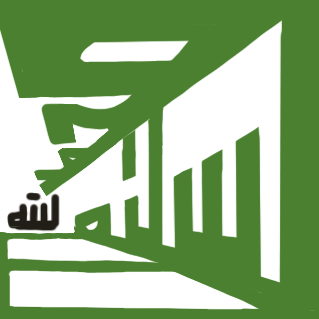
My design is an illustration of a dimensionless space where the single point of convergence is Allah. Allah is the generic Arabic name for God; its etymology designates something unable to be fully understood. I thus chose this abstract representation as the God conceptualized in Islam is inherently confounding, paradoxical, and transcendental. Allah is positioned in the vanishing point, yet still readable, demonstrating the dual nature of God as close to humans even as He is far from humans in His exalted perfection.
Some of the dimensions pointing to the vanishing point of Allah are denoted by the fundamental concepts of “Muhammad” and “islam” (submission). Muslims have common ground with those who submit to God, with monotheists in the worship of one deity, and with Ahl al Kitab, or the People of the Book. However, Muslims distinguish themselves from other religious adherents through their assertion of tawhid and the role of the Prophet Muhammad as the final messenger of Allah. A third dimension is left blank, evoking a path; it is a challenge to the viewer to imagine other important aspects of Islam. It is equally an invitation to interpret Islam according to the individual viewer, as Islam is interpreted by Muslims differently based on their individual contexts.
FINAL EXAM
Section B
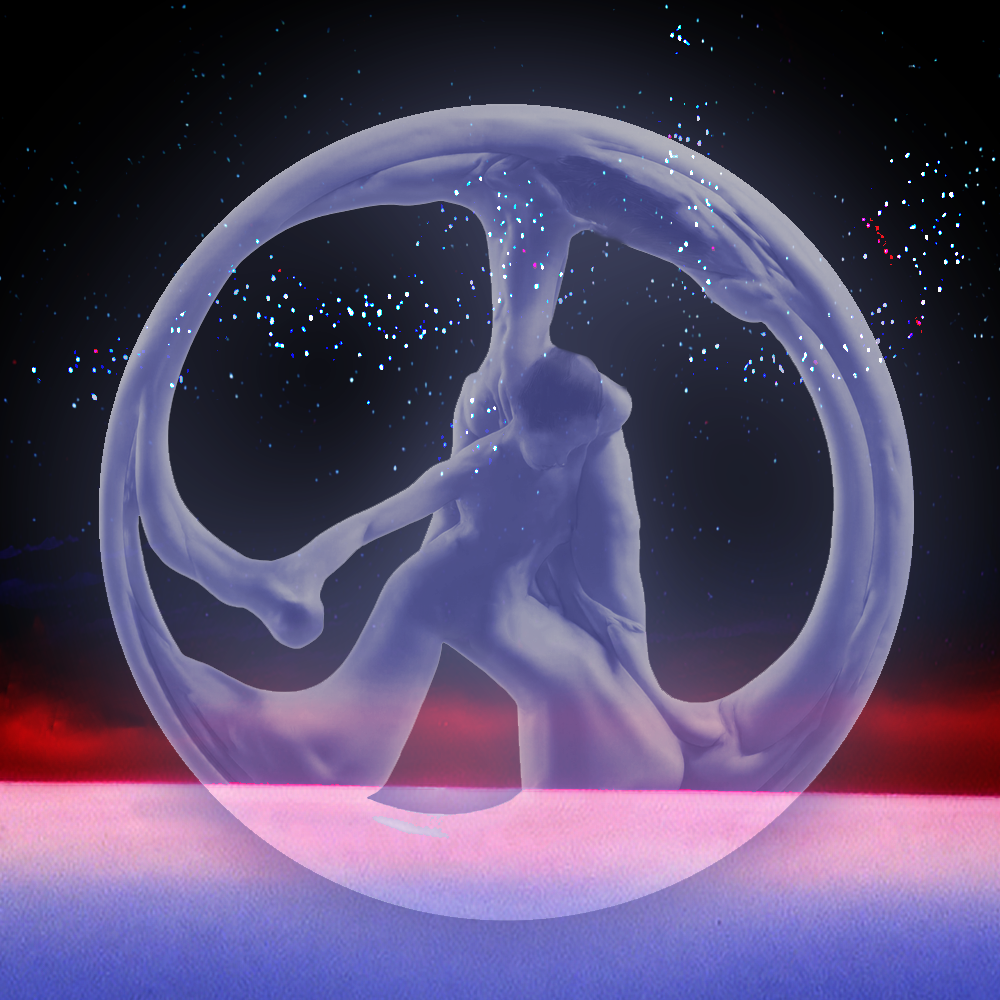
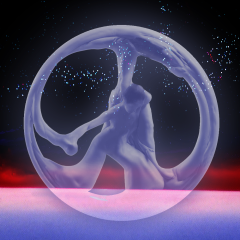
This digital collage made use of Hyperbolic Composition II by Scott Eaton and a frame from the 1995 anime Neon Genesis Evangelion.
The museum label accompanying this piece in an exhibition would read:
Annihilation
Anu Zaman (b. 2001)
Digital collage
Wajd is a trancelike state of ecstasy evoked by connection with the Divine and a cornerstone of Sufi practice, which emphasizes the search for spiritual enlightenment through remembrance of God. The contortion and dematerialization of the human figure in the center of the piece represents the ultimate goal of fana fillah, or annihilation of the Ego to be part of a collective consciousness with Allah. This collective consciousness is represented by the oceanic dreamscape behind the figure, where every particle of water exists as part of a larger whole, just as human individuality would cease in favor of union between man and God. The androgyny of the figure deemphasizes constructs of the material world, such as the gendered body, and emphasizes the inherent gender equality of fana fillah, which allows women to participate in dhikr, or Sufi rituals of remembrance.
Section C
I chose to construct my message as a work of visual art, to be displayed in a prominent contemporary art museum, such as the Institute of Contemporary Art in Boston or the Whitney Museum in New York City. I chose this medium as visual art, especially contemporary art, can be highly conceptual and open to interpretation. It demands a level of time and attention in order to be understood, as well as (informal) application of the cultural studies approach (Moore). This is more easily achieved in the physical art gallery than in online spaces, though the latter may be more accessible to the public. Unlike Internet users who are inundated with (contradictory) information and sensory stimuli, museumgoers are immersed in a minimalist space consisting of thematically consistent art objects and digestible artist statements. Of course, some contemporary art objects can be at the extremes of either unintelligible or didactic, but curation of physical exhibitions is often able to temper this by constructing narratives and putting pieces in conversation with one another, which requires a level of intentionality that is more difficult to assert online.
My audience consists of visitors to these institutions and consumers of contemporary art, of any age, especially those interested in modern visual culture and social issues. I selected them for my focus as museums get a wide variety of visitors, so my piece would expose the general populace to a lesser known aspect of the Islamic tradition. I specifically mention individuals interested in modern art and social issues as the scarcity of textual context would particularly interest people with artistic and religious literacy.
As explained in the mock accompanying museum label, my piece represents wajd, the state of ecstasy reached upon connection with the Divine. The dematerialization of the human figure represents fana fillah, while the dreamscape in the background represents a return to the Divine. The stars spelling out “wajd” in Arabic in the night sky represents batin, or esoteric knowledge, since this hidden detail requires prior knowledge of Islam. Moreover, it invokes tawil, or mystical interpretation of the Qur’an, as such wisdom takes time and guidance to develop (Asani). I chose to represent wajd, rather than a ritual such as dhikr or qawwali, in order to emphasize the spiritual aspects of Sufism. As Cragg and Speight explain, these rituals aim to remove the “veil of sensual perception” to emphasize inner spiritual and divine qualities within the Sufi (174). Thus, I believe that non-Sufis should also be exposed to elements of Sufism that are not iconographic, such as the whirling dervishes, and cannot be seen with the naked eye (Asani).
Works Cited
Asani, Ali. “An alternative interpretation of Islam: Sufi piety and practice.” GENED 1134: Understanding Islam and Contemporary Muslim Societies, Harvard University, Cambridge, MA. Lecture.
Cragg, Kenneth, and R. Marston Speight. Islam from Within, 1980, pp. 173-207.
Moore, Diane L. "Overcoming religious illiteracy: A cultural studies approach." World History Connected 4.1, 2006.