Oliver Cheng
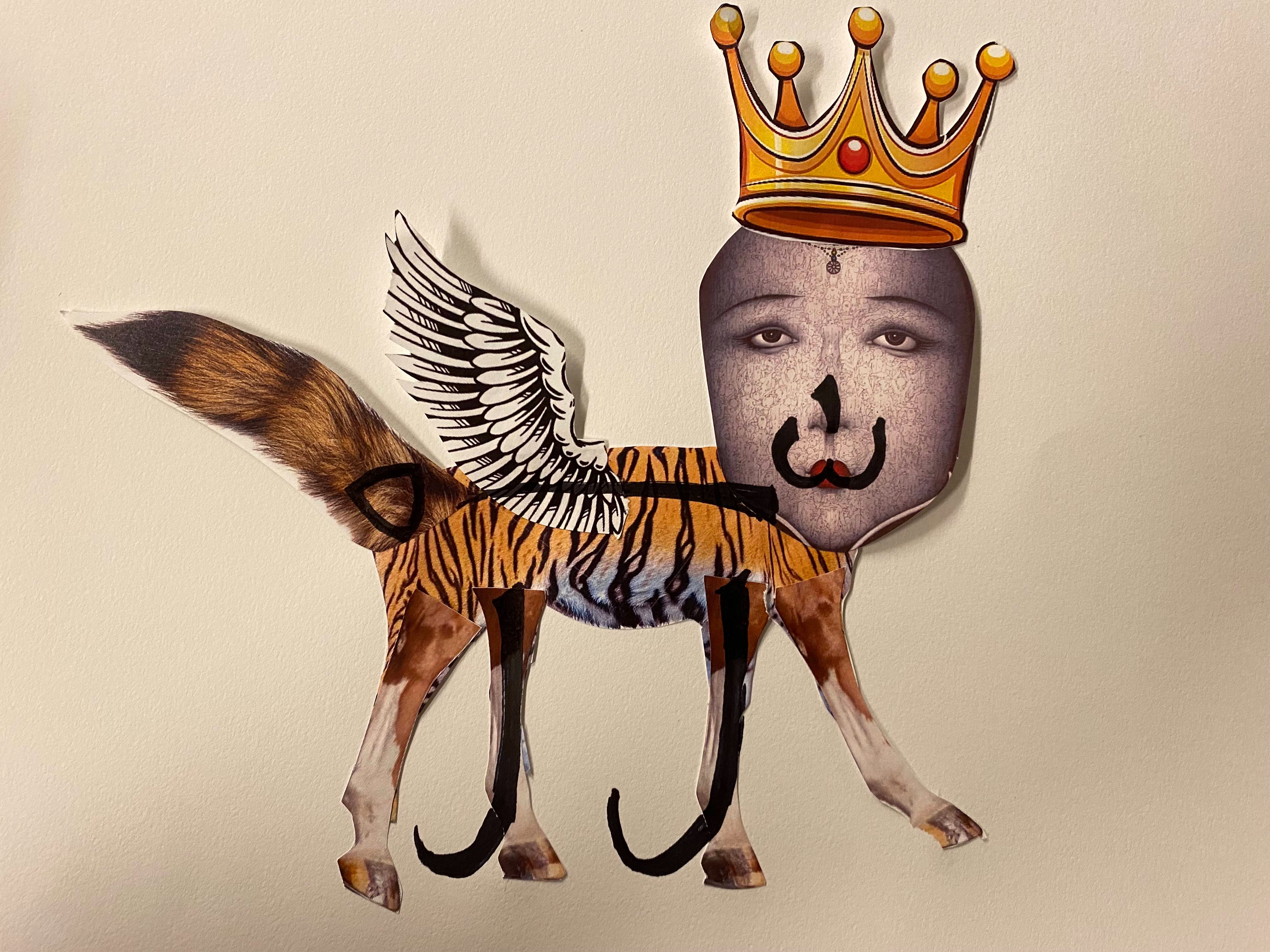
This calligram depicts Bu'raq as taking the form of the characters of Allah. The premise of this depiction is that one of the fundamental parts of God is his Love, and the primary way for someone to transform from an ego-centric human, to a God-centred being is through Love. To depict this transformative nature of Love, I chose Bu'raq, the mystical creature which transports the Prophet Muhmmad to God during the Mi'raj. During lecture, Professor Asani talked about the fact that Bu'raq represents this exact love. Bu'raq is generally depicted to be a horse, but it seems as though there is no consensus on what animal it is exactly. To show this ambiguity, I took imagery from a tiger, from a horse, and from a beaver to create the body of Bu'raq. In all depictions, Bu'raq has mystical wings, and a human head. It seems as though the gender is also ambiguous in Hadiths so I chose a head that has both masculine and feminine features. I placed the lām and aleph on the legs and back respectively to represent its position as a transporter; it is a transporter with many attributes, love being one of the primary ones. I placed two characters around the face's lips and face, linking the compassion and love that comes from the mouth to the compassion and love of Allah. An interesting connection between Bu'raq and the characters of Allah is that there are generally 7 characters in Allah, and Bu'raq's journey was through to the 7th heaven. Bu'raq is also commonly depicted with a crown on its head, suggesting the majesty of both Bu'raq as a mythical transporter, but also of the majesty and oneness of Allah.
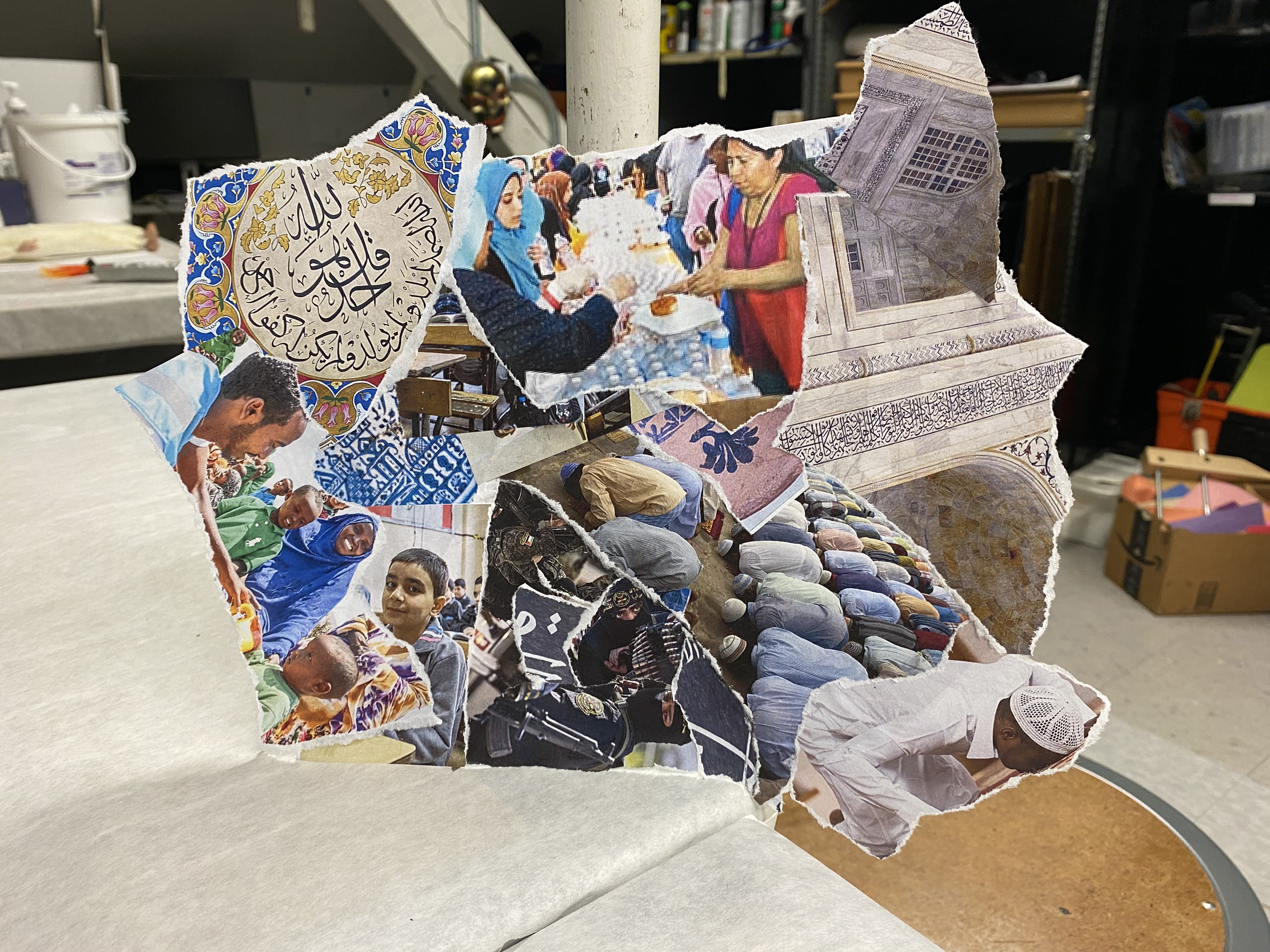
If one Googles "jihad", the first images that come up are of terrorism and armed militia. Most of these comes from news stories talking about jihadists, but some reporters, such as BBC News and The Conversation, are even trying to give a deeper picture of what jihad truly is (Google Images). Unfortunately, even for these journalists, bloggers, and media editors who are trying to clarify what jihad truly means, they have no imagery to explain the complexity of the word. In our world that focuses on headlines and instant imagery, it is easy for someone unfamiliar with the notion of jihad to immediately assume that jihad is a violent and militant notion. This collage of collages is meant to show the complex meaning of jihad through a single image, as I described in part A. This piece would be one that is offered to journalists and media reporters to place in the headline of their articles which explain the complexities of jihad. These people who control the media have a substantial platform to clear up the modern misunderstanding of jihad and Islam. In many ways, they control the general public's perception of Islam. There is a growing number of journalists that are speaking up about how Islam has been unjustly portrayed in media, and the purpose of this piece is to give them artwork that accurately depicts some of the content of jihad.
The medium, collage, was chosen in order to use real imagery of what jihad has looked like in different Muslim societies. These pictures were sourced from journals and news articles about Muslim communities. They may not have used the exact term "jihad", but they exemplified this Islamic characteristic in some way. The collage medium allowed me to combine several different forms of jihad to describe how broad and complex jihad means to Muslims.
Since the concept of jihad is so broad, I could not encapsulate every aspect of the way Muslims understand the concept. The ones I focused on were jihad of the sword, pen and tongue, one's personal struggle with faith and devotion, and jihad in order to help those in need and build societal infrastructure. It was important in this piece not to ignore the fact that jihad can be used to describe holy war and armed struggle. However, it is only one small piece of the definition of jihad. I showed this by giving jihad of the sword space in the collage, but it is only one of the many different forms of understanding of jihad present in the piece. Finally, an additional note is that the boundaries of what jihad is for a person are constantly changing. I showed this by combining parts of the collage with ripped pages as opposed to cleanly cut imagery and leaving parts of the imagery off the page (Asani Ch. 1).