Mahia Rahman
Calligram Project
As the product of creation, we tend to forget our origins as spiritual beings trapped in the material world and suffer due to the separation from God. We must remember our primordial being to reach a state of oneness with the divine. Evelyn Underhill describes mysticism, an important concept in Sufism, as “the art of establishing his conscious relation with the absolute.” It involves “the perfect consummation of the Love of God.” Similar to the Prophet Muhammad's experience of the Mi'raj, Sufis strive for a direct, personal experience of the divine. There are many ways to achieve this relationship of love with the divine and remember our primordial selves, but I found the concepts of whirling and Qawwalis present in South Asia particularly captivating.
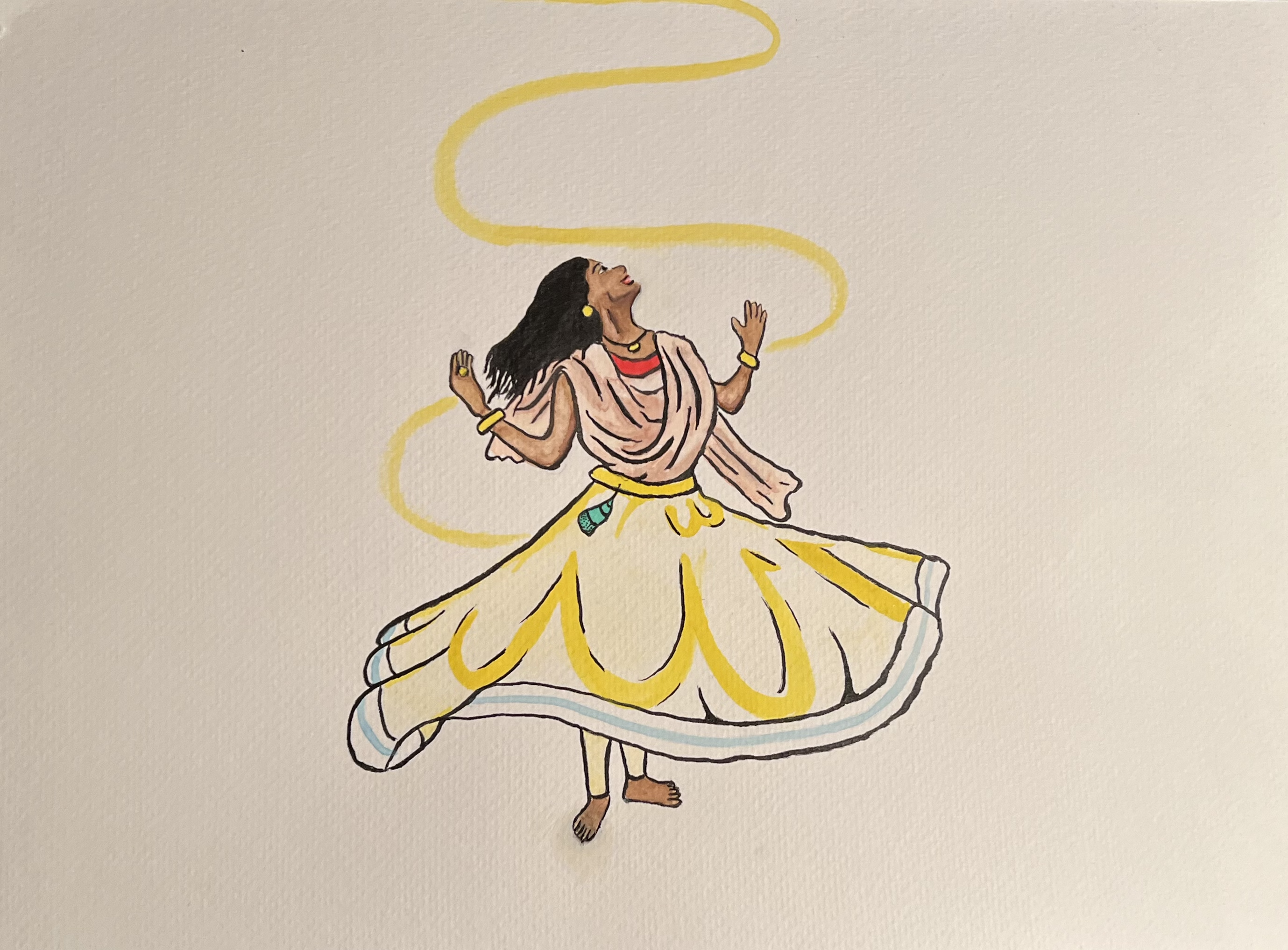
In my calligram project, I painted a woman participating in the whirling who has successfully transcended the abyss that separates the human from the divine. Prior to her whirling, she was in a state of the Shariah (the “outer”), present only in the physical world. Through whirling, her method of Tariqah (the “path”), she was able to ascend to a state of Haqiqah (“the real”), represented by the transcendent yellow light inspired by the Light verse from the Quran, and the appearance of Allah on her dress. Although Allah was not visible in the Zahir (“the physical”), once the woman became one with the divine, the Batin (“the hidden”) revealed itself through the calligraphy of Allah on her dress. Through this spiritual practice, the woman was able to liberate herself from the separation from Allah and establish a conscious relationship with the divine.
Final Exam - Sections B and C
Section C
For Section B, I chose to focus on the topic of diversity in Islam. As previously mentioned in Section A, Islam's 1.9 billion population come from diverse cultural, geographic, and political background. Furthermore, every Muslim interprets and practices their faith in their own unique way, depending on the individual worldly contexts that shaped them.
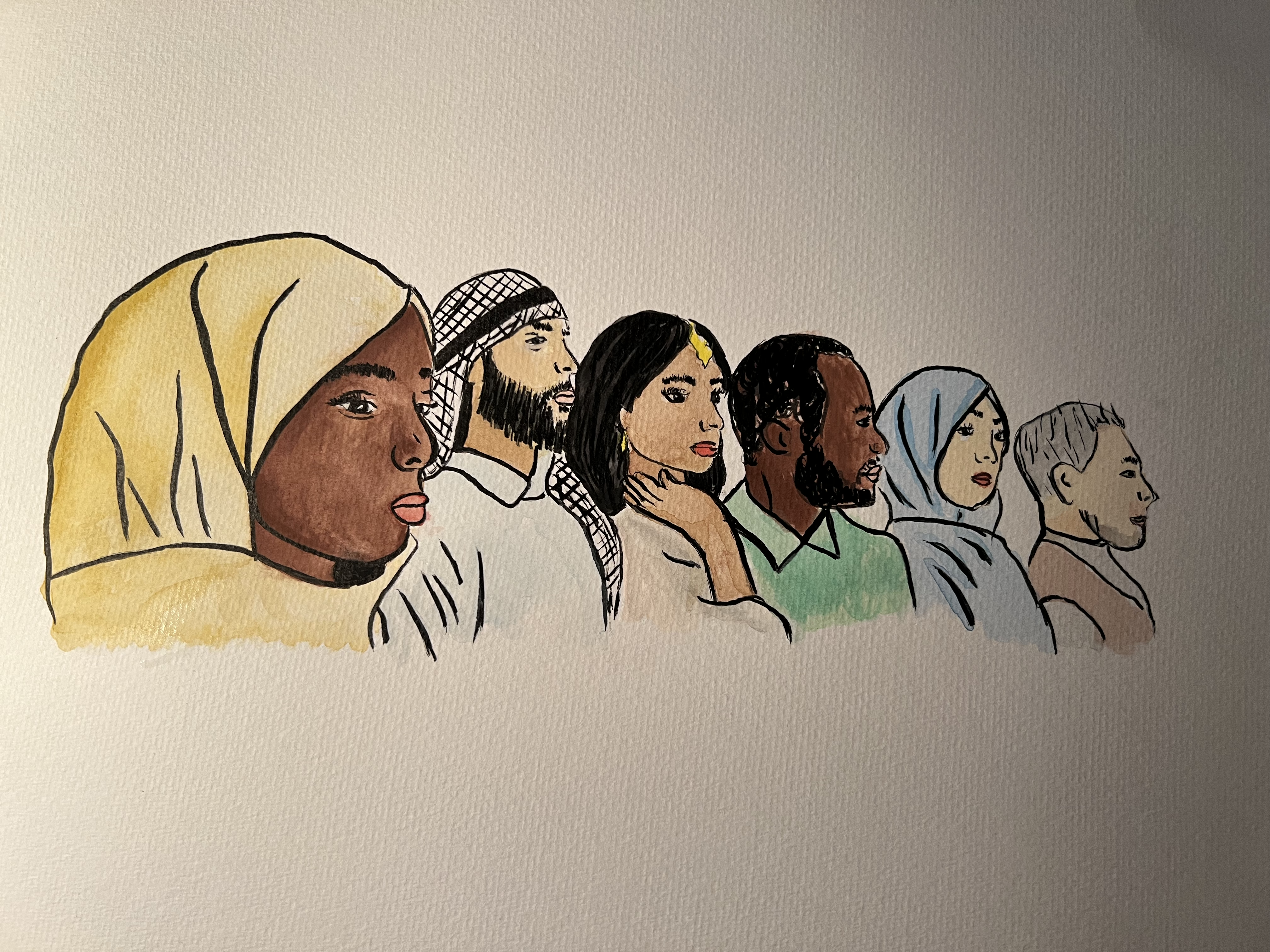
To celebrate this diversity within Islam, I have painted six Muslims with diverse backgrounds, all gazing in the same direction. These Muslims have distinct clothing, skin tones, and ethnic features representing the multitude of practicing Muslims across the world. Some may choose to uphold the common “Muslim” appearance, such as wearing the hijab, while others choose to wear other items of clothing. Clothing also signifies the rich cultural diversity within Islam as regional customs and traditions often influence clothing. For example, the South Asian woman in my painting is wearing South Asian jewelry while the Arab man is wearing the kaffiyeh, which is often associated with Arab culture. Likewise, the varying skin tones within the people in my painting reflect the many races and ethnicities that make up the global Muslim community. I painted the six Muslims standing in unison and gazing in the same direction, symbolizing the shared spiritual journey that Muslims undertake. While each individual may have unique interpretations and experiences of the faith, a sense of unity connects Muslims worldwide.
In addition to my genuine love of painting, I chose paint as the medium for this project because paint is a very versatile tool. Just as paint can be changed or shifted depending on the technique or colors I use, so too can the practice of Islam vary or evolve depending on an individual’s cultural, geographical, political, and ethnic background. Paint can convey complex emotions and ideas through color, form, and texture. Thus, I was incredibly excited to create a vibrant and dynamic representation of the diverse Muslim community, showcasing the beauty of Islam through my artistic expression.
The intended audience for my painting is individuals who regularly use social media platforms. I hope to reach a diverse audience of individuals as many around the world use and are influenced by social media. Furthermore, Islam is often misrepresented in social media, often perpetuating harmful stereotypes that impact the lives of many Muslims. To combat the marginalization many Muslims experience, I hope to showcase the rich diversity of the Muslim community through my painting to provide a source of education and empowerment to those who may be unfamiliar with the religion or have been exposed to negative portrayals of Muslims. By using paint to explore the theme of diversity within Islam, I hope to capture the complex nature of the Islamic faith and promote understanding.
Word count: 454