Anisa Prasad
This calligram explores the role of the bee in the Quran. The 16th chapter is titled The Bee, and it says that God inspired the bee. Bees are God’s miracles – their function and behavior is an example of the presence of God. For instance, the “waggle dance” that bees do to communicate the whereabouts of pollen to other bees is fascinating. Not only does it convey the bearing, allowing an angle to be read and calculated by other bees, but the amount of time the bee spends “waggling” is proportional to the distance to the pollen. The beehive, a neat, orderly tessellation found in nature, and honey, a sweet drink that varies in colors, are also extraordinary. In the Quran, these aspects of bees are considered divine, inspired by God, and a sign of God’s presence.
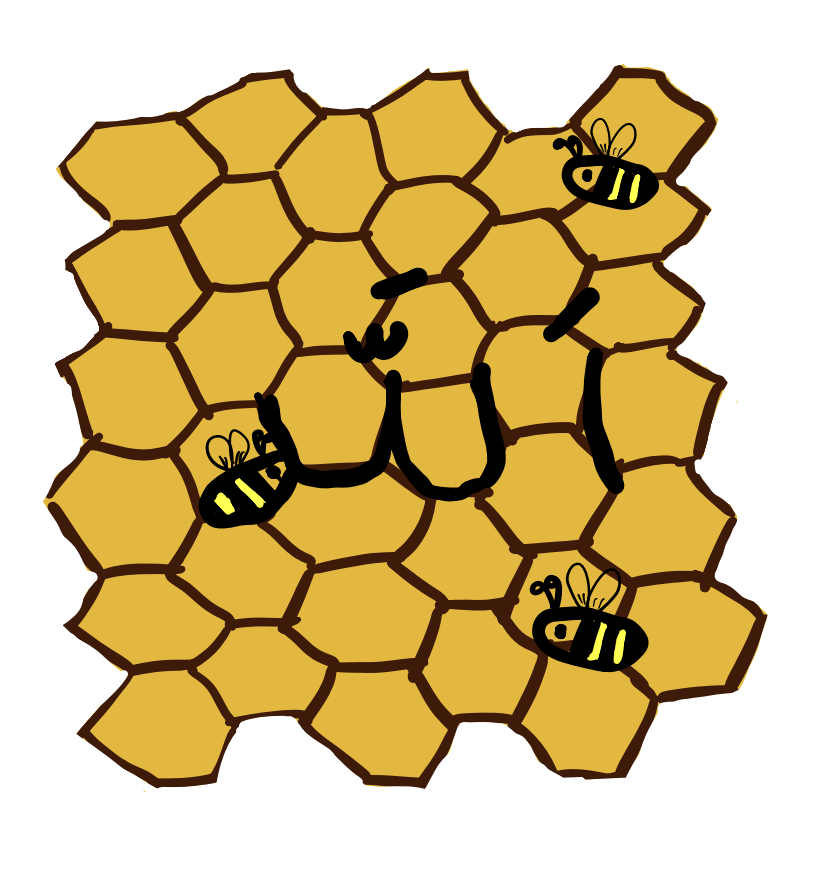
In my calligram, I tried to represent this in multiple ways. The honeycomb represents the neat, orderly tessellation that is found in nature. I tried to blend the “Allah” Arabic script into the beehive, so as to represent the way signs of Allah can be found in bees / beehives. I wrote it in a dark color, similar to the edges of a beehive, to blend it in, but I didn’t make it completely blend in with the beehive. I wanted the “Allah” script to be visible if you were looking for it - the same way that you can find signs of God in nature and in bees if you look for it. I also drew a bee in the last “h,” to represent a dancing bee.
**Fun fact: Bees have either 16 pairs of chromosomes (Queen/workers, female) or 16 single chromosomes (drones, male), and The Bee is the 16th chapter in the Quran!
Final Exam parts B & C:
Part B: New York Times, Op-Ed (point #3 in part A, importance of the cultural studies approach)
I recently read Bapsi Sidhwa’s Cracking India, a spine-chilling tale of mixed-religion friends torn asunder by the Partition of India. Sidhwa opens with an all-too-vivid description of a man's head being cracked open. Shocked by the savage communal violence that filled page after page, I felt compelled to dig deeper. I discovered that this tale of Hindu-Muslim savagery was widespread and uniform: fiction, non-fiction, and film on Partition all echo rape, pillage and plunder—to the near total exclusion of all else.
The scholarly discourse on the Partition of India reads like an epic tale of tragedy. Always written with a capital ‘P,’ the Partition of the subcontinent and subsequent mass migration that accompanied the birth of the new nations was the largest forced migration in human history. Upwards of 12 million people moved across India’s northern borders, Hindus moving southward from Pakistan into India passing Muslims as they headed in the opposite direction. The violence that is typically married to such demographic upheaval was particularly fierce. Sidhwa’s Cracking India recounts the savage immolation of entire families, as fire squads staffed by members of the opposite religion douse burning houses with kerosene instead of water.
I began to wonder why, if this kind of horror was an inescapable part of India’s past, I had never heard it discussed among my immigrant family members. Why was this all so new to me? Were the scars of Partition that must surely have marked my grandfather, who was 10 years old at the time, or my great grandmother, who had been a young woman of 21 years, so painful that they could not bear to discuss them? Or was there another narrative to the forcible division of the British Raj? So began a months-long search for answers on India’s Partition. I read books, watched movies, skyped with my 97-year-old great-grandmother in India, took a two-hour train trip to my 85-year-old uncle’s house, and generally hounded every older Indian I know. I uncovered two partitions: the all-pervasive one, always written with a capital ‘P,’ speaks of brutality at the Indo-Pak borders. The other, lesser-known one, with a little ‘p,’ was lived by the majority of the country, in the central and southern parts of India. This was a calmer, quieter partition, still characterized by a sense of loss: how could any Indian not grieve the missing 400,000 square miles that became Pakistan, along with all the beauty, both human and non-human, contained therein? But farther away from the zones of migration this sense of loss was not expressed in the language of indiscriminate violence. The stories of Indians like my grandfather were not written in blood, but in the footprints of neighborhood kids playing ball, and in their parent’s sighs, laced with the awareness that in another India, Muslim and Hindu children were at war.
Of course, all of this begs the question–why is partition with a little ‘p’ nowhere to be found in the voluminous literature on the topic? The answer, I think, is that we prefer the grotesque version of events; it is more appealing to us, and it suits our vision of the Eastern ‘Other’ more than my grandfather’s narrative. It is in line with, for instance, the depiction of the Indian savage that we see in popular cinema, like Indian Jones and the Temple of Doom, where fictitious Indian villagers appease the gods by ripping the beating heart out of sacrificial victims. This is the stuff of Saidian ‘Orientalism’: it reinforces dangerous stereotypes on the essentially religious and barbaric character of Eastern societies as contrasted to the more scientific and civilized West. And it seems to dwell in both the academic and popular spheres. But we should not succumb to such impulses; we need to speak of both Partition and partition, for one without the other renders the historical record incomplete. Indians lived the P/partition of the subcontinent in multiple and nuanced ways, and we must unpack the diversity of this human experience so that third generation Indian immigrants like myself understand who they are and from where they hail.
Part C:
I chose to write an op-ed for the New York Times, because the media (and the New York Times in particular) is very influential in American discourse surrounding events. Many Americans (and people in other countries, although I’m mainly targeting Americans) read the New York Times at least every week, if not every morning. It’s a very effective way to spread ideas and opinions, and op-eds are pretty widely read. Thus, I chose the New York Times for its reach among the American population.
This piece represents my opinion, so I thought an op-ed would be the best format. It’s a unique perspective on an issue that is not widely talked about, making it an interesting read for the morning paper. My target audience is civically engaged members of the American public, because they are the most likely to have opinions on historical and current events. They report their opinions on TV news shows, form political platforms surrounding their opinions, and formulate American responses to world events based on their opinions. It’s important that they realize the importance of the cultural studies approach because of the larger impacts that they have on American society and culture, which is why they’re my target audience. They also likely read the New York Times!
This piece conveys my third point in A, the importance of using the cultural studies approach to study religion. The cultural studies approach supports studying aspects of religion (such as partition) from multiple perspectives and in multiple contexts. Partition, which represented a divide between two different religious groups, has multiple stories and perspectives, yet mainstream media and literature really only recognize one. My piece highlights another perspective, one that is less “headline worthy,” per se, but is nevertheless needed to complete the story. My piece demonstrates the importance of understanding all perspectives on issues about religion.