Andrew Gordan
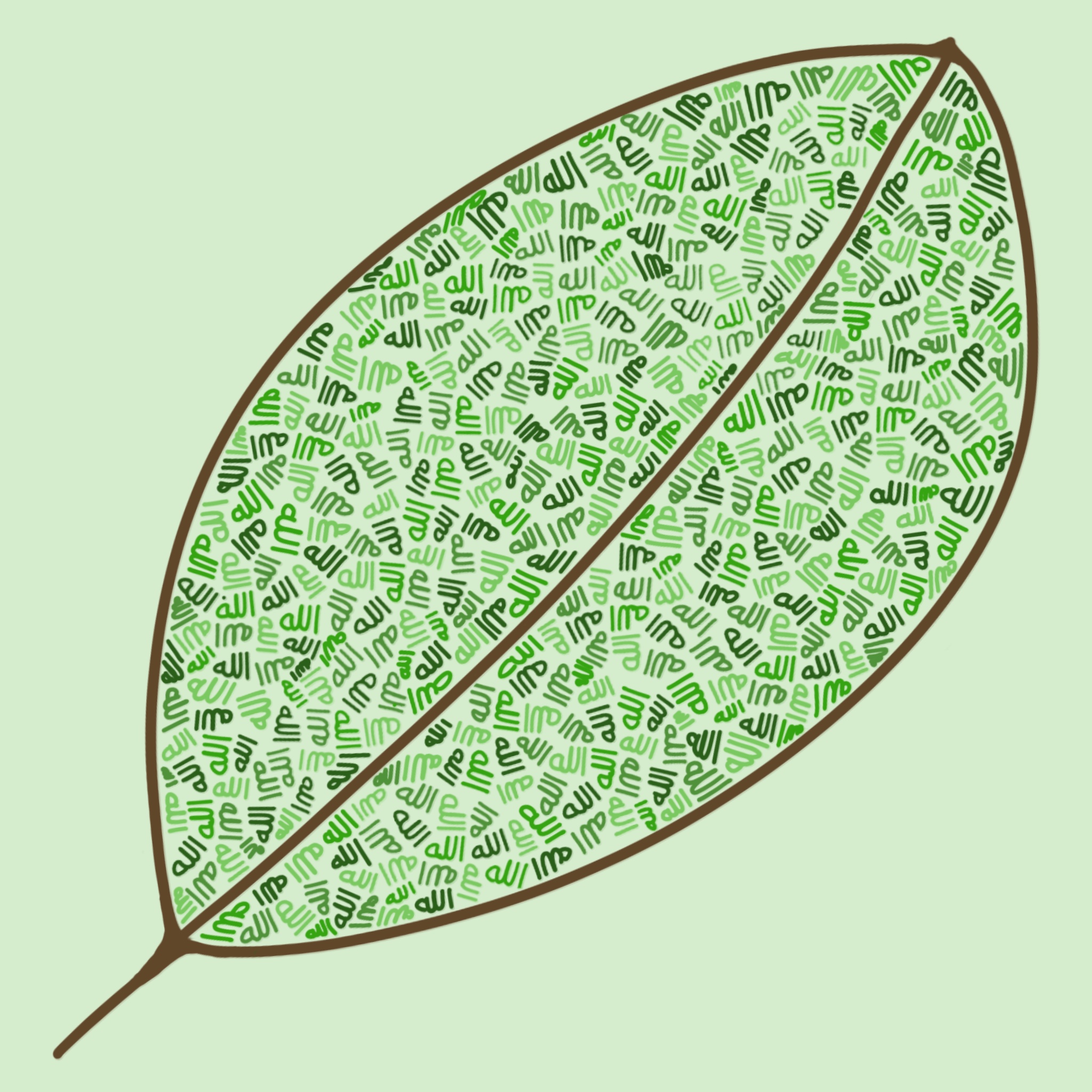
My design is a digital illustration of a single leaf, populated by an arrangement of hundreds of miniature Allah scripts. The design reflects the notion that Allah is found everywhere by demonstrating the apparent presence of Allah in even the smallest segments of a single leaf from the natural world. The design also represents the role of Allah as the creator of nature. On the aesthetic level, the varying color palette and random arrangement of the scripts attempts to convey the beauty, majesty, and complexity of Allah’s creations. The design intentionally challenges observers to focus in and discover the presence of Allah in unexpected locations. Thus, it also seeks to demonstrate the role of Allah as a confounder—and the duty of Muslims to seek him out in themselves and in the world around them.
Final Exam
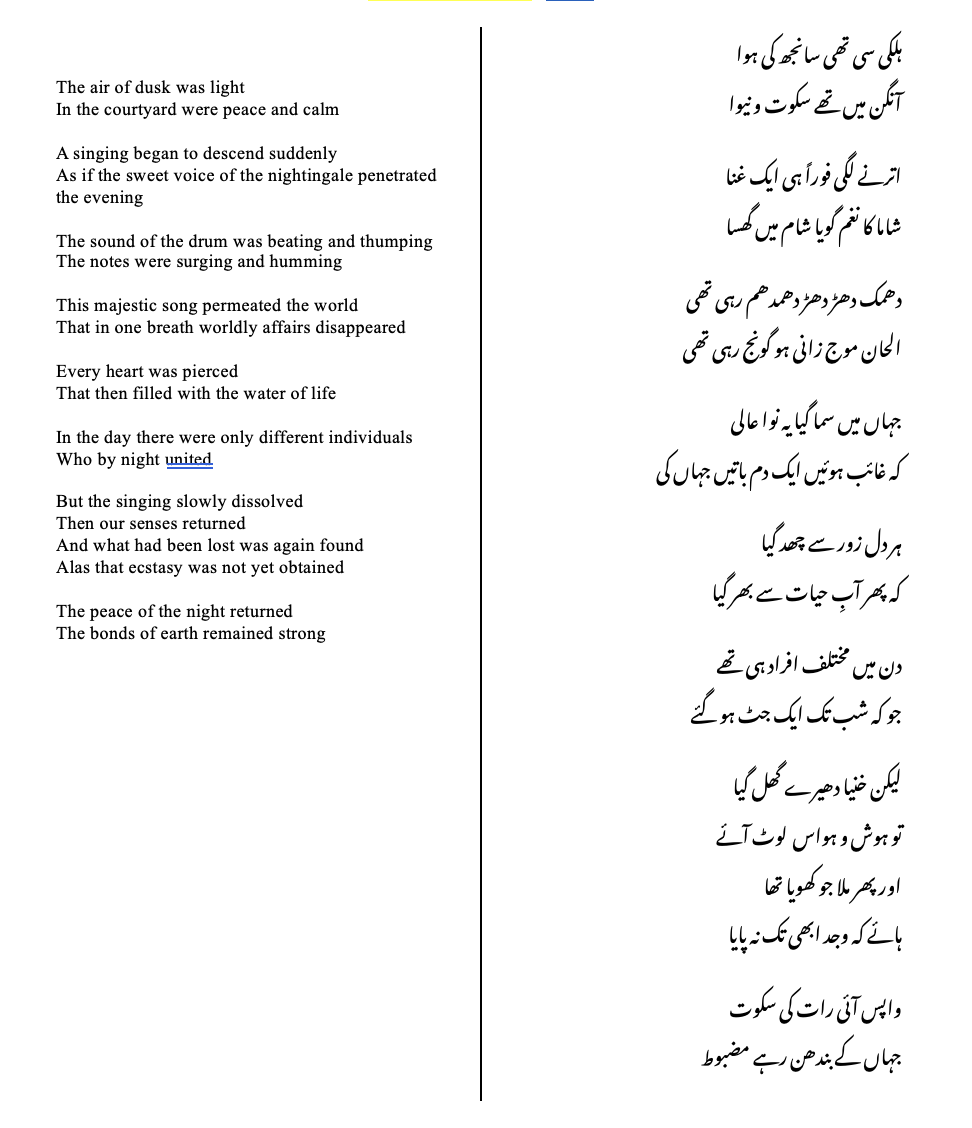
For my piece, I chose the medium of an Urdu poem for several reasons. First, I wanted to draw from my personal experience with qawwali singing in Rajasthan, India, and my interest in Urdu poetry, which is typically full of Islamic themes. I felt that the medium of poetry best captures the intangible experiential elements of listening to qawwali, especially because poetry enables the poet to play with structure, form, and grammar, leaning into rhythm and feeling and away from the rationality and order of a normal prose piece. Furthermore, by also reciting my poem, I hoped to harness the rich oral tradition of Islam, and particularly of the South Asian Islam I have more experience with. In addition, when Adnan led our section in some devotional singing, it reinforced for me the value of hearing and performing to generate a more intense, fulfilling experience.
For my piece, I chose the venue of YouTube for two reasons. First, I really wanted people to hear the poem, not just read it. Even if a reader knows Hindi-Urdu, reading a poem is simply less engaging than listening to it or performing it. Moreover, my audience is the YouTube-watching American public, almost none of whom would know Hindi-Urdu. Thus, the audial component of the recitation spares the audience from merely reading the awkward translation, instead inviting them to enjoy the experience of hearing the poem. I chose this audience—the American public—because I find it incredibly disturbing how Islam is often portrayed in American media, especially on platforms like YouTube, as a universally rigid, rules-based religion. I wanted to help portray a very different side of the Islamic tradition, one less focused on discursive knowledge or bound by scripture but full of the possibility of life and the connection to the divine.
I hoped to do so by representing the concept of ma’rifah in my poem. The poem connects to the notion of ma’rifah, or experiential knowledge, in several ways. First, the subject of the poem is a personal experience with qawwali in Rajasthan—qawwali is an important practice through which to access ma’rifah for many Sufi Muslims in South Asia. Throughout the poem, I attempted to convey the intangible and deeply spiritual qualities of the music and the singing. For example, the rhythm, flow, and substance of lines five and six, in which I discuss the beating of the drums and the surging and humming of the singing, attempts to evoke the deeply personally affecting character of qawwali, the way in which one can become immersed in and enthralled by the performance. I also tried to highlight the way Sufi practitioners use ma’rifah on the path towards wajd (ecstasy) and fana (annihilation of the ego/communion with God), by explicitly mentioning the escape from “worldly affairs” and wajd.