Aseel Rawashdeh
Final Exam:
“O Lord, if I worship you out of fear of hell, burn me in hell. If I worship you out of hope of paradise, forbid it to me. And if I worship you for Your own sake, Do not deprive me of Your eternal beauty.” - Rabia al-Basri
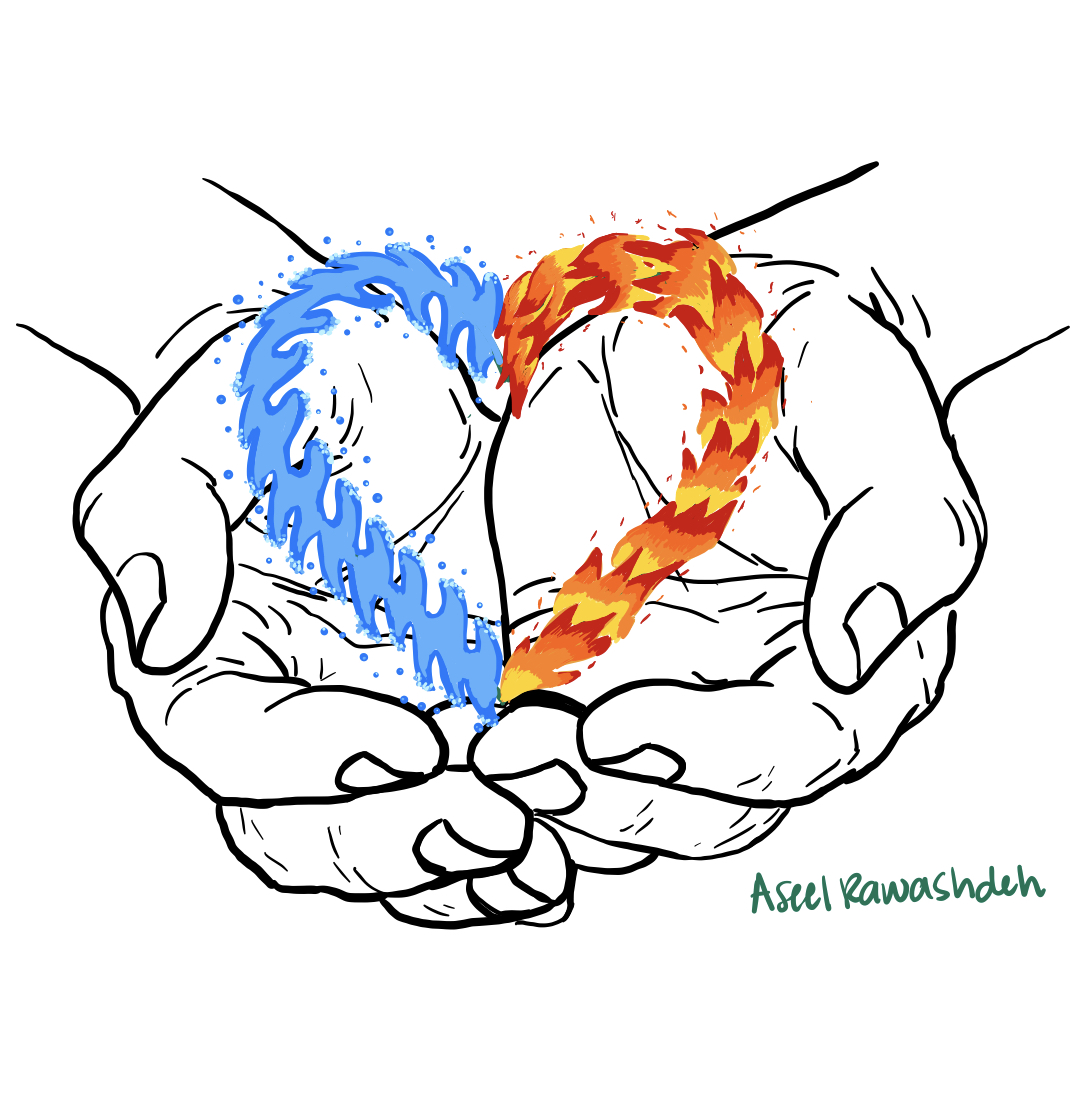
I am choosing to represent my second lesson from Section A. Namely, I chose to represent the dual role of selfless love in Islam. I believe colorful art is the best medium to represent this because art can be interpreted in many ways depending on the person looking at it. Similarly, the expression of love and compassion is also an individual relationship and can come in many different forms depending on the person. My primary audience for this piece is my peers in this course; I would like for this piece to serve as a reminder to treat others with compassion and love, but also to represent, for those who are religious, that your relationship with God should be one of unconditional love and joy. I also believe that the story of Rabia al-Basri (detailed below) is one that we should remember when leaving this course. The secondary audience is the general public because I believe that everyone can benefit from adopting this conception of selfless love.
I chose this particular representation for a few reasons. First, the fire-and-water heart in the middle of the cupped hands is symbolic of the story of Rabia alAdawiyya al-Basri (d. 801) who preached an unconditional love of Allah. According to the most popular account of Rabia’s story, she was once seen walking around the streets of Basra (in present-day Iraq) with a torch in one hand and a bucket of water in the other saying, “I am looking for Paradise so that with this fire I can burn it, and I am also looking for Hell so that with this water I can put out its fires.” When asked why, she responded: “Because people worship God either out of hope (of going to Paradise) or out of fear (of being cast into Hell).” [Asani, 16]. This rationale for worshipping God, in her view, was selfish as it was contingent on an expectation of reward or fear of punishment and was therefore not sincere.
I placed this dual-sided heart of fire and water inside of cupped hands because these hands represent two things: 1) On the one hand (no pun intended), they can symbolize someone raising their hands to make dua’a (supplication or personal invocation; a 'calling upon' Allah) or prayer. In this way, by putting the heart in the center of the hands, this expression of submission of faith to God is framed by a relationship of love guided by the story of Rabia. 2) On the other hand, the hands can also represent extending your compassion to others with open arms. It represents always giving more compassion and love than you take, which is consistent with Rabia’s teachings of unconditional love. Our mercy and compassion should not be dependent on an incentive or avoidance of punishment. This, in my opinion, is a beautiful perspective and will lead to personal fulfillment and happiness as we love for the sake of loving.
Calligram
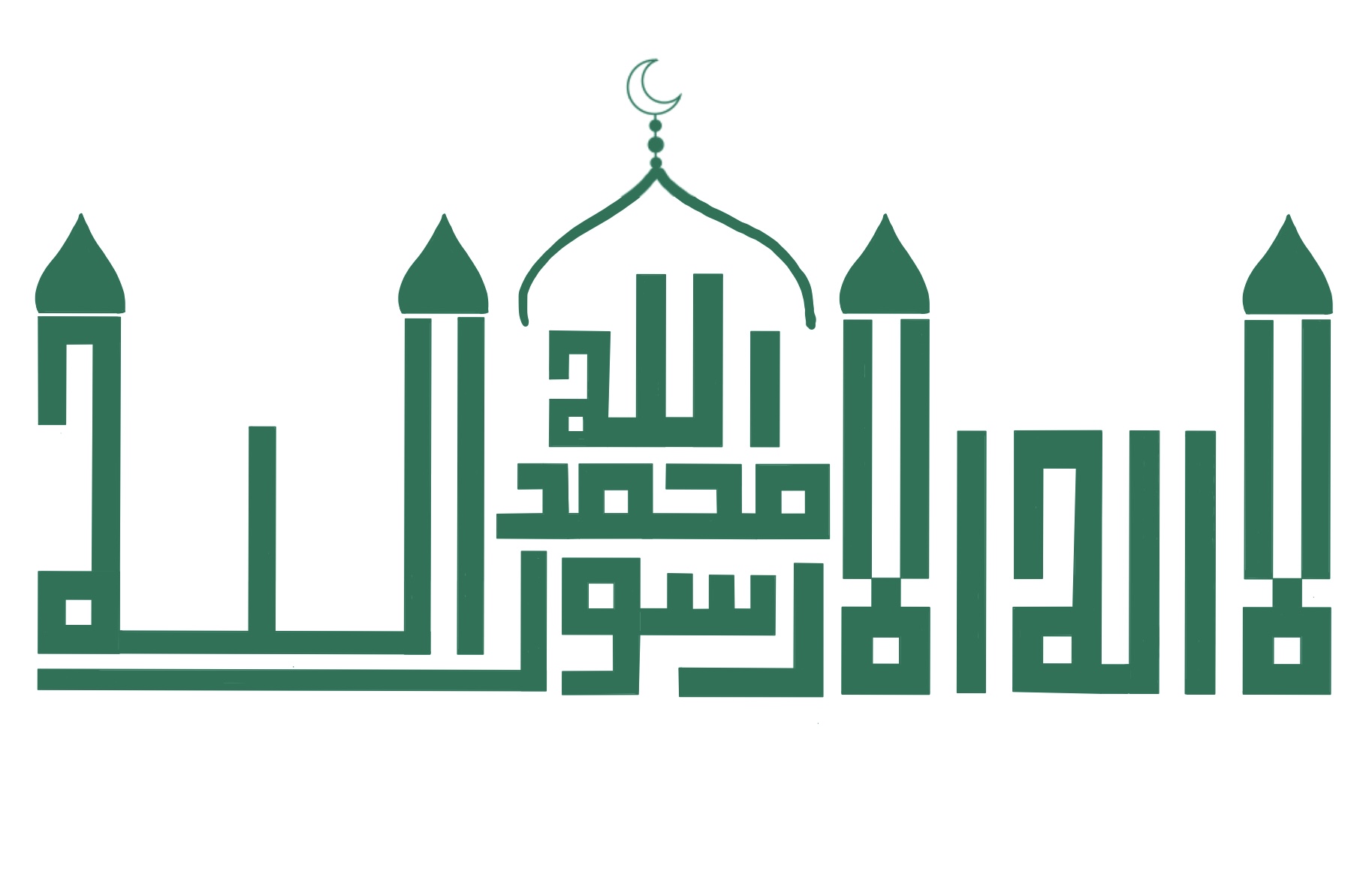
la ilaha illa Allah, Muhammad Rasulu-Allah
“There is no god but Allah, and Muhammad is the messenger of Allah”
In my calligram project design, I chose to represent the shahada (or a derivative of it without the word “ash’hadu”) to make a masjid (mosque) structure. I decided to use the Shahada to do the calligram because I think it is an important phrase that conveys the oneness of Allah. I also specifically chose to illustrate the shahada as a Masjid because it is a part of the Athan, which is the call to prayer that is usually recited from the Masjid. Therefore, having a part of the athan as a representation of the Masjid also represents communal gathering, as the Athan is commonly viewed as being a source of unity among Muslims. In many Muslim countries, when the Athan is called, people put their work down and make their way to the Masjid to pray together. For me, this is one of the most beautiful parts of Islam; the way it brings people from all different backgrounds together several times a day reminds us of the value of love for the community.
I chose the Kufic script because of its block-like lettering which makes it well-suited to create an architectural design like a masjid. For example, I used square-shaped letters to make the columns and the dome. I also chose to make ‘Allah’ the dome as well as one of the largest words in the left half of the masjid to emphasize the centrality and oneness of Allah. I chose the color green as it has become associated with Islam over time. It is supposedly the favorite color of the Prophet Muhammad (SAWS) but it is also associated with nature (such as trees, grass, plants, and other organic life) which is another miracle of Allah. Finally, I chose to add the crescent on the top because it is a common symbol of Islam, as it represents the start of a new month in the Lunar, or Hijri Calendar. The crescent is also cited as a symbol of the greatness of Allah’s creation as well, and it is commonly found in Masjids.