MyeongSeo Kim
First of all, given that traditional Arabic calligraphy mainly uses a reed pen–in reference to The Pen, the first thing Allah created, in the Quran–I decided to use my collection of pens that I used for many years as tools for this project. I was especially inclined to use a marker from Korea that is culturally equivalent to No. 2 pencils in the U.S. It was used to draw the contours.
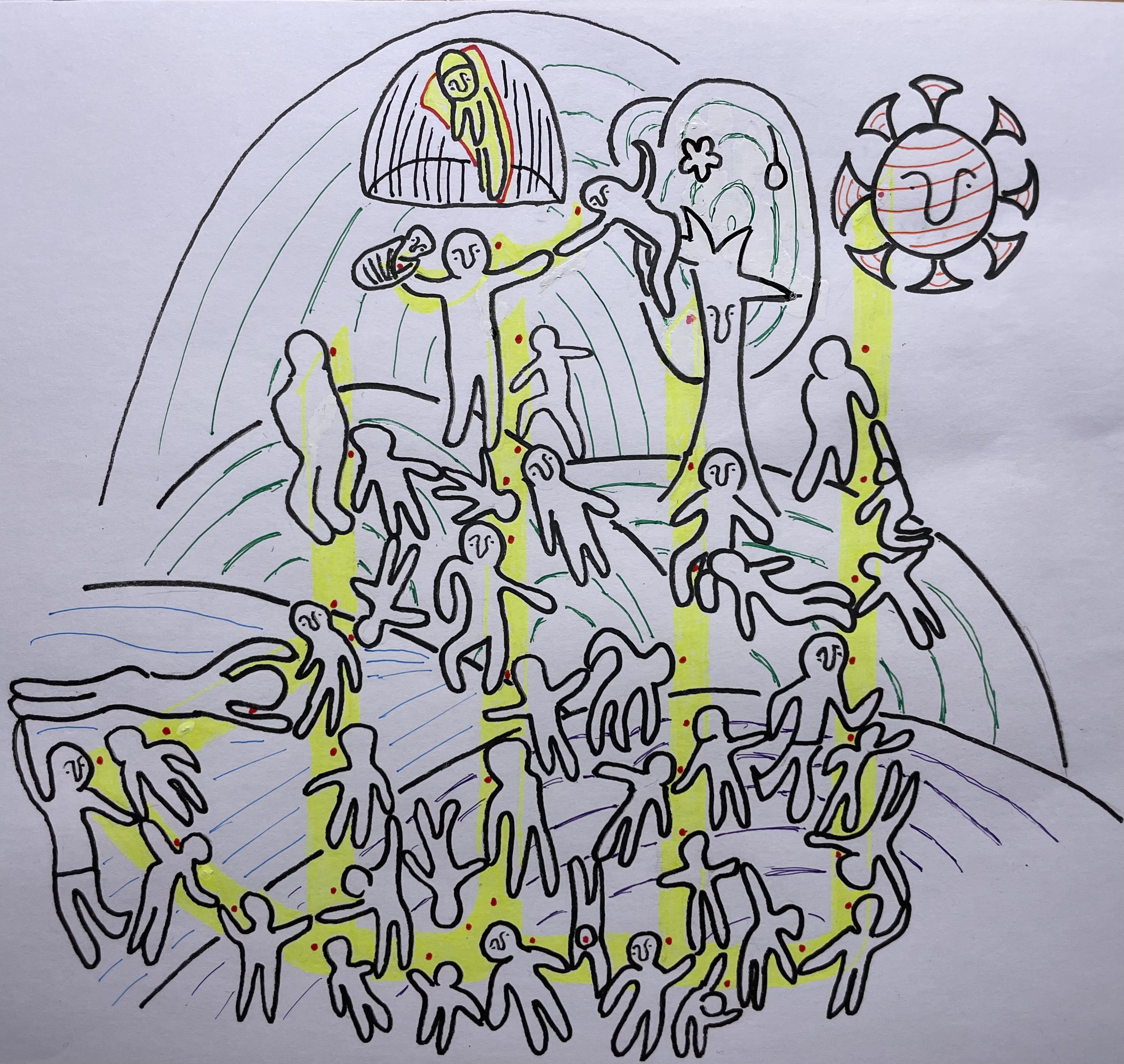
I chose to incorporate the concept of ‘nur’, God as the ‘Light of Heaven and Earth’ into my calligraphy, aided with a drawing of ‘The Prophetic Succession’ scene from “The Mevlid-i Sherif”. In this scene, the poet is telling the story of the Light migrating from a prophet to another until it reaches Muhammad: “From brow to brow, in linked chain unbroken, The Light at last attained its goal, Muhammad.” This visualizes the common Islamic theme of the Light, as in wisdom or knowledge of God, finally being transmitted from God to mankind through Muhammad. It also reminded me of 'isnad', which literally translates to 'chain'. As such, I thought a constellation (i.e. a graph in mathematics) would be a good way to illustrate nodes being connected by a chain of light. I hope it is intuitive in my drawing that the Light stretches from earth and earthly creatures to beyond and that the Light ends at, or equivalently the last stroke of the calligraphy lands at, Muhammad. This is rather trivial, but I was also took the fire halo behind prophets in the paintings we saw and abstracted it into a red dot.
The poet also attempts to list a few of the prophets, but states that there are more than listed: “Adam… Eve… Mustafa… Abraham… Ishmael… My time would fail should all the line be counted.” We learned that the definition of prophets varies, from strictly Muhammad to everyone who demonstrates ‘divinely’ achievement or knowledge, and that not all prophets are written in the Quran.