Fraz Javed
My design is meant to represent Sufi conceptions of God being the sole reality of the world. This claim stems from the following mystical claims: reality is explained and contained in the Quran; the Quran itself is contained in its opening chapter, the Fatiha; and the Fatiha itself can be said to be contained in the first line of the chapter, the bismillah. Taking this a step further, some explain that the bismillah is contained in the ba, the first letter of the statement. In the last step of the claim, it is explained that the ba itself is contained in the dot below the letter.
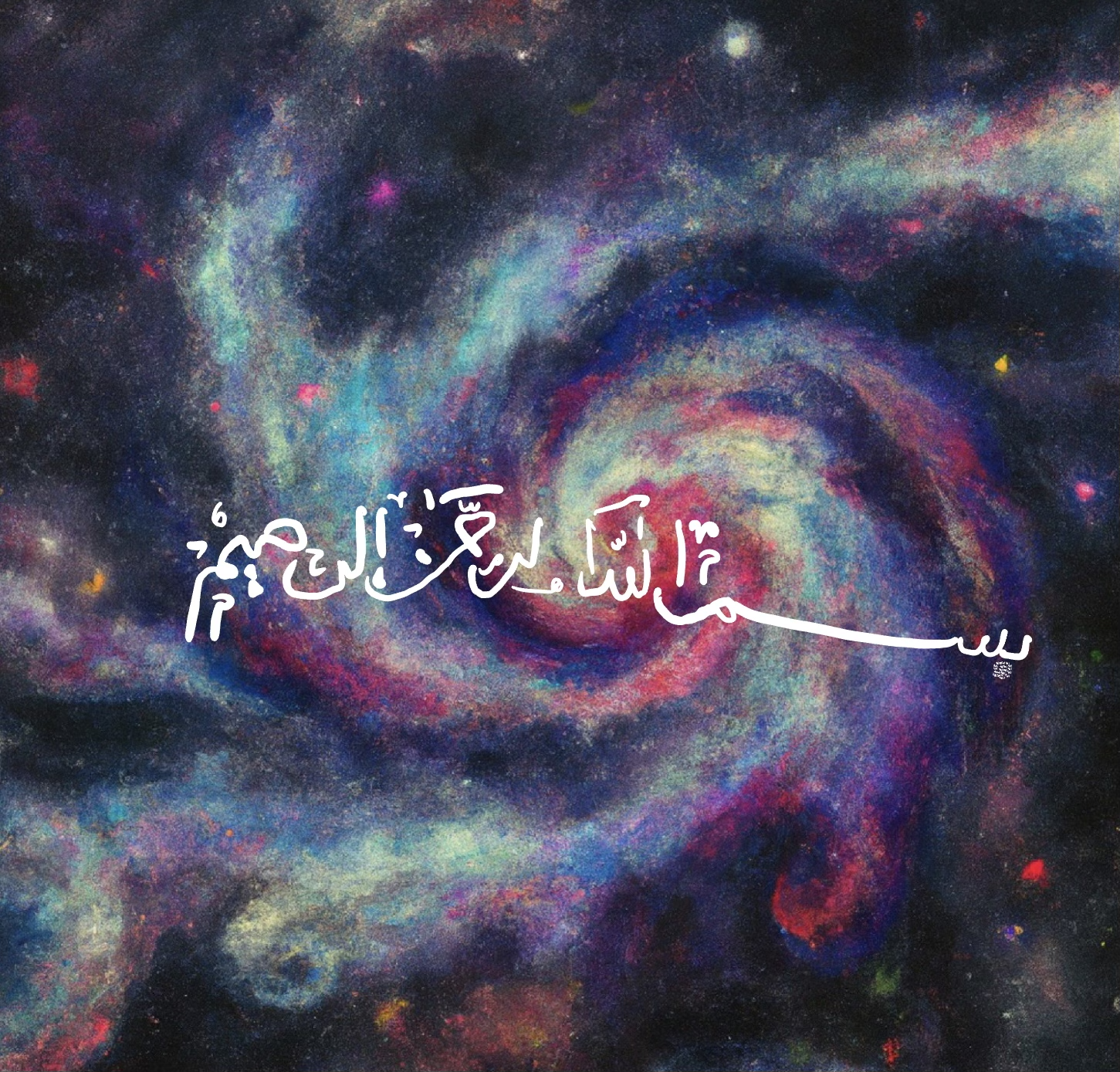
Thus, the dot on the ba metaphorically contains all that is in existence. It is through that dot that the infinite tapestry of the universe is woven, with each thread representing a unique aspect of existence. The Shams al Ma’arif, Perhaps one of the most controversial and nebulous works in the Islamic tradation focused on occult practices, references this tradition. This is to demonstrate how concepts of the unity of God are comprehensively applied to all facets of reality, to the point where God is the only reality.
In my design, I write the bismillah. This is the phrase that starts the Fatiha, which also represents reality. While it may be difficult to see in the picture, the dot below the ba – the very first letter on the right – is filled with Allah in Arabic. This is to demonstrate the dot being reality and God being that very reality. All of this is in the backdrop of a galaxy as a reminder that the universe is constructed through this very dot. The idea is to represent how this world – in all its entirety, beauty, and grandeur – is but a single drop in the ocean of reality.The Wizard Chooses the Wand: an Exploration of how Islam is Wielded as an Ideology
In the media, Islam often plays an antagonizing role with everything that has to do with progress. Muslim countries appear on screens as the sites of gross injustices. The Muslim world appears to be the epicenter of ugliness. More so than begging the question, stories of governments repressing women point to backwardness. After all, these countries we hear about all the time justify their acts through Islam. Yet, the 3.45 million Muslims in the United States are not are not plotting to overthrow the United States – they might even be some of your close friends or coworkers. So what gives?
Enter the world of Harry Potter. Every magic-wielder in that fantasy world knows that the wand chooses the wizard. The all-powerful tool cautiously gives itself up to the user. When it comes to religion, there are no such choosings – the very interpretation of the religion is malleable to a person’s understanding, and when put in the hands of power-hungry polemics, can become politically-charged.
When we consider Islam as an instrument the government wields to impose itself on its citizens, the tales of oppression are better understood through exploitation of beliefs. It is vital to draw distinctions between personal acts of devotions and outward manifestations aimed to serve an ideological movement. C.M. Naim, retired professor at the University of Chicago, explores his personal experiences on how Islamic practice manifests, namely exploring how people conceive that they have the right to critique others on matters of outward expressions of practice.
Naim explores how, growing up, he had been exposed to a practice of Islam that – through his mother, grandmother, and teachers – had been concerned with commitment to faith. He recalls how his Islamic understanding “did not reflect any self-consciousness that was imbued by power and authority.” This attitude encompasses the realm of devotion and humility in practice. It is what nearly all Muslims around the world concern themselves with and what motivates selfless and ascetic practices.
At the same time, Naim writes there is a hyper-represented strand of thought that seeks to justify power structures as part of Islamic practice. This is what is showcased when we hear about terror groups. That is a performative Islam seeking to propagate itself and rule over others. And still, there exists an inner Islam that is an expression of humbleness and charity. By making this distinction, we grasp why the same Islam that brings community members together to fund relief efforts in a flooded Pakistan can also be adulterated into expressions of power: the latter strand of thought touts its possession of the complete Islamic vision, lending credence to itself as the executor of religious expression. This ultimately forces those who practice into conforming to ideology.
The Islam being discussed in the media is of a particular brand and view. Beyond the importance of recognizing this for navigating international policy-making, ignoring complexities will only result in peddling those authoritarian brands of Islamic thought that will ultimately harm the majority who are concerned with individual practice.
Putting the religion in the hands of an all-powerful entity, as is done when religion is exclusively in the hands of the state, is also contrary to the spirit of historical Muslim traditions. Pluralism flourished in the rich histories of Muslim civilizations for about eight centuries. Interpretations of Islam were understood to be subjective, and scholars agreed true knowledge was possessed only by the Almighty. Therefore, there was no uniform opinion on matters related to normative practice. Gokalp, in his discussion of the Islamic order stresses that while caliphs represented the Musilm world, scholars were not bound by their whims on matters of judicial decisions (196). In fact, he explores how multiple schools of thought existed and were each considered legitimate for centuries under the same rulers (196).
The ideological conception of Islam, in its agenda-driven state, sees the religion as a monolith to be exploited. Histographing the fall from a plurality of understanding to the modern, religiously authoritarian Muslim nation-state brings light to this phenomenon. Failing to understand the complexity of religious interpretation will only continue to prop up the fringe groups who hijack the religion, casting spells of their choosing over powerless citizens.
Section C
For Section B. I decided to discuss the differences between Islam as an ideology and Islam as a practice. I feel that this was an extremely important discussion that is central to religious literacy and also summarizes the purpose of the class. I chose to write an op-ed style because I thought this would best allow me to organize and express my thoughts. The op-ed style also allows me to freely discuss the narrative I am wanting to explore and draw connections to pop culture, which I do when explaining religion through Harry Potter. My goal was to explore the idea of religious literacy through something that would be more relatable to my audience. Given the complexity of religious literacy, I felt this setting was vital for my presentation to ensure that I was able to properly articulate my points. I also felt that the more relaxed tone that is afforded to op-eds better suits my audience, who I imagined to be people living in the United States who have not taken this class and are not familiar with religious literacy. I imagined my audience to have heard of Islam from outlets in the West, so they would generally associate the religion with a negative or skeptical connotation. I also imagined readers who were from this group but also had Muslim friends/colleagues, which is a group that I would classify as confused about Islam. They might have consumed media that showcases the atrocities existing in the Muslim world, but they also have amicable relationships with Muslims in their personal experiences. I wanted to address this group of people because I feel that this group is most curious about Islam while being most susceptible to generalization from religious illiteracy. This piece was meant to explore the difference between the terror groups they see in the media and the friends they may have who are Muslim. I allude to this in my title and discussion of Harry Potter. In Harry Potter, the saying goes that the wand chooses the wizard, but I went with an inversion of this in my title because I feel religious interpretations can very easily be twisted by those in power to serve their agendas. My piece represents the idea I highlighted about there being two Islams – one as a practice and another as a tool for ulterior means – and I believe I was able to expand on this point from section A by providing an example that is much more accessible to people outside of academic settings. I also attempted to explore the diversity of thought that existed before nation-states to better underscore my point that Islam cannot be treated as a monolith historically.