Vinson Martin
CALLIGRAM PROJECT
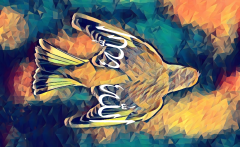
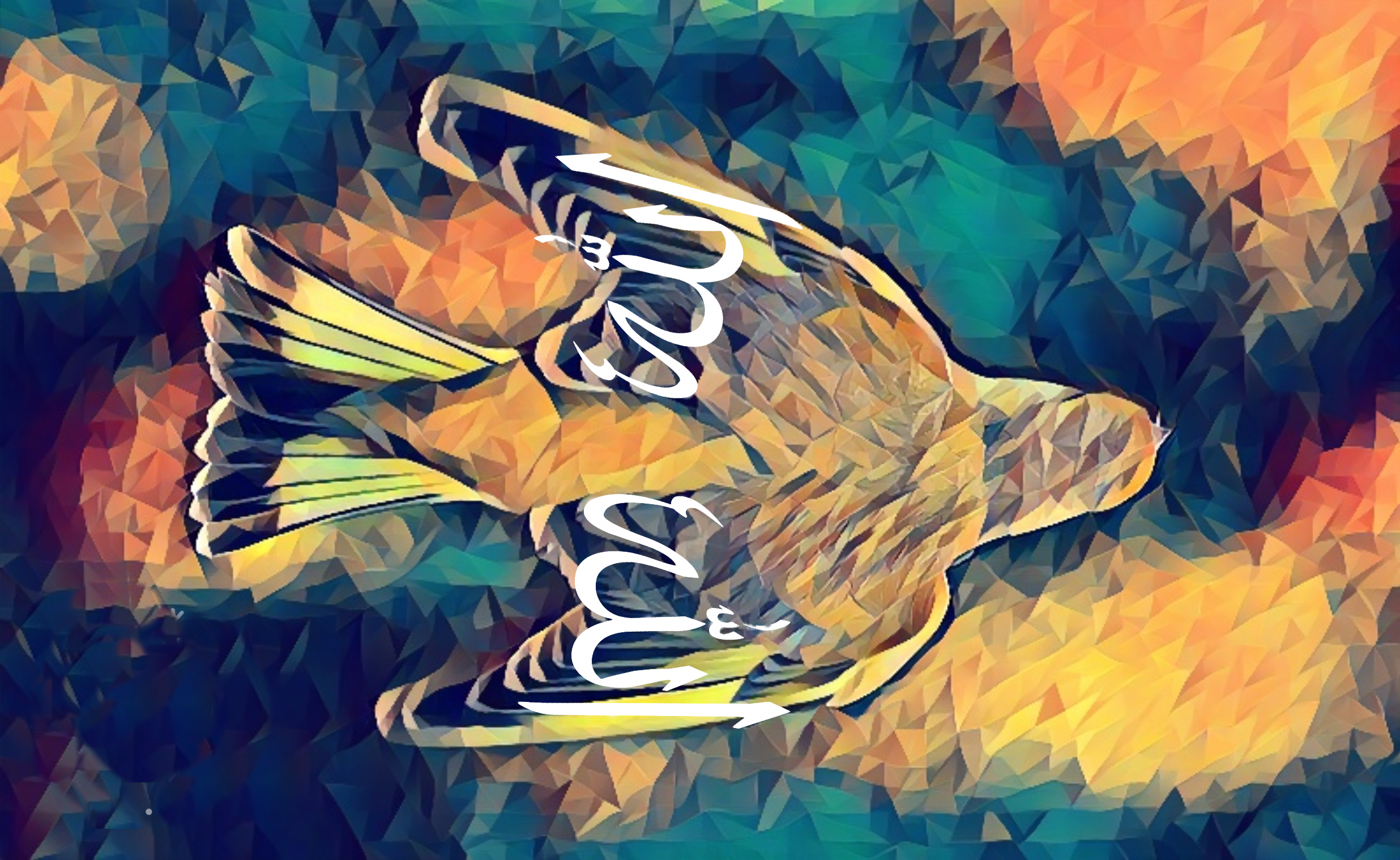
For my calligram project, I chose to create an image of a bird with the calligraphy of Allah (الله) inscribed on its wings. Growing up, my family and I would visit our cousins on their potato farm in Washington State every summer. My earliest memories are of playing hide and seek in the hay barn and my excitement when the tiny barn swallows danced around me. This is why I chose the small bird to signify the power of Allah. Allah's greatest gift is life, and nothing feels more alive than the swirling birds in that barn. Much like the whirling dervishes, their dance feels hypnotic and pious.
In creating this image, I used photoshop to make an abstract and colorful drawing of an image of a small bird I found online. For the colors, I chose a blend of orange and teal, colors on opposite ends of the color wheel, signifying Allah's beauty and presence everywhere one looks. I then photoshopped the calligraphy to appear as though the letters made up the bird's wing feathers, as Allah is not separate but entwined in everything we perceive.
In the image itself, I purposefully chose to place the word Allah on the top of the bird's wings. In flight, humans predominantly gaze upon birds from below. In this way, the bird becomes a symbol for the ideas of Zahir, or apparent meaning, and Batin, or esoteric meaning. If a mortal were to look upon this bird in flight, he would be unaware of its message. Only someone who stands on the mountains of knowledge and piety could look down at the bird's wings and see its true beauty.
Image
FINAL PROJECT
Youtube Link
For my message, I decided to create a short video highlighting Quranic verses that focus on the beauty of nature and the role that Allah plays in creating that beauty as a mirror of his own Jamal. I found 11 Quranic verses and their recitations and overlaid the audio with my favorite nature videos I have taken over the last few years. My first thought was to use my photography, but I decided that video was a much closer representation of nature’s true beauty, and therefore Allah’s true creation. On top of the audio of the recitations, I decided to include a selection of a dhol recorded at the shrine of the medieval mystic Madho Lal Husain in Lahore, Pakistan (Pakistani Soul Music). The drum player Pappu Sain says he “sees the "face" of the Prophet and his spiritual guide” when he plays his music. The selection would be experienced by young men “dancing themselves into ecstasy” (Canvas Media). The dhol captured exactly what I was trying to convey through the video, an ecstasy within Allah’s creation of nature.
At first, I planned for my audience to be non-Muslim Westerners as this subgroup would likely know the least about Islam and nature. However, upon researching nature in the holy books, I found that there are a plethora of websites dedicated to educating Muslims about their duty in protecting God’s world through environmentalism. For instance, one article states that, “Muslims are taught that ‘greater indeed than the creation of man is the creation of the heavens and the earth’. The reality is that nothing could be more Islamic than protecting God’s most precious creation: the earth” (Ozdemir). Both Muslims and non-Muslims can benefit from learning about the Islamic mandated dedication to serving as protectors of the natural world.
In choosing the video clips for each section of the video, I tried to employ captured moments in which I felt a force greater than myself, whether that force be the beauty of a sunset, a puma walking through my campsite, or the power of a wave barreling over my head. I am not Muslim, but in making this video, I remembered a quote from a video we watched early in the semester about who is a Muslim: “According to my father, a Muslim is any person who surrenders to a force greater than themself” (Ali et al). According to this definition, we are all Muslims. We all ultimately surrender to the power of nature.
As I finished the video, I thought back to one of the first days of class, when Professor Asani showed us “Muhammad Walks” a rap song by Lupe Fiasco. “Don’t think Osama and Saddam is Our leader” (Fiasco). When many people think of Quranic recitation, unfortunately their minds go to ISIS videos or negative politically derived imagery. With my video, I hoped to provide a voice to Arkoun’s “silenced” Islam, a voice that is more representative of the qualities and practices of the Holy Quran.