Bobby Degeratu
Calligram Project:
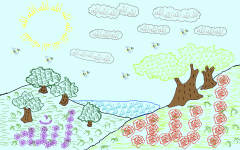
My calligram project contains a basic nature scene with one change: all major features–the sun’s rays, the trees’ leaves, and the blooming flowers–are constructed with the word Allah in Arabic. This design was inspired by our discussion in Week 2, and the Quranic idea that God’s presence is everywhere: “to God belongs the East and the West, so wherever you turn, there will be the face of God” (2:115). Since there is no conceivable depiction of God’s face, the closest association in my calligram is the recurrence of the word Allah.
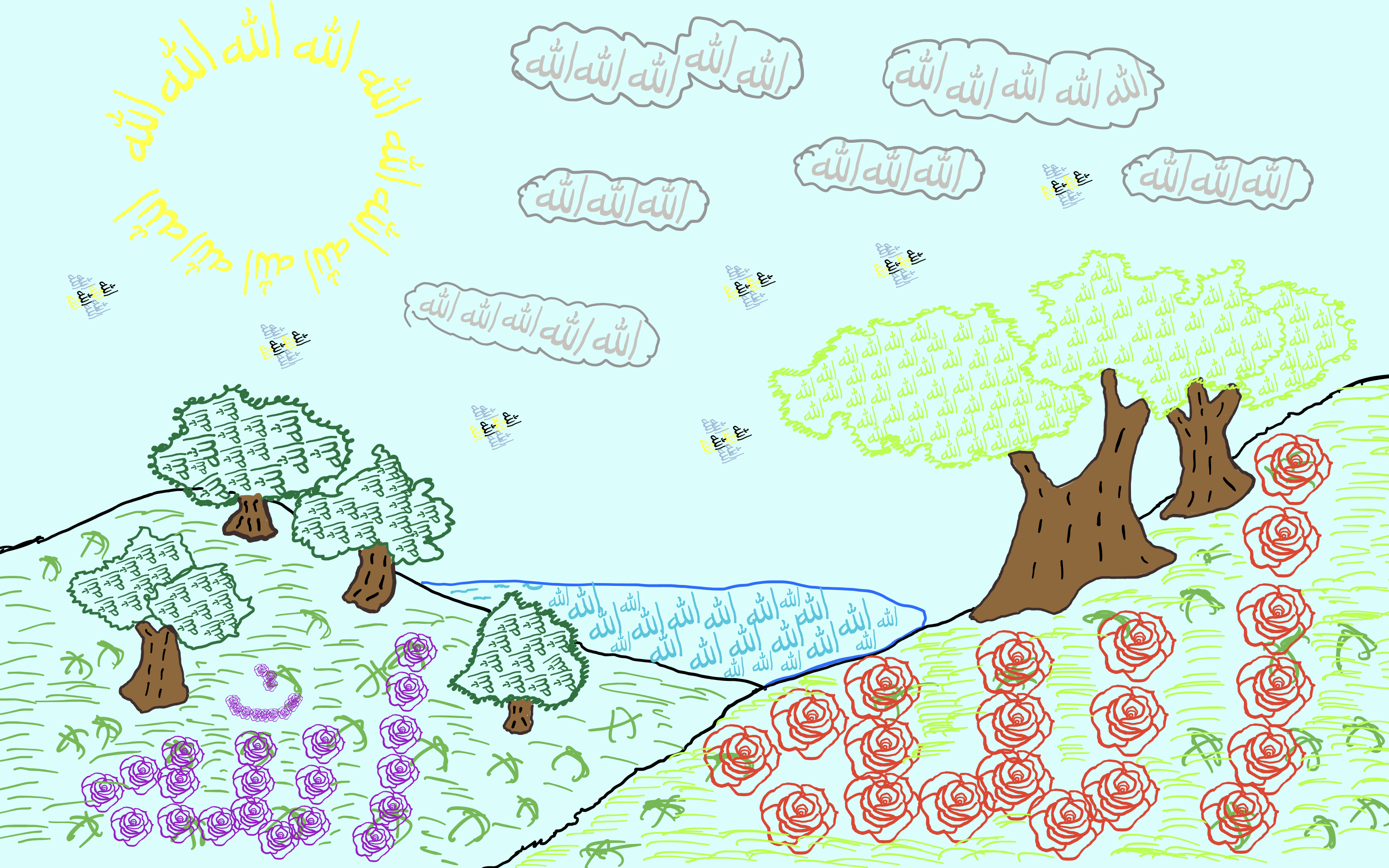
My depiction also highlights a related concept, which is the possibility of not seeing God with the “right eye.” From afar, it might just look like I drew a typical hill and some trees, but upon closer inspection, an observer can distinguish the repetition of Allah. As attributed to Sa’adi in Week 4, “every leaf of the tree becomes a page of the sacred scripture once the soul has learned to read.” I tried to reflect this idea: Allah is everywhere in my drawing (as he is for Muslims) but only if you look carefully and meaningfully.
I also included subtler hints to some major themes we have discussed in class. For example, I did not just draw objects using the word Allah, but also one animal in particular: bees. This was inspired by Quran verse 16:68-69, which explained how Allah inspired bees to build houses in the mountains–a sign of His involvement in creation that I did not want to omit. Furthermore, every appearance of Allah in my creation is somewhat different, whether in color or size, to emphasize a central idea of the cultural studies approach. Belief in Allah, just like adherence to any major figure or religion, is never exactly the same between people.Final Exam, Section B
Overcoming Superficial Thinking - A Speech
No, jihad does not mean terrorism.
In the early 2010s, Americans expressed concerns that undercover jihadis would take over and institute Islamic sharia law. During Trump’s presidency, he stoked fear in the public by warning about “radical Islamic terrorism,” banning travel from multiple Muslim-majority countries. His National Security Advisor called Islam a “malignant cancer,” while his senior adviser called Islam “the most radical religion in the world.” These comments are not novel Islamophobic discourse, but coincided with a surge in hate crimes and stereotyping of Muslims. Growing up in a public school system where talking about religion was taboo, kids often made crude jokes about “jihadis” and Muslims acting on behalf of the Islamic State. No one was there to correct them; despite our rigorous International Baccalaureate curriculum, the focus was on solving math problems or submitting the next paper on time.
So let’s take a step back and realize how surface-level thinking and preconceptions can keep us from a more complete truth.
The problem starts with buying into a one-sided history. Certainly, jihad has been used as a rationale in violent contexts. During the 16th century, the Ottoman Empire, driven by the notion of jihad, expanded their reach across Europe and Africa through military conquest. Across the 18th century in west Africa, jihads were also proclaimed against non-Muslim elites, leading to numerous military conquests that established Islamic states. Wahhabi thinkers–who advanced a literalist and conservative view of Islam–even considered the 9/11 attacks part of a “righteous jihad against the West.”
However, many forget that the US was complicit in launching a violent jihad of its own. During the Cold War, the CIA helped recruit fighters from Egypt, Saudi Arabia, and Algeria to fight the Soviet Union: an anti-Soviet jihad that laid the foundation for contemporary extremist movements in countries like Indonesia. Across the late 20th century, the CIA–in collaboration with countries Pakistan and Iran–facilitated training and arms to the Afghan mujahidin, planting the seeds for future terrorist activity. With this context, jihad is no longer such a foreign phenomenon, nor one exclusively linked to the Muslim community.
For those who may have been taught that jihad means “holy war,” the media’s use of eye-catching headlines like “Islamic Jihad threatens Israel” or even “We Must Declare Jihad Against AI” perpetuate a negative connotation that fails to tell the full story. Like many ideas in Islam, jihad does not have a singular definition. Conflicts tell part of the story, but jihad can also refer to an inner struggle against greed and jealousy. It can be used to describe the struggle to promote state development in the face of poverty, as in Tunisia. It could refer to one’s duties to their community, or even more routine struggles like getting to class on time. By not talking about these possibilities more, we fail to dismantle the wider notion that jihad has to mean something bad.
Aside from advancing harmful stereotypes about Muslims, an overly rigid understanding of jihad suffocates some of the real struggles that the community faces. For starters, writers like Asma Gull Hassan have proposed the idea of a “gender jihad” to free Islam from its patriarchal roots and fight back against sexism. LGBTQ Muslims have also perceived the social stigma they are faced with as a jihad: a personal struggle.The goal is not to be dismissive of violent acts that are sometimes committed in the name of religion, but making that the only way to think about concepts like jihad fosters a worldview void of nuance.
The best way to rectify the tunnel vision that has plagued our understanding of Islamic tenets like jihad is to educate yourself. Whether this means fact-checking what you see online, engaging in dialogue with others, or taking courses that foster religious and cultural awareness, even the smallest action can have a major impact on policy, on popular discourse, and on the world.
If we put in the effort to understand that jihad does not mean violence, more awakenings will follow. Suddenly, Allahu Akbar goes from a threat to a marker of gratitude. Allah goes from the “Muslim God” to the same being that Christians and Jews–as righteous people–also worship. And the understanding of a Muslim is elevated beyond “someone who follows the 5 Pillars” to someone for whom practicing can look a myriad of ways, whether they wear a hijab, fast for Ramadan, or believe in the coming of the Twelfth Imam. I hope that you will do your part to dispel misconceptions and overgeneralizations one step at a time, so that we may enjoy a more unified and tolerant world. Inshallah.
Final Exam, Section C
For Section B, I wrote a speech titled “Overcoming Superficial Thinking,” to discuss the implications of understanding jihad as only a negative concept. As an avid writer, I felt this medium was most appropriate to highlight my passion for writing and articulate some of the most important takeaways from this course. I find other modes of expression like drawing to have strong merits, but I did not believe I could encompass the significance of my message in any other way other than through words. While I could have performed this speech, leaving it as a transcript offers each individual the opportunity to bring their own tone and inflection while bringing the words to life.
I imagine that I would give this speech to a room of students with little knowledge about Islam, much like the state I was in this past January. The speech packages my intellectual journey in this course in a few hundred words, and was inspired by just how much of a different outlook I have on studying Islam now. By making the speech easily digestible and addressing it to students, I feel like I am targeting the very institution that is void of proper religious teaching: schools. By targeting college-age students, I can assume that their maturity will make the message resonate more, while also being early enough in their lives to inform their future studies. A “by students, for students” approach makes the intention more genuine and would eliminate any notions of indoctrination, especially as a white, Christian male.
While my speech is rooted in unpacking the concept of jihad–showing there are multiple modes of interpretation–it ends on a big picture note that encourages listeners to consider other unfamiliar concepts with an open mind. The decision to focus on jihad was a personal one, coming out of preconceptions that people who I grew up around had, but also my own assumption that it was inextricably bound to terrorism and violence. By showing ways to illuminate one’s understanding of a single concept, like reviewing the history and thinking about people’s personal interpretations, I hope to leave a blueprint for individuals to apply those good practices in other situations. The evidence I weaved into my argument came from many course readings that touched on how jihad has been reinterpreted and co-opted, while my call to action–educating oneself–was inspired entirely by the cultural studies approach. Stringing together these two elements with my own prose, which I wanted to keep clear yet convincing, I aimed to create something that could change minds and push an audience towards thinking critically about religion. By taking the advice I included in my speech, I feel like I have become more educated about Islam as an ideology, and as a concept that varies wildly in different local and historical contexts. Thus, I hope an audience could get an abbreviated version of that same realization, and use it to correct others, fight back against malicious discourse, and potentially save lives in their communities.