Samuel Ho
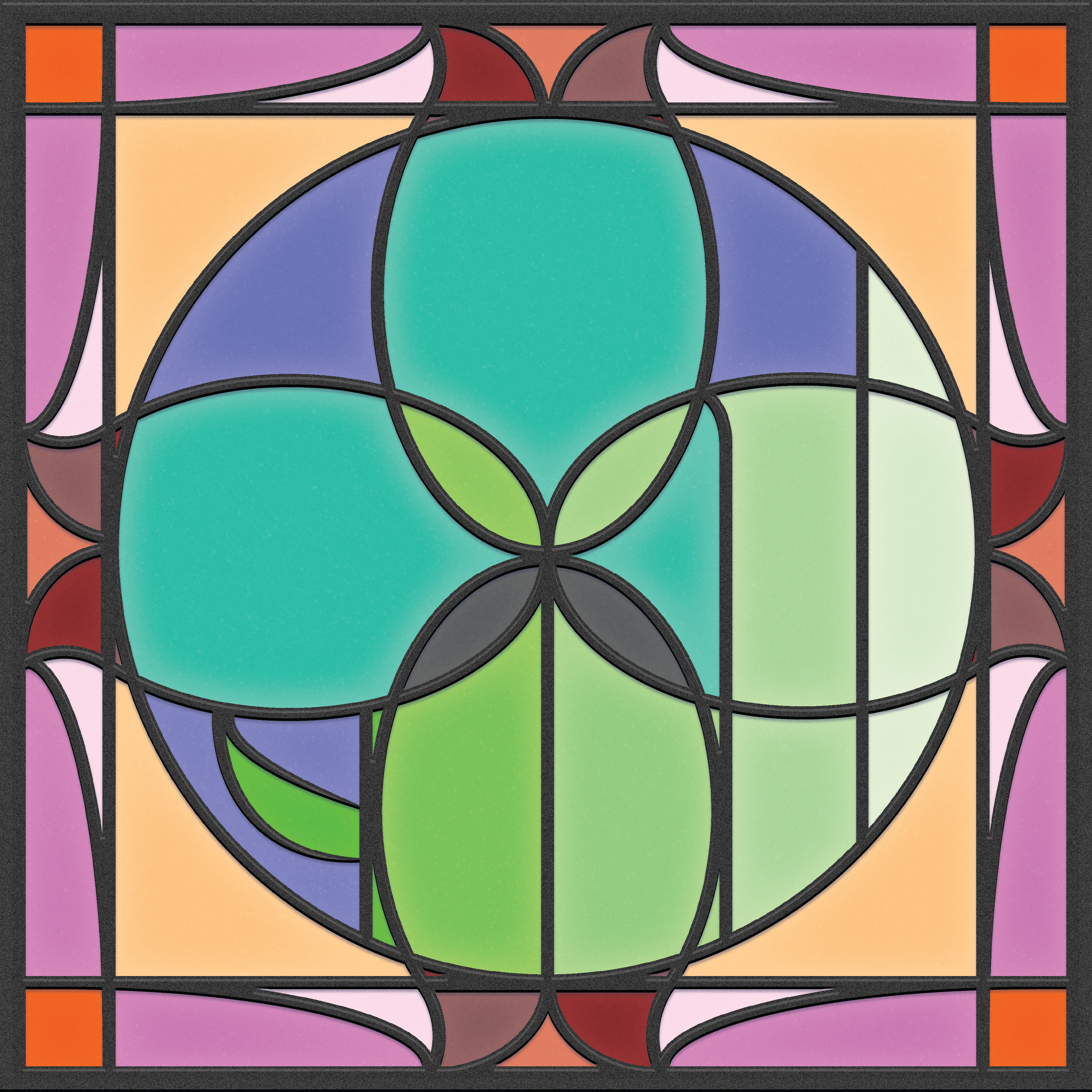
This calligram of Allah was designed in the style of stained glass: a medium which has been used to great effect across the Muslim world, from the Masjed-e Nasir ol-Molk in Shiraz, Iran, to the Büyük Çamlıca Camii in Istanbul, Turkey. When light shines through stained glass, it is an awe-inspiring experience, and is a perfect metaphor for the duality of jalal/jamal: of majesty and beauty. The light from the sun reflects a phenomenal power of such grandeur and extremities beyond our human understanding (and about which we can only attempt to speak of theoretically, but cannot possibly attest to a personal experience); yet when it is filtered through the stained glass, it is turned into a mosaic of beautiful colors reflected upon the ground. So too, is Allah simultaneously majestic beyond human understanding and possessing a compelling and stunning beauty.
In this manner, the window frame represents the frame of the Qur’an and the ways of the Prophet Muhammad which guide Muslims in their adherence to the majesty of God’s light.
Firstly, the calligram of Allah is centered in the frame, reminding Muslims of the centrality and oneness of God. Nonetheless, it is not immediately apparent, and the observer must isolate the word Allah from the rest of the patterns, reflecting the practice of interpretation and search for inner meaning.
Secondly, while all of the other patterns have a circular/elliptical form, and flow from edge to edge, the writing of Allah are some of the only straight lines that cut across the symmetry of the underlying patterns. This reflects the righteousness of Allah that surpasses human design, and of how humans can only approach perfectness by following and submitting to Allah.