Rohan Rajeev
I chose to represent the calligram of Allah through music. Music resonates with me on a deeply personal level, and I also believe that Islam has a strong history that is intertwined with music, as the Qur’an is not merely a text but passed down through oral recitation and interpretation.
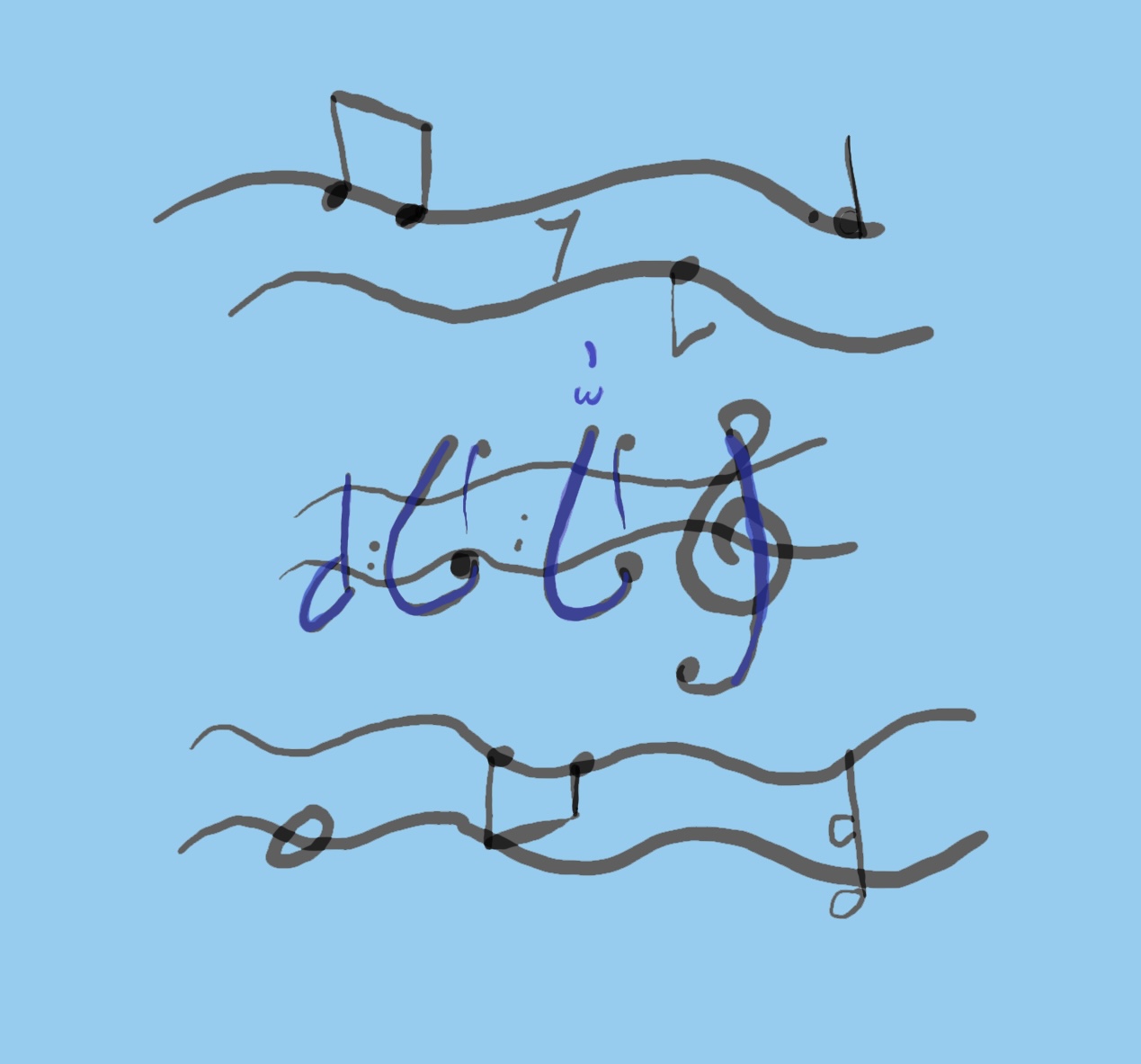
In the middle two bars is my actual calligram of ‘Allah.’ The theme for my work is Tawhid—the oneness of God and reality, and this is represented on several levels in my work. There are many names of Allah, and the collection of musical notes and symbols represents the various manifestations of God. For example, two seemingly opposite symbols representing higher notes and lower notes, the treble and bass clefs, respectively, are equally important figures in the calligram because without them the calligram of Allah would be incomplete. Similarly, God is an entity that is both beautiful as well as held to be feared—seemingly contradictory ideals but nonetheless in coexistence.
The writing of Allah is meant to be subtle, and might be missed without the dark blue overlay that I’ve highlighted it with. This was purposeful, as it was meant to demonstrate that in the grand scheme of the work (which includes the bars below and above the actual calligram), God makes Himself known in subtle ways, but if sought out diligently, can be found. The overall flow of musical notes is meant to represent the grand scheme of space/time that God makes Himself known through. There is no clear beginning or end to this “piece,” but the presence of God in the story that the piece tells is undeniable. Disparate parts of musical brilliance come together and represent the oneness of reality—thus, music is a way for us to access God and understand this reality.