Hamaad Mehal
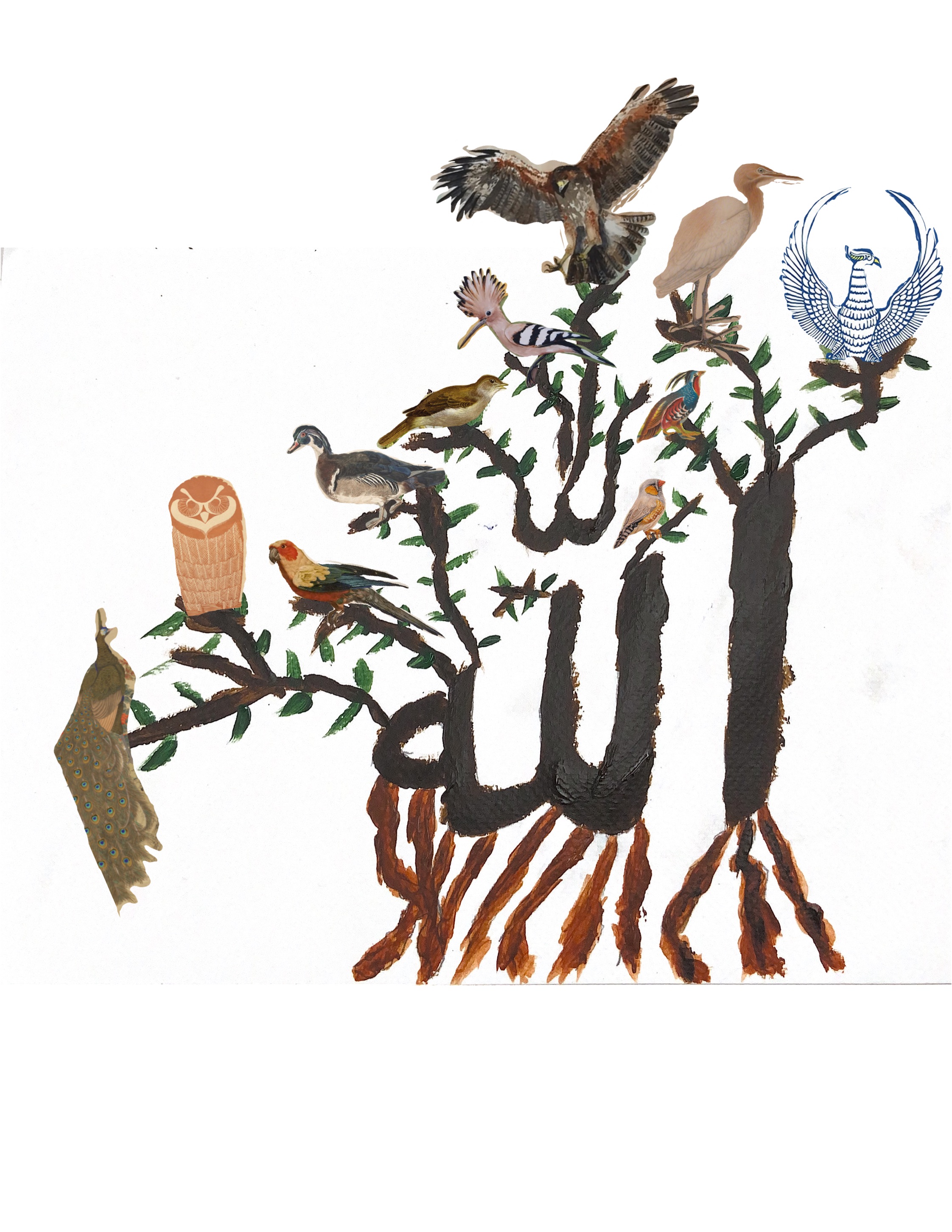
I decided to create a project with a painting and digital collage component. For the painting component, I painted Allah as a tree from which roots and branches emerge. I painted Allah as a tree because trees are generally used to symbolize life and sustenance, both of which arise from God. The tree’s roots provide everlasting sustenance, and the tree itself demonstrates the ways that Allah’s creative force sustains life and existence. For the digital collage portion, I perched eleven birds upon the branches, and these birds were all taken from The Conference of the Birds by Attar. I chose to make my project an allusion to Attar’s work because The Conference of the Birds is about how human fallibility hinders the journey to divine love. Each bird represents a different character weakness within humans that prevents us from reaching Allah’s love. They are perched upon Allah as, once each of these character weaknesses is overcome, an individual is able to achieve union with God through his divine love. The digital collage medium seemed to be the best one to employ because it allowed me to stay true to the representation of the birds in Attar’s work while providing the creative freedom to draw upon other works to express every bird. All of these birds were made into historical art pieces over the course of history - many of which were likely inspired by The Conference of the Birds; thus, I felt as if it were appropriate to add them via the digital collage medium. Ultimately, I feel as if this calligram engages with Allah as the eternal life force and source of divine love through a famous Islamic literary work that focuses on how humans can achieve a union with the divine, the force and love that sustains our existence.
Work Cited
TAOUJOUTI, A. (2021). Hoopoe (2021). artmajeur. Retrieved from
https://www.artmajeur.com/abdelmouhaimen-taoujouti-art-et-peinture/en/artworks/16024
654/hoopoe.
Pomata, A. M. (2016). Zebra Finch. Fine Art America. Retrieved from
https://fineartamerica.com/featured/zebra-finch-angeles-m-pomata.html.
Buncho, T. (1820). Peacocks and Peonies. The Metropolitan Museum of Art. Retrieved from
https://www.metmuseum.org/art/collection/search/49003.
Jessurun de Mesquita, S., & van Es Wassenaar, J. A. A. M. (1928). Birding at The Met: A
Selection of Drawings and Prints. The Metropolitan Museum of Art. Retrieved from
https://www.metmuseum.org/perspectives/articles/2022/9/birding-at-the-met-drawings-an
d-prints.
Fakes, D. (2018). Hawk Landing . Fine Art America. Retrieved from
https://fineartamerica.com/featured/hawk-landing-dennis-fakes.html.
Soreide, H. (2020). Nightingale - Luscinia philomela. Fine Art America. Retrieved from
https://fineartamerica.com/featured/nightingale-luscinia-philomela-hakon-soreide.html.
Levaillant, F., & Barraband, J. (1805). Female Golden Parakeet. Birding the Met Museum .
Susan Kirby. Retrieved from
https://www.pmsaga.com/blog-2-1/2019/11/24/birding-the-met-museum.
Schouman, A. (2004). A Duck. Wikimedia Commons. Retrieved from
https://commons.wikimedia.org/wiki/File:A_Duck_MET_DP800684.jpg.
Bequest of Minassian, A. (18 c.). A Heron. The Metropolitan Museum of Art. Retrieved from
https://www.metmuseum.org/art/collection/search/453397.
Issued by Allen & Ginter (American, Richmond, Virginia). (1889). Plumed Partridge, from the
Game Birds series (N13) for Allen & Ginter Cigarettes Brands. The Metropolitan
Museum of Art. Retrieved from
https://www.metmuseum.org/art/collection/search/407960.
Persian Huma Bird: Blank Lined Notebook, Journal or Diary. (2019). Amazon. Retrieved from
https://www.amazon.com/Persian-Huma-Bird-Notebook-Journal/dp/1794504249.