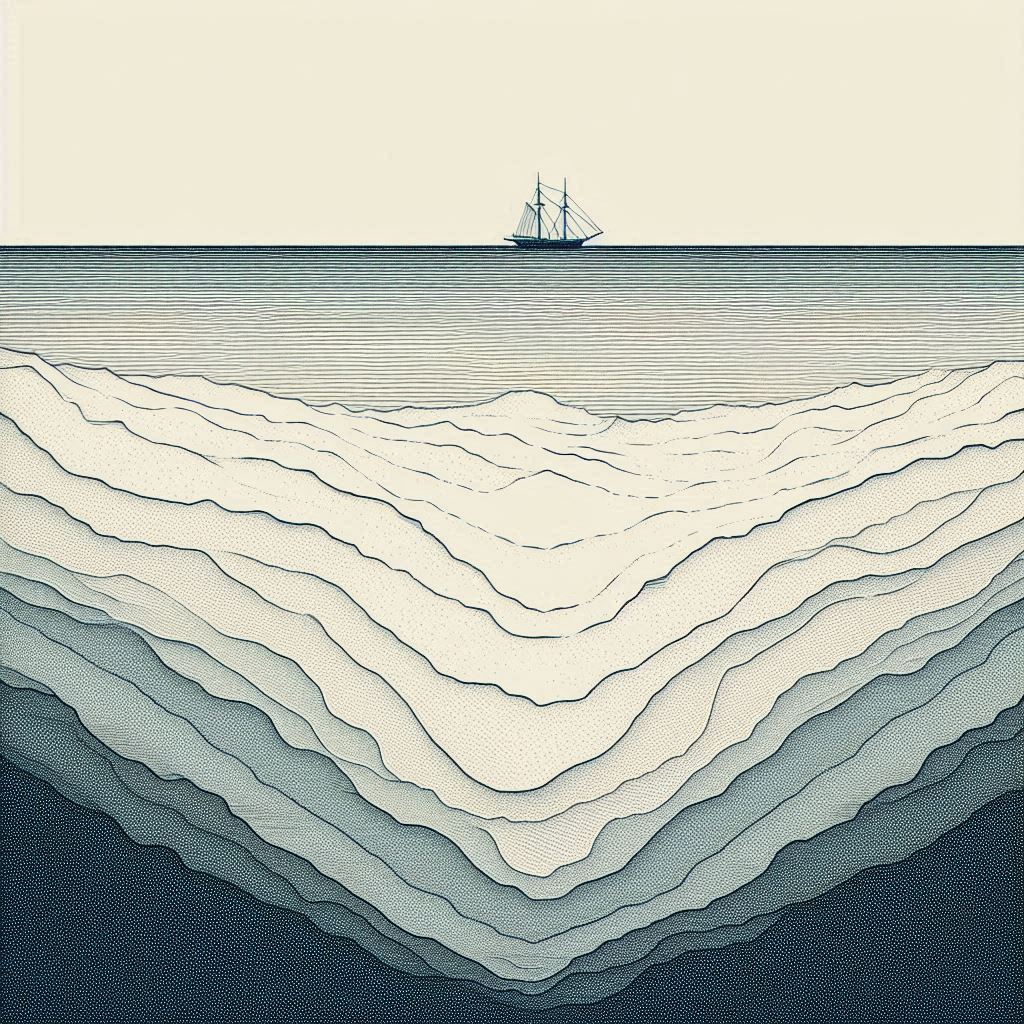
Olha Kobylianska — Crossing the Sea
Olha Kobylianska (1863 – 1942) was born in Gura Humorului, in Bukovina (now in Suceava County, Romania). She was a renowned poet, prose writer, pioneering modernist and feminist, who enjoyed a close relationship with fellow writer and activist, Larysa Kosach (Lesia Ukrainka). Her works are known for their impressionistic, lyrical descriptions of nature and subtle psychological portrayals.
Excerpt:
At dawn the day already shone bright.
So bright and sunny that the sky, which on clear days was usually a deep blue, was reflecting itself in the sea in a perfect sky-blue. So bright and sunny that the blue sea itself sparkled with silver, looking serene and boastful. Its waves frolicked merrily and raced one past the other, as if in noisy agreement to rush joyfully to shore forevermore.
On the shore stood two white seagulls—a larger and a smaller—locked in argument.
“I must cross the sea!” declared the larger. “I absolutely must! I have to stand on the high cliff that’s on the other side! They say the view from there is totally different from the one here. And that once you’re there, it’s impossible to return. So I must make a final decision, whether to be here or there. And I want to be there!”
“Then I want to go too!” said the smaller seagull.
“No,” said the larger. “You have to stay here!”
The smaller, offended, puffed up in anger.
“I want to fly across the sea with you too and stand on the same cliff as you! I’m a seagull too, just like you!”
“What does that matter—that you’re a gull too?” said the larger, fuming with rage and beating his wings furiously.
“You poor thing—just look at your wings!” he went on. “How can you possibly fly across this dangerous sea! Do you think the sun will always shine like it does now? That flying across the sea is like gliding around here, sailing about above it and then turning and going back whenever you please? It is not! You have to understand that once you set out to fly across the sea, there is no turning back! And that death will be staring you in the eye every minute! Besides, I don’t want to be tied to you! You’ll collapse right in the midst of the journey, and what kind of glory will that bring? Find some other companion—I’ll fly alone! So farewell!”
And off he flew.
Sad and heavy of heart, the smaller gull remained standing on the shore. She examined her wings despondently: they looked so much weaker and smaller than those of the larger gull. She gazed out at the sea—it looked immense, boundless, and barren. She peered into the distance, where the larger seagull shone in flight like a silvery arrow. Mournfully, she spread her wings wide and set out across the sea, in the path of the larger gull.
And so they flew…
A wide expanse lay between them as the roiling sea foamed below— there was nothing playful about that sea.
“Is that you behind me?” the larger gull shouted.
“Yes—it’s me.”
“You’re flying to the cliff?”
“Yes—I’m flying there.”
“Too bad for you! And I’m telling you again right now,” he cried out to her, “I won’t be any friend of yours there! I’m flying to that cliff to be alone— for my own pleasure alone!”
“I know, I know,” she responded. “And I’m not your friend, either. I’m flying to the cliff for myself alone too.”
And on they flew…
The stronger gull flew high and straight as if pulled by a string, soaring through the air like a silvery arrow. Energetic, indefatigable, and powerful, he propelled his white breast through the invigorating air. Peering ahead far and wide, his sharp eyes calculated the distance to the looming cliff ahead.
The weaker gull flew haphazardly, at times higher and then lower, at times faster and then slower, too close to the sea’s depths to gaze into the heights; when she did raise her small head, it was to glimpse where the larger gull was heading before her gaze again fell to the depths below. Time and again she felt cold splashes from the sea’s murky waves, stark reminders of the frigid sea below.
From time to time the larger gull would turn and cry back to the smaller: “Remember, I will not be your friend. I am flying to the cliff for myself alone!”
“I know, I know! I’m not your friend either,” the smaller called back. “I’m flying to the cliff for myself alone too!”
On and on they flew, the larger one in front, and the weaker much farther behind. The sun rose and set, days replacing nights, as down below the sea foamed and roiled, transforming itself continuously.
“You’re still there, following me?” the larger one called out, veering back closer to the smaller.
“I am.”
“You’re not turning back?”
“No, I am not.”
“I won’t be able to see you back here, you know. The expanse lying ahead is so big that it will surely sap all your strength. It consumes more and more of my attention and strength. But somewhere out there, far, far off in the distance, like in a misty dream, I’m glimpsing the very cliff I so want to reach.”
“I see only the depths below,” said the weaker. “And within them I see Death. And alongside Death I see the sky. And between Death and the sky I see you.”
“So you’re not turning back?"
"I'm not turning back."
The larger, beating his wings, called back: “Just remember that I won’t ever be your friend there. And that I’m flying to the cliff for my own pleasure alone."
And on they flew.
Anyone who thinks the sea is always calm and friendly, comforting and unmenacing, is greatly mistaken. It is always in motion and in flux. Suddenly, without warning, its calm and friendly surface, sparkling with silver and shimmering in tones of blue and green, can turn ominous. The sky darkens, a furious wind arises, and the sea, roaring like a giant, goes mad. Waves form in huge walls, one mounting another, rolling over and crashing, only to rise and crash into the depths once more. Time and again they arise, crash, and dissolve, creating a frenzied white foam that surges along the spine of the raging surf, only to burst and rip itself apart.
Noise…moaning…a kind of hell under a darkened sky. And above it all, the gulls still fly.
They don’t see or hear each other. They don’t meet. Beneath them lies grief.
Straining to his utmost, the larger gull streams through the air, barely staying aloft in the midst of the terrifying storm. He has never lived through a storm like this—only now does he know what a storm at sea truly is. But what has happened to the other unfortunate gull? Drowned…
“Where are you?” he called back forlornly. “Are you drowning? Have you already drowned? I’ll be blamed for your bad luck! Although I told you right from the start that I am not your friend! That I am flying to the cliff for my own pleasure!”
He listened but heard no response.
“Where are you?” he cried out again.
Again, no answer…Down below, the roiling sea was driving clusters of foam into a windswept mane that crested with every wave. But wait—over the din of those frenzied waves, from the core of that hell, a cry seemed to echo: “I am here!”
“Down there, just above the sea? I am up high, far removed from that hell!”
“And I am just above the sea depths, witnessing hell. My wings are already covered in deathly sweat, and I may be about to die right now. I can’t fly on my own strength anymore—the sea’s madness is what is carrying me!”
“And what did I tell you?” cried the other. “Remember, I’m not to blame! I’m not your friend—I’m flying to the cliff for myself alone!”
“I know, I know—and I’m not your friend either,” the smaller called back. “I’m in flight through this hell on my own account!”
Then, nothing more. The wild storm still twisted the smaller gull’s weary wings, bending them inward and pitching her high above the depths, only to let her drop to just above the foam. Then, at last, the storm exhausted itself. Finally, its wild game had ended.
The larger gull reached the cliff. He stood on top of the cliff, and he saw that this cliff, the goal he’d strived so hard to reach, was in fact the cliff of death. Suddenly his powerful wings drooped, and the spasms of death swept through him… Some minutes later, as might be expected of one more frail, the weaker seagull arrived. The larger lay dying in agony…
“I’m glad that you made it across the water,” he whispered. “Now I won’t perish here alone!”
“I’m glad that I didn’t stay behind,” she replied softly. “Now I won’t perish back there alone.”
“Just understand,” he whispered, “that though I’m no friend of yours, in meeting Death I won’t bring you along.”
“I know,” she said. “And I’m no friend of yours either. I’ll fly on, to meet death on my own.
Explanation:
Ukrainian author Olha Kobylianska’s short story Crossing the Sea (1902) explores the interaction of two seagulls, one older and larger, the other younger and smaller, as they fly across the tumultuous Black Sea waters. Before they depart, the older seagull warns the younger: “you have to understand that once you set out to fly across the sea there is no turning back! And that death will be staring you in the eye every minute! Besides, I don’t want to be tied to you! You’ll collapse right in the midst of the journey, and what kind of glory will that bring?” The younger seagull, however, persists, navigating “noise…meaning…a kind of hell under a darkened sky”. The littoral space is presented as a darkened abyss, a site of death and impossible connection. At the story’s conclusion, the two birds fail to be united by their shared experience. As the older dies, the younger does not mourn him, but continues on into the distant horizon.
Citation: Kobylianska, Olha. Crossing the Sea. Trans. Olha Rudakevych, Ukrainian Literature: A Journal of Translations, edited by Maxim Tarnawsky, vol. 6, Shevchenko Scientific Society of Canada, 23 Nov. 2021, pp. 225-228. Ukrainian Literature, tarnawsky.artsci.utoronto.ca/elul/Ukr_Lit/Vol06/.
Original publication: Ol'ha Kobylian'ska, Cherez more, Zibrannia tvoriv u 10 tomakh, Chernivtsi, Bukrek, 2013. Vol. 1, pp. 346–49