Maria Stepanova (III) — Holy Winter
Maria Stepanova (1972 –) is a Russian poet, novelist, journalist, and the founder of online arts and culture forum, Colta.ru. Born in Moscow, she is one of Russian literature’s most influential contemporary voices, having published over ten collections of poetry as well as the 2017 non-fiction novel, In Memory of Memory (shortlisted for the Booker Prize). Stepanova is a vocal critic of Vladimir Putin’s political regime and full-scale invasion of Ukraine. She lives and writes from Berlin, where she has resided February 2022. She is a poet of immense technical and stylistic mastery, renowned for her command over canonical Russian and world literatures, as well as the voices of popular contemporary culture, slang, and internet speech. Her poetic landscapes are incessantly moving, shifting, and oscillating between different genres and forms. Her poetic subjects are frequently fragmented, difficult to pin down or identify, composed of many voices, and engaged generally in a process of reckoning with their constituent parts.
Excerpt:
(D)
You, whoever you were: a refugee, forgot your name
Or even where you came from, carried on your family’s back
Little piss-pants, your father always on about how
He was once some big shot in the Veterans’ Office
You mixing up words, always on the lookout, ready to draw
If it hadn’t been for me and my strip of farmed land
My widow’s capital, where would you have been
Would you even have been.
When I lay with you, I lay as if in a small boat,
As if in the winter sea I lay, and slowly
Learned to see, through the wreck of your hull
The slow procession of sea monsters
The hulks of sunken cruise ships
The thrum of the motor as immigration draws alongside
Demanding all hands on deck and no resistance—
And I showed no resistance.
But still we went down. And you emerged onto dry land
Under different constellations, you lost your fins
Grew lungs and left me there in the sand:
“Driftwood, driftqueen, drifting boat.
And if I want to give chase—to catch you
I must make myself to fire and air, like the Egyptian
So the smell of me clings in your nostrils, and you wish to dispel it
But can’t.
(A)
I wake on the white, the empty white island
Of the bed you have already left
And know then that you have abandoned me
And know, too, that I am an island.
He who said no man is an island
Never lay isolated in a lonely bed
Where white sheets heralded the winter as it fell
Between lines of text; where, between you and me,
Only whiteness, the unseen intervals between metro trains
The wide avenues unpeopled, the squares where we are not,
And no connective tissue, no silken threads
To catch hold of and cling to,
No balls of words coiled neatly for another to catch:
A man, imprisoned in his own flesh
And another, escaping his captivity
Not wishing to be part of the archipelago
Nor the federal republic clinched in embrace
Nor the zone where territories meet
For all these lay bare the scar for all to see:
His island nature. I see cliffs on the coast.
The God of Love pierced me with his stinger
The God of Sleep couldn’t keep me in my cradle
But the God of Alcohol comes to my aid
Caresses me from within, his sprouting thyrsus anesthetizes.
Explanation:
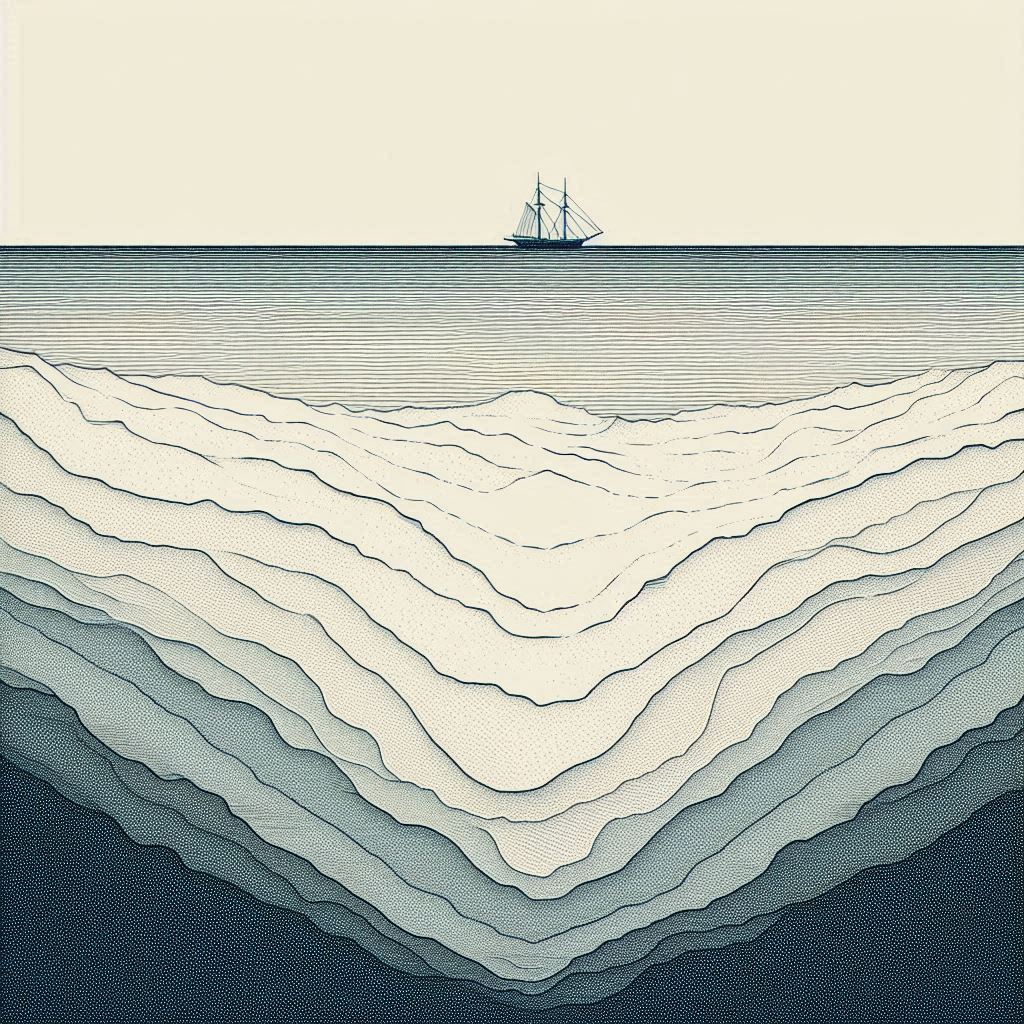
Russian poet and prose writer Maria Stepanova’s epic poem, Holy Winter (2021), engages, in this third excerpt, with the water as a powerful metaphor for human relationships – illustrated, in many ways, as a container or spatial whole that is both constituted and severed by processes of love and loss. Stepanova draws prolifically upon the writings of Roman poet Ovid – namely, his recounting of a journey into exile across the Black Sea waters in Tristia, and separation from his wife. Here, the event of shipwreck is emblematic of many things: the breakdown of a relationship, experience of betrayal, miscommunication, and misunderstanding. It also reflects upon mechanisms of perception, identity formation, and subjectivity more broadly, considering the means by which we come to understand one another: “When I lay with you, I lay as if in a small boat,/ As if in the winter sea I lay, and slowly/ Learned to see, through the wreck of your hull/ The slow procession of sea monsters/ The hulks of sunken cruise ships…And I showed no resistance./ But still we went down…” Stepanova draws upon familiar metaphors of relationships as a journey, and understanding or connection as a process of immersing oneself within the depths of another.
Citation: Stepanova, Maria. Holy Winter 20/21. Trans. Sasha Dugdale, New Directions, August 2024, pp. 18.