Rebecca Horn's Magical Prostheses
Horn’s masks and extensions elongate, contain, or constrain the bodies of their wearers. The performances are meditations on the body in space (moving, touching, groping), on space itself (verticality and horizontality, interior and exterior), and on the relationship between the two.
Just as she tailored the early body extensions to fit her own measurements and those of her friends and collaborators, the dimensions of the paper support in Rebecca Horn’s large-scale paintings on view here correspond to the size, and thereby the limits and possibilities, of her own
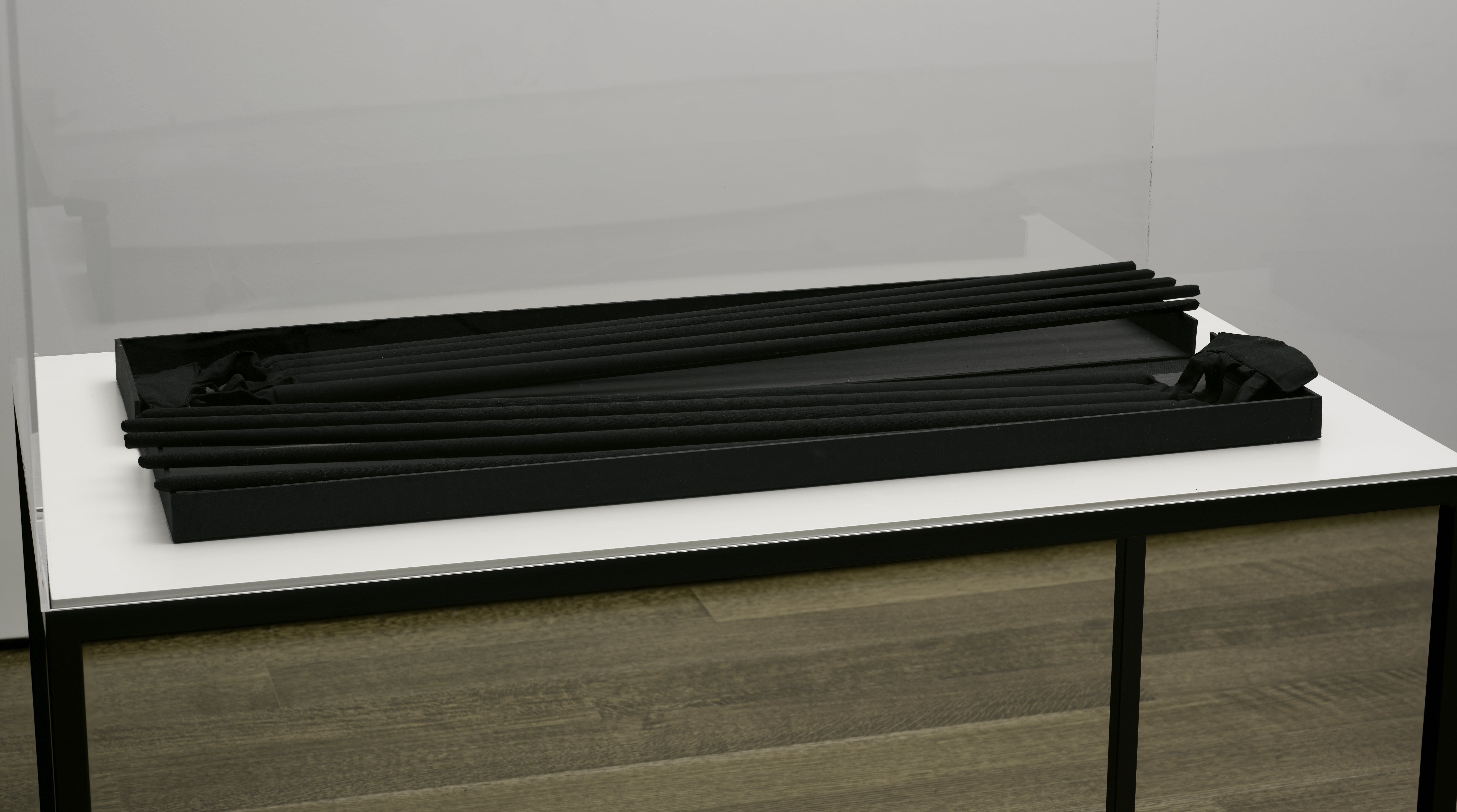
body. The viewer, too, encounters these works, called Bodylandscapes, face-to-face. From the outset, Rebecca Horn placed the body extensions and other objects she constructed for her performance pieces—from mirrored leg braces to feather masks—in specially made traveling cases (Reisekoffern), often exhibiting them together with the related still photographs and films. Some of these objects were reproduced as a multiple, or editioned artwork. For example, her first multiple, Handschuhfinger (Finger Gloves), is a version of the prosthesis used in the 1972 performance of the same name. Housed in their own boxes, and presented here in
cases designed by the artist, these editioned objects reference (and frequently provided the funding for) large-scale, site-specific, and often ephemeral installations by the artist.
Rebecca Horn’s three-part Out of the Black Rain, painted mechanically during the activation of her Flying Books under Black Rain Painting (2014) at the Harvard Art Museums, has also become a work of art in its own right. Rebecca Horn’s artistic production over the past four decades can thus best be understood as an ongoing work in progress. As the artist herself
has said, “It all interlocks.”
—Lynette Roth, Daimler-Benz Curator of the Busch-Reisinger Museum, Harvard Art Museums
This exhibition was funded by the Charles L. Kuhn Endowmen