Rebecca Horn's Magical Prostheses
Just as she tailored the early body extensions to fit her own measurements and those of her friends and collaborators, the dimensions of the paper support in Rebecca Horn’s large-scale paintings on view here correspond to the size, and thereby the limits and possibilities, of her own
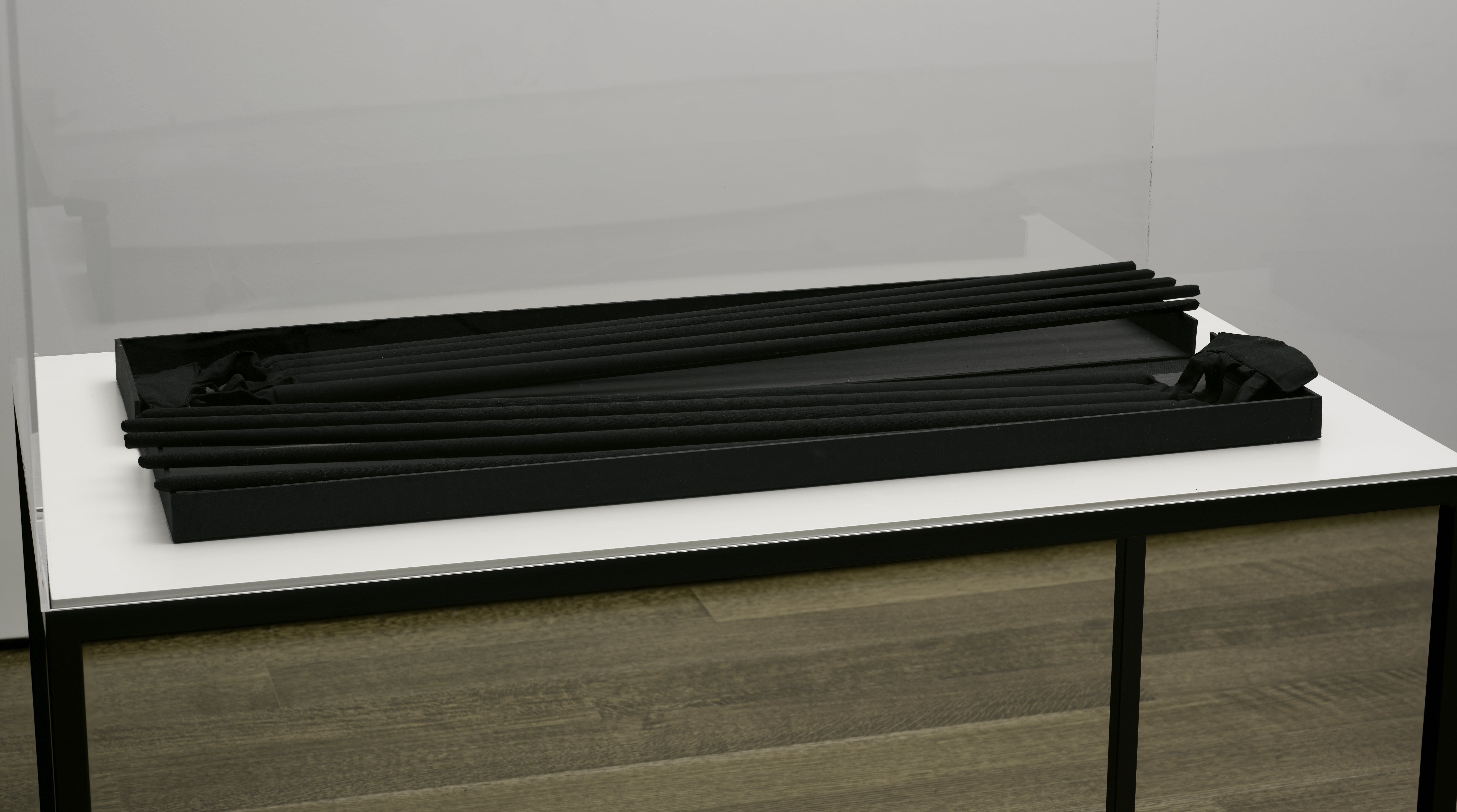
body. The viewer, too, encounters these works, called Bodylandscapes, face-to-face. From the outset, Rebecca Horn placed the body extensions and other objects she constructed for her performance pieces—from mirrored leg braces to feather masks—in specially made traveling cases (Reisekoffern), often exhibiting them together with the related still photographs and films. Some of these objects were reproduced as a multiple, or editioned artwork. For example, her first multiple, Handschuhfinger (Finger Gloves), is a version of the prosthesis used in the 1972 performance of the same name. Housed in their own boxes, and presented here in
cases designed by the artist, these editioned objects reference (and frequently provided the funding for) large-scale, site-specific, and often ephemeral installations by the artist.
Rebecca Horn’s three-part Out of the Black Rain, painted mechanically during the activation of her Flying Books under Black Rain Painting (2014) at the Harvard Art Museums, has also become a work of art in its own right. Rebecca Horn’s artistic production over the past four decades can thus best be understood as an ongoing work in progress. As the artist herself
has said, “It all interlocks.”*
*This blurb was authored by Lynette Roth, Daimler-Benz Curator of the Busch-Reisinger Museum, Harvard Art Museums
Lesson Plan
Rebecca Horn's “body extensions” (Körpererweiterungen) offer language instructors an opportunity to integrate German cultural knowledge into early language teaching. The construction of and play with these fanciful prostheses can help students to learn the names of body parts and movement verbs. Additionally, because so many of Horn's works are housed at the Harvard Art Museum, a lesson on Horn would give students a chance to work with some of Harvard's unique resources.Objective:
By creating their own "Körpererweiterungen," students will practice describing the parts of the body and the movement verbs that accompany them. In doing so, students will begin to think about human bodies and their abilities in a non-normative way.
Materials:
Crafting materials such as construction paper, cardboard, paper towel rolls, pipe cleaners
Tape or staples
Scissors
Procedure:
Before class
As homework, students visit the Art Study Center at the Harvard Art Museum to view her “Finger Gloves” in person.
During class
-Warm Up
On a sheet of paper folded in half lengthwise, students create a list of body parts (on the left) and movement verbs (on the right).
Die Hand, Der Fuß, Der Mund
klatschen, streicheln, winken
-Planning
In pairs, students create designs for their own body extensions. The challenge will be to think of a design that will facilitate new ways of experiencing the environment. Students will ask themselves: Where and when will their prostheses be worn? How will they be attached? What abilities will they augment? What new abilities will they facilitate?
Größere Ohren, damit man besser hören kann
-Construction
Students spend some time creating a prototype of their body extensions.
-Exploration
As a group, the class goes outside and uses the body extensions they have built to explore the environment.
-Conclusion
Students return to the classroom and review the list of verbs composed at the beginning. If they have discovered new actions during the exploration phase, these are added to the list.