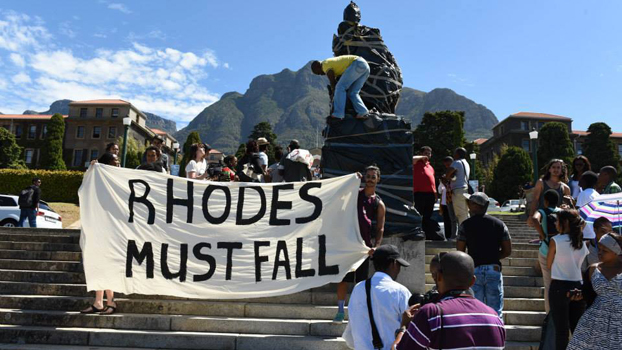
What and where are the movements?
The Rhodes state at UCT was removed a month after the initial protests, although the work to decolonize the education system as a whole continues passionately. The success of the movement in removing the statue led to multiple other movements across the globe, adopting the same principles but adapting them to their local contexts. The Fees Must Fall movement originated in October of 2015 at the University of Witwatersrand, South Africa, led by Shaeera Kalla, to stop increases in student fees and to demand greater governmental funding of higher education. It quickly spread to universities across South Africa, and other countries across Africa (such as Namibia), emphasizing the way in which Africa 'is not necessarily poor but...materially and epistemically impoverished via (neo-)colonial dispossession and exploitation' (Nhemachena et al., 2017:93). The movement was successful in its initial goal of preventing the planned increase in fees, but the broader work of decolonizing the institutions is far bigger, more diffuse, and more difficult - it is not enough to make 'toxic education affordable without paying attention to the need to detoxify such dangerous forms of education', requiring 'the proactive eradication from Africa's educational system of any knowledge systems that perpetuate the reprehensible wrongdoings, moments, and ambitions of the (neo-)colonialists' (Nhemachena et al., 2017:102-104).
The digital nature of all the movements, which made substantial use of hashtags, virtual groups, and social media networks to share information and mobilize support for the protest, meant that it quickly gained global attention and adaptation. In the U.K., the focal point became the statue of Cecil Rhodes at his alma mater Oriel College, a constituent college at the University of Oxford. The initial response to the protests from administrators was clear - Chancellor Lord Patten suggested that students involved in the campaign might 'think about being educated elsewhere' (Allnutt and Holden, 2016). However, after several years of sustained effort and a rise in the movement's prominence amongst the student population, Oriel College has now committed to setting up an independent inquiry into key issues around the statue, alongside investigating how to improve the access and attendance of BAME (Black, Asian, and minority ethnic) students and faculty (Mohdin et al., 2020).