Farmlands: Counting Sheep
What It Is
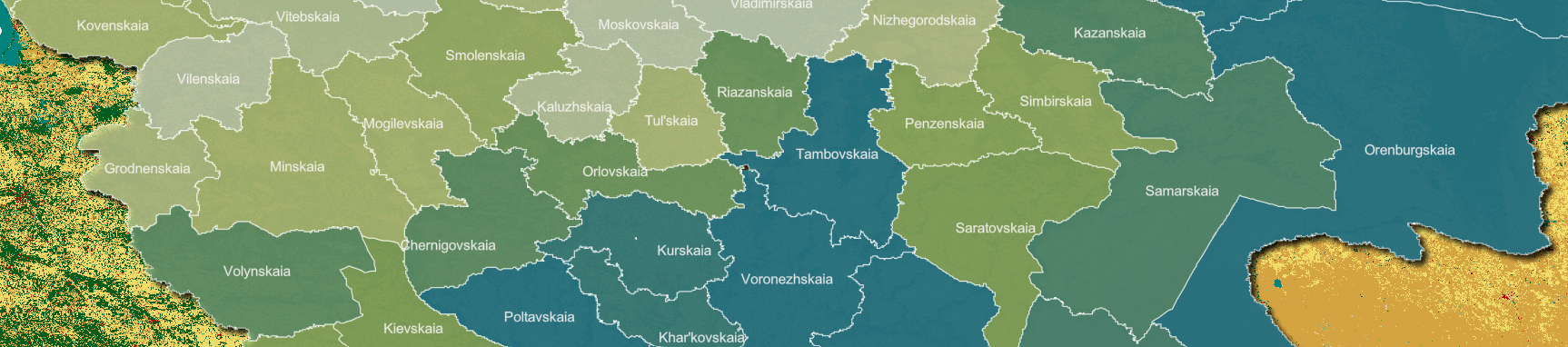
This dataset contains information about the population size and diversity of livestock in 49 provinces of European Russia based on a census compiled by the tsarist government in the middle of the 19th century. You will find population counts for the eight most prominent agricultural animals in the region: cattle, reindeer, goats, horses, ordinary sheep, fine-fleeced sheep, swine, and camels.
GET THE DATA
Explore the maps
About the Primary Source
Citation: Центральный статистический комитет Министерства Внутренных Дел [Central Statistical Committee of the Ministry of Internal Affairs], Статистический временник Российской империи выпуск I [Statistical yearbook of the Russian Empire, Issue 1]. Saint Petersburg: Ministry of Internal Affairs, 1866.
Part of a two-volume series, the first issue of the Statistical Yearbook was compiled by the Central Statistical Committee helmed by the famous and formidable Pyotr Petrovich Semyonov-Tyan-Shansky (1827-1906). Semyonov served as director of the Statistical Committee from 1864-1875 though he is more commonly recognized for his role as director of the Imperial Russian Geographical Society and his exploration of the Tyan Shan Mountains. This publication, one of the first of his tenure, was created with the goal of providing a broad statistical picture of the geography, demographics, and economy of the Russian Empire.
The source of this dataset is the eleventh table in the second section of the volume. It records the number of horses, horned cattle, ordinary and fine-fleeced sheep, goats, swine, reindeer, and camels reported in each province in a single year. The provinces of the Kingdom of Poland, Grand Duchy of Finland, and the Caucasus are not included. See pages 242-243 [images 464-465].
Historical Context
Animals and empires go hand in hand. Wild animals and domestic pets have always been celebrated in media and art, but livestock have provided humans with sustenance, mobility, and power for millennia. The history of livestock is a history of farmlands, battlefields, commerce, and imperial politics. Within the Russian Empire, horses and camels played key roles in interactions with rival powers such as the Mongol, Qing, and Ottoman empires, while sheep and cattle figure prominently in literary and artistic depictions of the countryside as well as in the development of domestic and international markets. Despite their significance, livestock are a neglected topic. This dataset provides a window onto their world and an opportunity to define countless question for further research.
Project Team
Olga Kiyan, Kelly O'Neill, Paul VădanPublication Date
15 February 2024