Chapter 21: Mullis Invents the Polymerase Chain Reaction
“….EUREKA!!!! I could do it over and over again. Every time I did it I would double the signal.”
Gene cloning and DNA sequencing set the stage for the development of another highly impactful technology, the Polymerase Chain Reaction, PCR. PCR makes it possible to amplify exponentially particular short segments of DNA from long stretches of chromosomal DNA. This amplification involves the use of two oligonucleotide primers that flank the target region of interest, one being complementary to one strand of the DNA and the other complementary to the other strand. In the first step chromosomal DNA is denatured and the two oligonucleotides are used to prime the synthesis of polydeoxynucleotides that extend across and past the target region in the separated strands. In the second round, the DNA is again denatured and the oligonucleotides are again used to prime DNA synthesis. In this and subsequent rounds newly synthesized DNA becomes available as a template, with each oligonucleotide priming synthesis at the opposite end of the target. Thus, with repeated rounds of denaturation and priming, the target is selectively amplified. Moreover, this amplification is exponential, that is, 2X in the first round, 4X in the second, 8X and so forth until billions of copies of the target have been generated. The science education site, LabXchange features and an excellent animation of PCR-mediated amplification:
https://www.labxchange.org/library/pathway/lx-pathway:05cd9910-1ea6-49ef-9360-f6d9fd6523f0/items/lx-pb:05cd9910-1ea6-49ef-9360-f6d9fd6523f0:video:82f475b3
PCR was the invention of Kary Mullis (1944-2019). We began this eBook with the warning that people are complicated, and they can have good sides and bad sides, they can have brilliant insights in some domains and articulate falsehoods in other areas, as we have seen for some of the scientists considered in earlier chapters. This assessment also applies to Mullis, as we will come to. Mullis graduated from Georgia Institute of Technology in 1966 and enrolled in the graduate program in the Biochemistry Department at the University of California, Berkeley. Remarkably, he published a paper in Nature on astrophysics in 1968 while a graduate student. He comments on this in his Nobel address in 1993, writing, “I was in the laboratory of Joe Neilands who provided his graduate students with a place to work and very few rules. I’m not even sure that Joe knew any rules except the high moral ground of social responsibility and tolerance. Not knowing that the department did have rules, I took astrophysics courses instead of molecular biology, which I figured I could learn from my molecular biologist friends. I published my first scientific paper in Nature, in 1968. It was a sophomoric astrophysical hypothesis called “The Cosmological Significance of Time Reversal.” I think Nature is still embarrassed about publishing it, but it was immensely useful to me when it came time for my qualifying examination. The committee would decide whether or not I would be allowed to take a Ph.D, without having taken molecular biology. And my paper in Nature, helped them to justify a “yes”.” Mullis struggled while in the Biochemistry Department, but eventually won a PhD in 1973.
Next, he did postdoctoral research at the University of Kansas Medical Center and then at the University of California, San Francisco in pharmaceutical chemistry. After this, he landed a position at a startup biotechnology company called Cetus where he famously invented PCR in 1983 and for which he won the Nobel Prize a decade later. Outside of science, Mullis was an avid surfer and famously used hallucinogens.
Mullis tells the story of how he came to conceive of the Polymerase Chain Reaction: “One Friday night I was driving, as was my custom, from Berkeley up to Mendocino where I had a cabin far away from everything off in the woods. My girlfriend, Jennifer Barnett, was asleep. I was thinking. Since oligonucleotides were not that hard to make anymore, wouldn’t it be simple enough to put two of them into the reaction instead of only one such that one of them would bind to the upper strand and the other to the lower strand with their three prime ends adjacent to the opposing bases of the base pair in question. …… But what if the oligonucleotides in the original extension reaction had been extended so far they could now hybridize to unextended oligonucleotides of the opposite polarity in this second round. The sequence which they had been extended into would permit that. What would happen?
EUREKA!!!! The result would be exactly the same only the signal strength would be doubled. EUREKA again!!!! I could do it intentionally, adding my own deoxynucleoside triphosphates, which were quite soluble in water and legal in California. And again, EUREKA!!!! I could do it over and over again. Every time I did it I would double the signal. For those of you who got lost, we’re back! I stopped the car at mile marker 46,7 on Highway 128. In the glove compartment I found some paper and a pen. I confirmed that two to the tenth power was about a thousand and that two to the twentieth power was about a million, and that two to the thirtieth power was around a billion…”
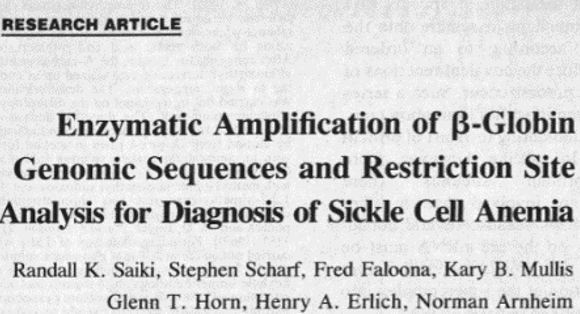
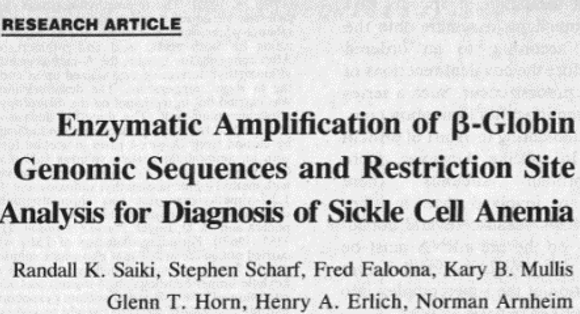
Mullis’s invention was published in Science in 1985. He and his colleagues at Cetus reported using PCR as a diagnostic test for sickle cell anemia, a genetic disorder caused by a mutation in the gene for β globin [as discovered by Pauling and Ingram (chapter 11)]. The mutation causes a change in codon six of the β globin gene. As a result of this mutation the recognition sequence for a restriction enzyme called Ddel, which overlaps codon six, is eliminated. So, the diagnostic test was to amplify the region the β globin gene corresponding to the sickle cell mutation and then test whether the amplified DNA was cleaved with DdeI; if yes, then the sickle cell mutation was absent and if no, then it was present.
Mullis published a follow up paper in 1987 that focused on the methodology, and in 1988, he published an important improvement in the procedure based on the use of a thermostable DNA polymerase from a thermophile. Prior to this, fresh DNA polymerase had to be added each cycle because the enzyme was inactivated by the heat-denaturation step. But with the thermostable enzyme, the entire amplification process could be carried out with simple cycles of heating and cooling without the need to replenish the DNA polymerase. With this advance, PCR became readily adaptable to automation and became widely adopted.
Mullis won the Nobel Prize in Physiology or Medicine the same year that Richard Roberts (now at New England Biolabs) would win the Prize for Chemistry (along with Phil Sharp of MIT) for mRNA splicing, which Roberts had discovered when he had been at Cold Spring Harbor Laboratory. Roberts recounts on their friendship and interactions over the years: In the articles that have been published since his death, much has been made of Kary’s eccentricities. He has often been portrayed as a wayward genius who enjoyed surfing, drugs, and wild women. Certainly, the word “quirky” scarcely does him justice. Kary had an agile mind that frequently wandered off in unexpected directions, and a conversation with him could be both an exhilarating and exhausting experience….I knew him in a somewhat different context, and it is that side of Kary that I describe here. In 1983, I was a consultant for New England Biolabs (NEB), where I now work. When we first heard about PCR, our immediate reaction was that sales of restriction enzymes might be negatively affected because it was now possible to clone DNA without using NEB’s products. Upon reflection, we realized that our fears were ill-founded. The development of PCR meant that much more DNA would now be available to researchers, and that larger quantities of restriction enzymes would be needed to cleave it. When he discovered the PCR, Kary had used a mesophilic DNA polymerase isolated from Escherichia coli. He soon realized that the thermostable Taq DNA polymerase—originally isolated from Thermus aquaticus, an organism discovered in a hot spring at Yellowstone National Park—was much more suitable. Kary and Cetus bought Taq polymerase from NEB …. ….our paths crossed on several occasions and we became good friends. I loved his rebellious nature. It was often remarked that Kary might one day win a Nobel Prize for his work on PCR, and when I learned that I had been awarded the 1993 Nobel Prize in Physiology or Medicine, one of my first thoughts was that this might be the year when Kary would win it too. Not long after, he was announced as the winner of the 1993 Nobel Prize in Chemistry. We spent a magical 10 days in Stockholm celebrating our wins in grand fashion. The Swedes know how to throw a party, and in Kary they found a willing collaborator. At one point during our stay, Kary had to be rescued from the clutches of the police, who wanted to arrest him for shining a laser pointer down from above onto unsuspecting pedestrians. Little did he know, a criminal in Stockholm had been doing just that for weeks on end and the police were desperate to make an arrest. It was only after the intervention of the management at the Grand Hôtel that they were able to prevent Kary from being taken into custody.
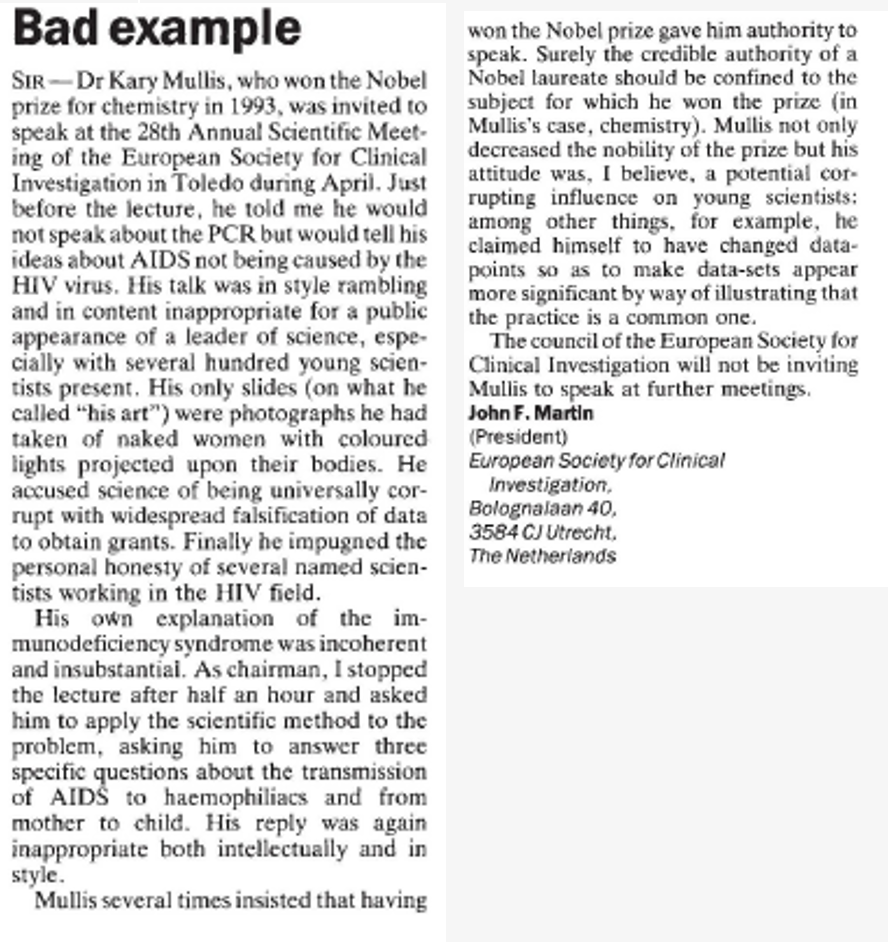
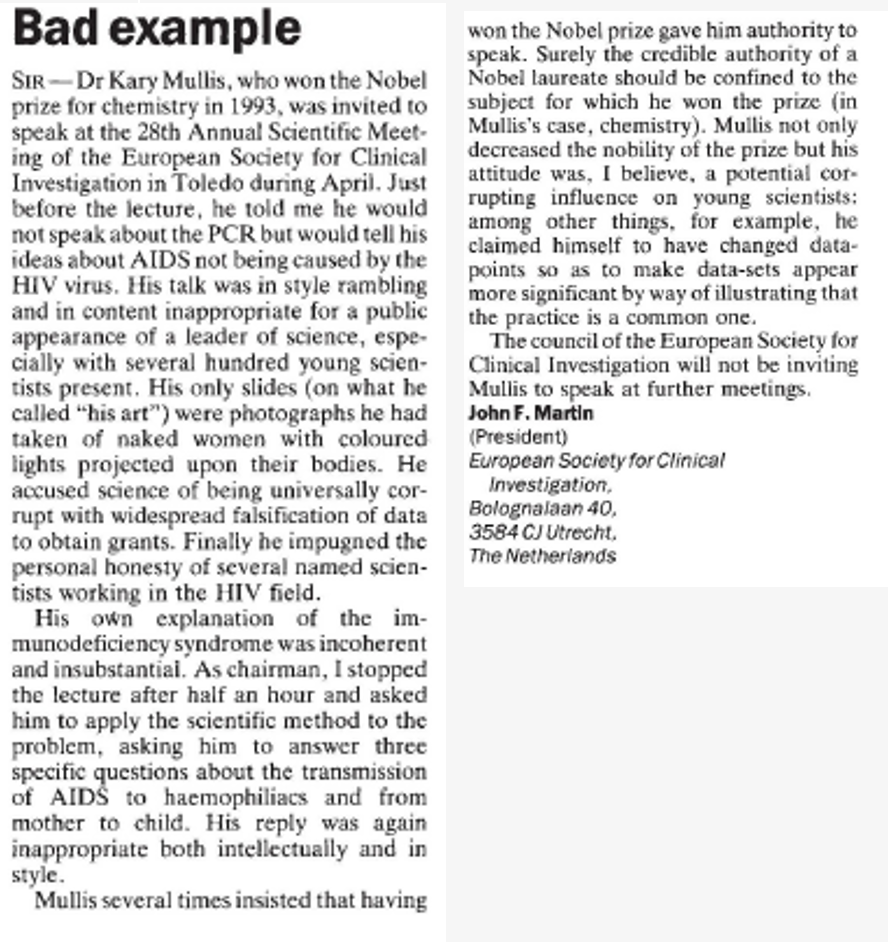
But Mullis was also the subject of criticism. He was a skeptic of holes in the ozone layer and of climate change and that HIV is the cause of AIDS. He associated himself with Berkeley Professor Peter Duesberg who helped persuade South African leader Mebeki that AIDS is not caused by HIV, writing the preface to Deusberg’s book, Inventing The AIDS Virus. Also, he would show naked pictures of his girlfriends in scientific talks. Shown is a letter published in Nature by the President of the European Society for Clinical Investigation following a talk given by Mullis at its annual meeting in 1993. And below is a video in which Mullis expounds on his skepticism about HIV (the Deusberg book can be seen on the table).