Chapter 3: Avery discovers that the “transforming principle” is DNA
“…by means of a known chemical substance it is possible to induce predictable and hereditary changes in cells. This is something that has long been the dream of geneticists…Sounds like a virus, maybe a gene.”
The next three chapters present stories on how it came to be known, and finally widely accepted, that the genetic material is DNA and not protein. Chapter 3 is in two parts. The first, as a prequel, explains the discovery of the “transforming principle” by Frederick Griffith. It then turns to the main story: the discovery by Oswald Avery and his team of Colin MacLeod and Maclyn McCarty that the transforming principle is DNA, the significance of which was slow to gain wide acceptance. In chapter 4, we turn to the history of the chemistry of DNA and the overturning by Chargaff of what was known as the “tetranucleotide hypothesis”, which was one of the impediments to accepting the concept that DNA could embed a code. Finally, in chapter 5, we delve into the sequel, the famous experiment of Hershey and Chase that finally overturned skepticism that DNA is the carrier of genetic information.
Fredrick Griffith was a Medical Officer of the Ministry of Health in London. He was investigating a pathogenic bacterium named pneumococcus or Streptococcus pneumonia, which causes pneumonia. Virulent strains of pneumococcus form smooth-looking colonies on agar plates (S) whereas avirulent mutants form small, rough-looking colonies (R). The cells of virulent strains are encased in a polysaccharide capsule whereas avirulent mutants lack the capsule. Griffith showed that different virulent strains could be distinguished serologically according to their capsule. Thus, infection with different virulent strains would generate antibodies that could be used to distinguish different serotypes, such as serotype l, serotype ll, and serotype lll.
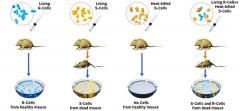
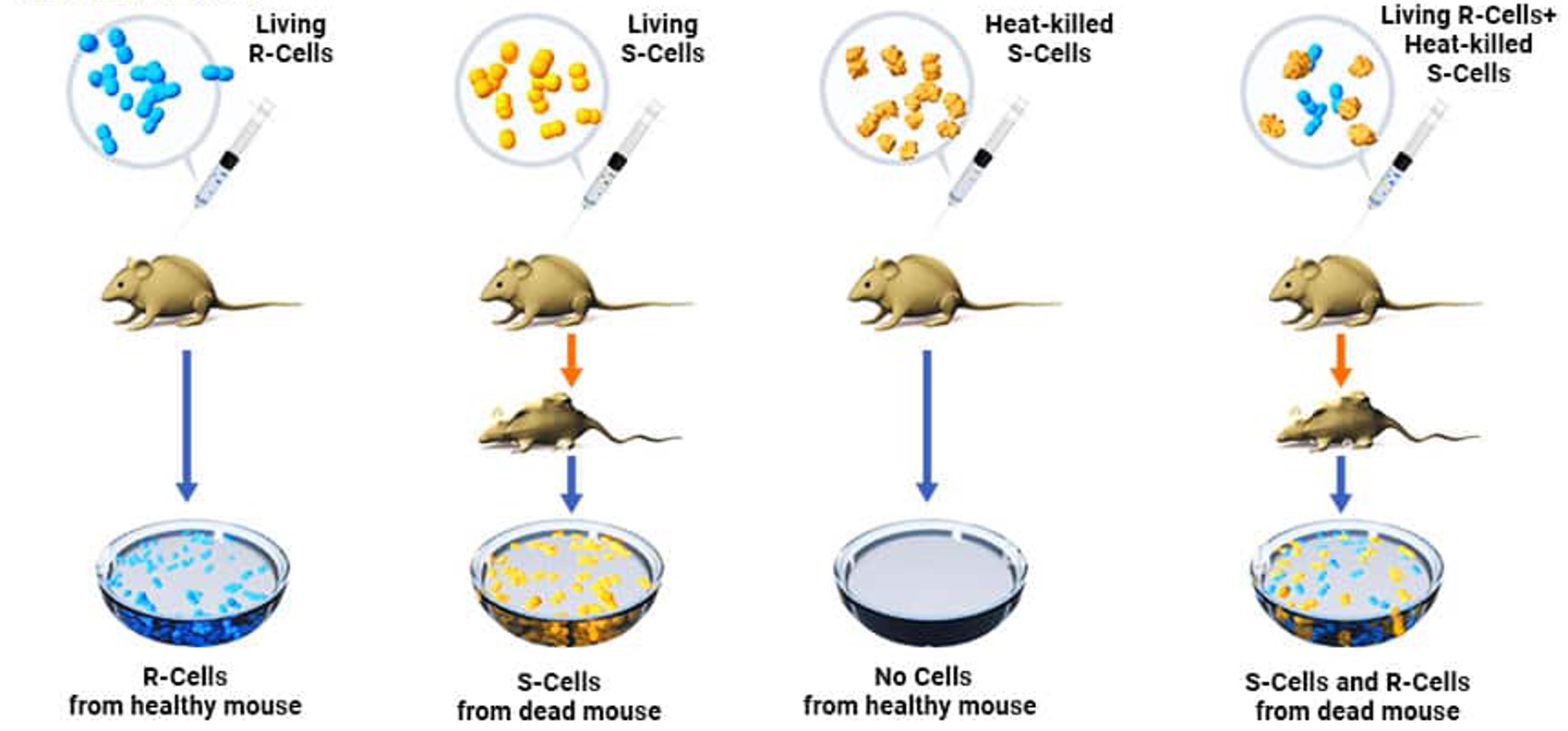
As reported in his seminal 1928 Journal of Hygiene publication entitled “The Significance of Pneumococcal Types,” Griffith reported that heat-killing a virulent strain would release something he called “transforming principle” that would convert an avirulent mutant back to virulence. He carried out these experiments in mice. As depicted in the cartoon above (Gunilla Elam / Science Photo Library), injecting cells of an avirulent, rough mutant (R) into a mouse had no effect and living R cells could be recovered from the mouse (left most cartoon). In contrast, injecting cells of a virulent strain (S) resulted in death of the mouse from which living S cells could be recovered (second from left). If, however, the S cells were first killed by heating, they were unable kill the mouse and no living bacteria could be recovered (third from left). Finally, and amazingly, injection with a mixture of heat-killed S cells and living R cells restored pathogenesis, resulting in death of the mouse and from the dead mouse living S cells could be recovered!
Griffith went further. If he injected a mouse with a mixture of heat-killed cells of serotype ll and an avirulent R mutant that had derived from a serotype l strain, then not only did the mouse die but from the dead mouse could be recovered serotype ll cells. That is, not only could “transforming principle” convert a rough mutant to a smooth, capsule producing strain, but it could also transform the rough mutant to a new serotype. Thus, and, as depicted below, a rough mutant derived from a serotype strain I could be transformed to serotype II:
\[
\text{serotype I} \longrightarrow \text{rough I } \overrightarrow{\tiny \text{ transformation with heat killed type II}} \text{ serotype II} \]
We would now say that the transforming principle was bringing about a heritable change in R cells. Moreover, this heritable change included converting a mutant that had been derived from one serotype into a virulent strain of a different serotype.
Tragically, Griffith died in 1941 during a German bombing raid on London. So, he did not live to see the fruits of his discovery!
In 1931, Martin Dawson, and Richard Sia at Columbia College of Physicians and Surgeons reported methods for transformation of pneumococcus in vitro, without the need for mice. And in the following year, J. Lionel Alloway at the Rockefeller Institute showed in 1932 that the transforming principle could be precipitated from cell-free extracts of pneumococcus with alcohol and then solubilized in water, which, as we will see, Avery and coworkers used to purify what proved to be DNA.
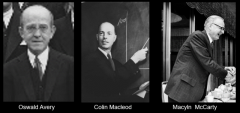
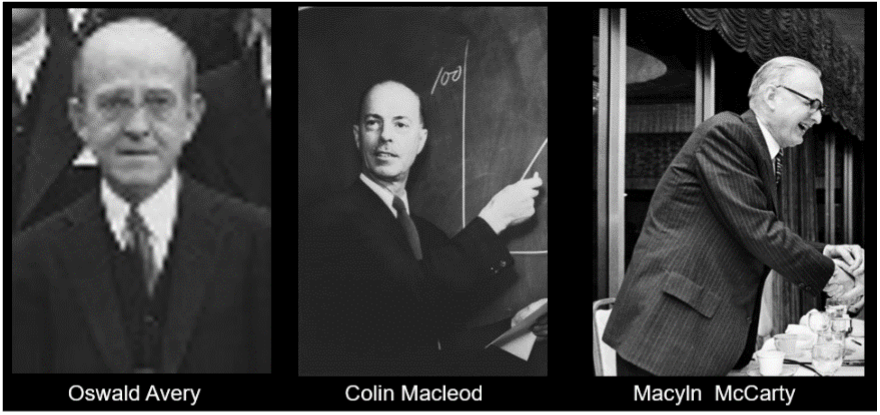
The hero of our story, Oswald Theodore Avery (1877-1955), was born in Nova Scotia but grew up in the United States. He received a medical degree from Columbia University College of Physicians and Surgeons in New York City in 1904. He joined the Rockefeller Institute in 1913 at age 36 with the mission, like Griffith, of investigating the pathogen that causes pneumonia, eventually tackling the challenge of determining the nature of Griffith’s transforming substance. He was joined in this effort by Colin Macleod and Macyln McCarty.
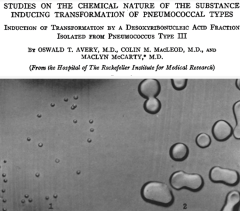
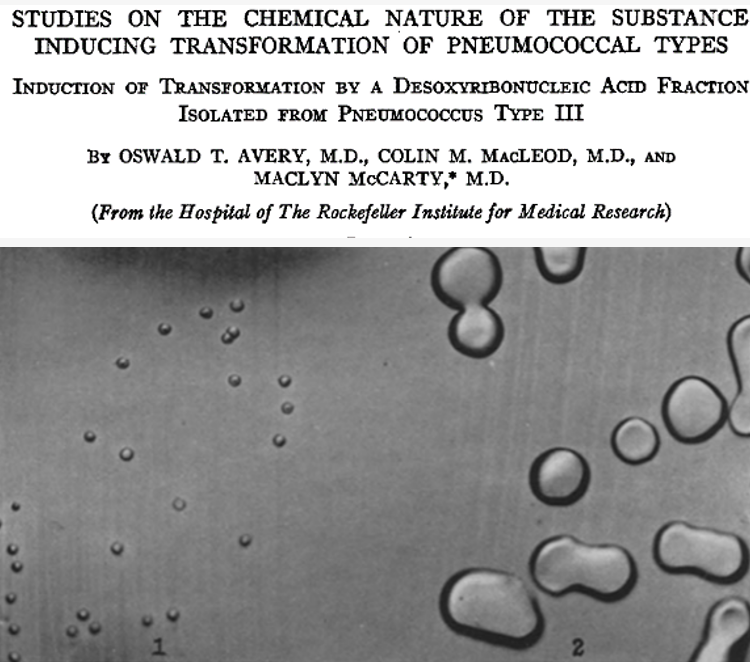
Avery, Macleod, and McCarty’s findings were submitted to the Journal of Experimental Medicine in 1943 (and published in 1944). Replicating the results of earlier investigators, Avery et al. observed that an R strain, which formed small colonies on agar (left), could be converted to an S strain, which formed “smooth, glistening, mucoid” colonies (right), by treatment with transforming principle. In their historic publication, the authors reported the purification of the transforming principle and presented compelling evidence that it was DNA. Like Alloway, they showed that transforming principle from a serotype III virulent strain could be precipitated as a fibrous, viscous material from an extract of virulent pneumococcus cells with ethanol and then solubilized in saline without losing activity. They then treated the principle with chloroform, which precipitated protein but not the transforming activity. Next, they treated the principle with an enzyme that degraded the polysaccharide capsule, again without losing transforming activity. They further showed that transforming activity was insensitive to purified proteases (crystalline trypsin and chymotrypsin) and an RNA-degrading enzyme (RNase).
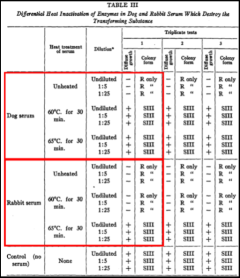
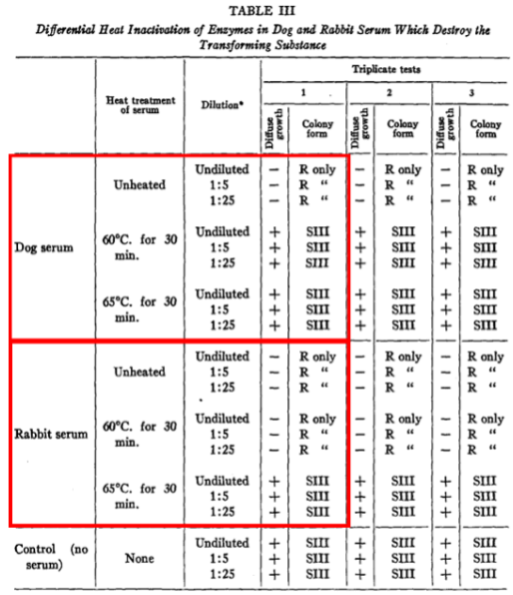
Transforming principle was, however, destroyed by rabbit and dog serum, which contained DNA-degrading enzymes (DNase). Pure enzyme was not available, but they took advantage of the fact that the DNases in dog and rabbit sera were temperature sensitive but at different temperatures. As highlighted by the upper red box in the Table below, when dog serum was incubated at temperatures of 60°C or 65°C, which were known to inactivate the enzyme as separately judged by effects on the viscosity of DNA (documented elsewhere in the publication), transforming activity was retained, that is, cells treated with the transforming substance were converted to serotype III. In contrast, the DNase activity in rabbit serum was inactivated only when incubated at the higher temperature of 65°C. As seen in the Table (lower red box), the capacity of the principle to transform a rough mutant to serotype III was destroyed by rabbit serum that had been incubated at 60°C but was retained when incubated with rabbit serum that had been incubated at 65oC. Thus, the capacity of the two sera to inactivate transforming substance was closely correlated with the temperature sensitivity properties of the DNase activities as measured by loss of the viscosity of DNA.
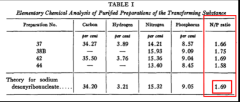
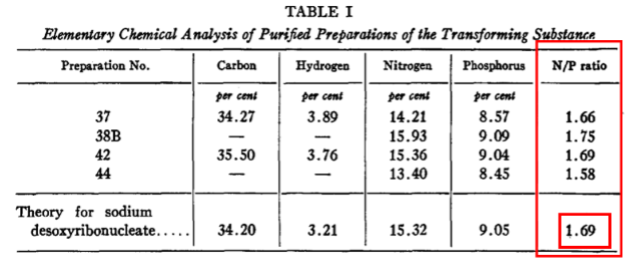
Perhaps most impressively, elementary chemical analysis showed that the transforming substance had a low ratio of nitrogen (N) to phosphorous (P), consistent with its being DNA and not protein. The observed ratios for four independent preparations were close to the theoretical value of 1.69 (as highlighted in red in Table 1). DNA is rich in phosphorous (nucleotides are joined by phosphodiester bonds) whereas proteins generally lack phosphates (unless they are phosphorylated and then usually at only one or a small number of amino acid residues).
Avery et al. summarize by saying that:
“…a biologically active fraction has been isolated in highly purified form which in exceedingly minute amounts is capable …of inducing the transformation of unencapsulated R variants of Pneumococcus….”
The fraction
“…..consists principally, if not solely, of a highly polymerized, viscous form of desoxyribonucleic acid.”
And they point out that the
“…induced alterations ….are predictable, type-specific, and transmissible …..”
Importantly, they also point out that the
“induced changes are not temporary modifications but are permanent alterations…”
Notice that Avery et al. did not explicitly state that the transforming principle is the stuff of heredity, which gave rise to the suspicion that the authors did not appreciate the significance of their own work. But this is refuted by a letter Avery wrote to his brother in Tennessee in which he stated that “by means of a known chemical substance it is possible to induce predictable and hereditary changes in cells. This is something that has long been the dream of geneticists…Sounds like a virus, maybe a gene.”
As a footnote to the discoveries of Griffith and Avery, we now know that many species of bacteria (pneumococcus among them but not E. coli) have a natural capacity to import DNA fragments from outside the cell and then incorporate the DNA into the chromosome by homologous recombination. The bacteria enter a state of “genetic competence” in which they can undergo DNA-mediated transformation. Thus, in the case of the experiments we have been discussing, a mutation that blocks capsule production in a rough mutant of pneumococcus can be corrected by uptake of wild type DNA during competence by DNA-mediated transformation. Indeed, genes for a particular capsule serotype can be thereby replaced by genes for another serotype.
We will turn to the perplexing issue of why Avery’s momentous discovery did not garner wide acceptance in the next two chapters. Nonetheless, it was appreciated by some investigators. One such individual was Harriet Taylor (later Ephrussi-Taylor), who in the words of Joshua Lederberg,
“…. was one of the first geneticists to recognize the importance of Avery, McLeod, and McCarty's 1944 paper on DNA as the transforming principle. After receiving her doctorate from Columbia University, she transferred to Avery's laboratory at the Rockefeller Institute in the summer of 1945. She studied the role of DNA in inheritance under Avery until both left Rockefeller in 1948.”
Importantly, Taylor extended Avery’s discovery to a gene unrelated to capsule production. Specifically, she demonstrated that pneumococcus sensitive to the antibiotic streptomycin could be transformed to streptomycin-resistance by DNA-mediated transformation with DNA from a streptomycin-resistant strain. This important achievement was captured in the following educational video below in which Taylor can be seen transforming cells to antibiotic resistance and then using the transformed cells to spell out the word DNA!