Chapter 1: Schrödinger asks “What is Life?”
“..the most essential part of the living cell, the chromosome fibre, is a piece of matter that differs entirely from any matter hitherto studied by the physicist. It may suitably be called an aperiodic crystal. By this is meant a regular array of repeating units in which the individual units are not all the same.”
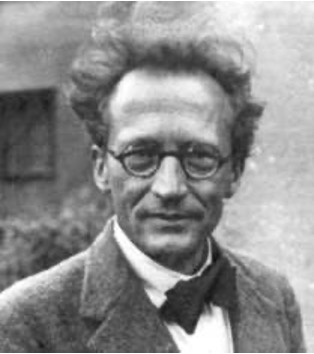
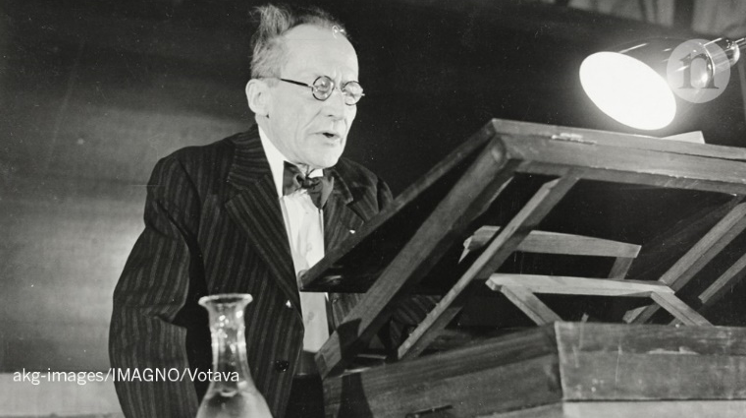
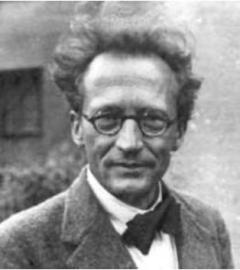
The great Austrian Physicist and Nobel Laureate Erwin Schrödinger (1887-1961) was known for wave theory. Rather than thinking of electrons as particles according to quantum theory, he argued that they should be thought of as waves. His famous Schrödinger’s wave equation was a powerful tool for dealing with the nature of matter. His famous Schrödinger’s Cat was a jab at the Copenhagen school, which advocated particle/wave duality. But he also had a profound influence on biology.
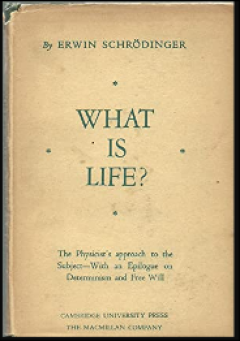
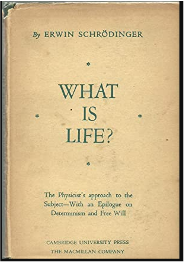
After fleeing the Nazis, he moved to Dublin were in a series of public lectures in 1943 and in a book based on those lectures published the following year, Schrödinger, posed the above question, a question that engaged physicists in the nature of living things and drew them into biology
He asserted that “…from all we have learnt about the structure of living matter, we must be prepared to find it working in a manner that cannot be reduced to the ordinary laws of physics.” Schrödinger based this assertion on two big ideas. First, he argued that the state of knowledge in physics and chemistry could not explain how living things maintain order, given that the Second Law of Thermodynamics holds that disorder (entropy) in the universe always increases. His second big idea, which is related to the first, is that the hereditary material represents a highly ordered state. Specifically, he argued, presciently, that chromosomes should be thought of as an “aperiodic solid with a regular array of repeating units in which the units are not the same”. In other words, chromosomes embed a linear code.
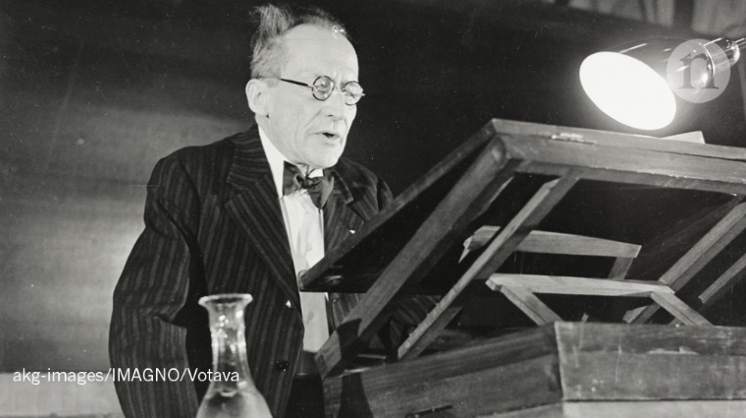
“Every process, event, happening — call it what you will; in a word, everything that is going on in Nature means an increase of the entropy of the part of the world where it is going on. Thus, a living organism continually increases its entropy — or, as you may say, produces positive entropy - and thus tends to approach the dangerous state of maximum entropy, which is death. It can only keep aloof from it, i.e. alive, by continually drawing from its environment negative entropy — which is something very positive as we shall immediately see. What an organism feeds upon is negative entropy.”
“An organism's astonishing gift of concentrating a 'stream of order' on itself and thus escaping the decay into atomic chaos — of 'drinking orderliness' from a suitable environment — seems to be connected with the presence of the 'aperiodic solids', the chromosome molecules, which doubtless represent the highest degree of well-ordered atomic association we know of - much higher than the ordinary periodic crystal — in virtue of the individual role every atom and every radical is playing here.”
“…we are here obviously faced with events whose regular and lawful unfolding is guided by a 'mechanism' entirely different from the 'probability mechanism, of physics. For it is simply a fact of observation that the guiding principle in every cell is embodied in a single atomic association existing only in one copy (or sometimes two) — and a fact of observation that it results in producing events which are a paragon of orderliness. Whether we find it astonishing or whether we find it quite plausible that a small but highly organized group of atoms be capable of acting in this manner, the situation is unprecedented, it is unknown anywhere else except in living matter.”
“How can the events in space and time which take place within the boundary of a living organism be accounted for by physics and chemistry? These sciences cannot answer the question, but in the future they will be able to do so. The reason no answer can be given now is that the most essential part of the living cell, the chromosome fibre, is a piece of matter that differs entirely from any matter hitherto studied by the physicist. It may suitably be called an aperiodic crystal. By this is meant a regular array of repeating units in which the individual units are not all the same.”
Schrödinger’s insights were breathtaking and prescient. But like many others, Schrödinger assumed that this aperiodic solid must be protein, given that only protein with its diverse chemical features (being composed of twenty amino acids) would be capable of serving as a storehouse of the linear code. Ironically, at the same time, and as we shall see, Avery and his colleagues were discovering that the genetic material is not protein but rather DNA.
What is Life? had a profound influence on future pioneers of molecular biology, both biologists and physicists. James Watson wrote:
“I was 17, almost 3 years into college, and after a summer in the North Woods, I came back to the University of Chicago and spotted the tiny book What is Life by the theoretical physicist Erwin Schrödinger. In that little gem, Schrödinger said the essence of life was the gene. Up until then, I was interested in birds. But then I thought, well, if the gene is the essence of life, I want to know more about it. And that was fateful because, otherwise, I would have spent my life studying birds and no one would have heard of me”.
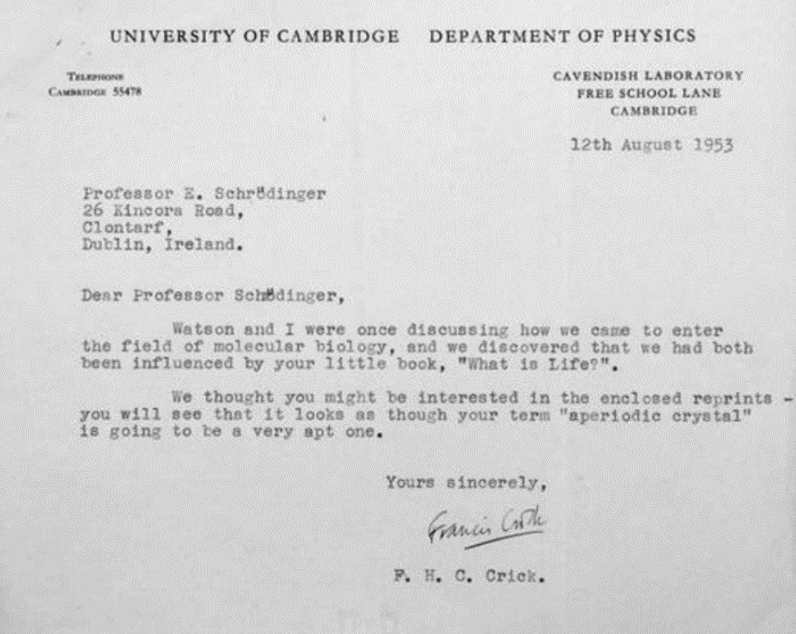
Francis Crick thought that the book was 'peculiarly influential' and 'attracted people who might otherwise not have entered biology at all’ and sent the following letter to Schrödinger:
"Dear Professor Schrödinger.
Watson and I were once discussing how we came to enter the field of molecular biology, and we discovered that we had both been influenced by your little book, "What is Life?".
We thought you might be interested in the enclosed reprints - you will see that it looks as though your term "aperiodic crystal" is going to be a very apt one.
Yours sincerely,
Francis Crick"
Maurice Wilkins reported that “Schrödinger's book had a very positive effect on me and got me, for the first time, interested in biological problems”.
Seymour Benzer was fascinated by Schrödinger's concept of the 'aperiodic crystal'.
Francois Jacob wrote that after returning to Paris after the liberation of France from the Nazis and finding himself bored working in industry to produce an antibiotic he spent the best part of his time reading, including Evolution: The Modern Synthesis by Julian Huxley and What is Life? by Schrödinger.
As asserted in the Preface, and as we remind the reader, people are complex. Even the greatest of scientists may excel in certain domains and fall short in others, such as in their personal life. Schrödinger is such an example. Outside social norms, he was polyamorous and kept a record of his affairs. He developed Schrödinger’s Equation while on vacation in Switzerland with his mistress, leaving his wife behind. But far more disturbingly, he tutored 14-year-old twin girls, Withy and Ithy Junger, one of whom (“Ithy-bitty” as he called her) he fondled and got pregnant at age 17. She subsequently had a disastrous abortion, which left her sterile while he lost interest in her.