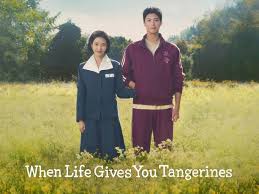
“When Life Gives You Tangerines" by Lim Sang-choon and Kim Won-seok, contributed by Eunah Jo (2025)
My contribution is the recently released Netflix Korean drama “When Life Gives You Tangerines.”
The Korean title is 폭싹 속았수다, or Pokssak Sogatsuda. It is a Jeju dialect phrase that generally translates to “thank you for working hard” or “you’ve worked so hard”. Rather than a literal translation, the English title is a play on the phrase “when life gives you lemons, make lemonade”, substituting lemons for tangerines, which are the hallmark fruit of Jeju Island.
The 16-episode drama follows the lives of three generations of women born in Jeju Island, a volcanic island off the southern coast of Korea known for its unique culture, language, and customs. Unlike the Korean mainland, Jeju has its own dialect and a history shaped by isolation, poverty, and resilience. One of the island’s most iconic figures are the haenyeo, female divers who free-dive for seafood. Spanning 65 years from the 1960s to the present, the series sheds light on the struggles of parents who endured hardship in the aftermath of the Korean War, all while hoping their children might lead gentler, freer lives.
I chose When Life Gives You Tangerines because it offers such a uniquely textured portrait of loss—not just the loss of loved ones, but also the quieter, often unspoken losses that accumulate across a lifetime. The show captures the generational toll of sacrifice, the fading of dialect and culture, the missed chances and unlived dreams. It’s rare to see a drama that gives equal weight to emotional resilience and unresolved grief, especially through the lens of women’s lives in a place as specific as Jeju Island. The drama captures what it means to grow up with the weight of someone else’s sacrifices, and to keep moving forward while still feeling the pull of what’s been left behind. It reminded me that loss isn’t always loud or final but can be slow, gentle, and even loving in how it shapes the people we become.