Watson Crick Portrait
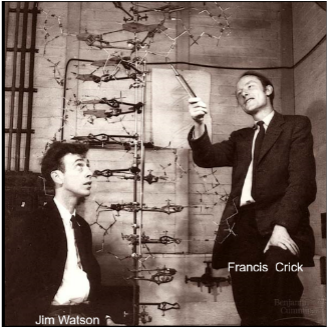
1 2025-01-22T09:20:35-05:00 George Shaohua Qiao 78e5371050dd5c0e21d36bad469c70d8d4be5464 225 1 A photo of Francis Crick, standing, gesturing at a large 3D model of DNA with a baton, while Jim Watson, seated, looks towawrd where Crick is gesturing. plain 2025-01-22T09:20:35-05:00 George Shaohua Qiao 78e5371050dd5c0e21d36bad469c70d8d4be5464This page is referenced by:
-
1
2025-01-22T09:20:26-05:00
Chapter 7: Watson and Crick propose that DNA is an anti-parallel double helix held by A:T and G:C base pairs
23
plain
2026-07-22T11:44:22-04:00
“It has not escaped our notice that the specific pairing we have postulated immediately suggest a possible copying mechanism for the genetic material.”
No doubt two of the most famous names in science are Francis Crick (1916- 2004) and James Watson (1928-2025). They are universally known for solving the structure of the double helix and will undoubtedly be remembered hundreds of years from now. How did they come to this revolutionary discovery, a discovery that held major implications for how the genetic material works? What was the influence of Rosalind Franklin, Maurice Wilkins and Linus Pauling?
Francis Crick was a British theoretician of molecular biology (with one notable exception; chapter 10). His education as a physicist was interrupted by World War II during which he worked at the British Admiralty Research Laboratory on the design of new mines that would be effective against German minesweepers. He later joined the Cavendish Laboratory in Cambridge headed by Sir Lawrence Bragg, who pioneered X-ray crystallography for which he won a Nobel Prize. Crick completed his PhD at Cavendish in 1954 under the mentorship of future Nobel Laureate Max Perutz. During his Ph.D. work, Crick helped develop a theory for the X-ray diffraction pattern of the α-helix of proteins as discovered by Linus Pauling. This theoretical work was published in 1952 and equipped Crick to interpret Photo 51 of Franklin and Gosling, as we will come to. He was joined at the Cavendish Laboratory when he was 35 by Jim Watson who at 23 already had a PhD. Later in his career he became an advocate for the origin of life theory Panspermia, which held that life arose elsewhere in the universe and was sent to Earth by intelligent life. He later moved to the Salk Institute in California and focused on neurobiology until his death.
Jim Watson (1928-2025), who had been an undergraduate at the University of Chicago (1947), considered becoming an ornithologist. As we saw, he read What is Life?, which influenced him to switch from birds to genetics. He went to graduate school at Indiana University, attracted by the presence of Nobel Prize-winning Drosophila geneticist Hermann Muller, whose work on the mutagenic effects of X-rays were pertinent to understanding Schrödinger’s genetic material. But once at Indiana he joined the lab of Salvador Luria (1948) with whom he studied phage genetics. He met Delbrück through Luria and during a visit to Cold Spring Harbor Laboratory. After completing his PhD, he joined Herman Kalckar at Copenhagen University and Phage Group member Ole Maaloe. While in Europe Watson heard a talk from Maurice Wilkins on the X-ray diffraction pattern for DNA, which intrigued him. Luria arranged for Watson to join the Cavendish Laboratory in Cambridge where he was supposed to focus on protein structure but managed to join Crick in tackling the structure of DNA. After solving the structure of DNA with Crick, Watson moved to Harvard (1956-1976) where he wrote Molecular Biology of the Gene and The Double Helix. Famously, he fought with the more traditional biologists, such as E.O. Wilson whom he called a “stamp collector”. Wilson in turn called Watson and his molecular biology cronies, “Storm Troopers.” He married undergraduate Radcliffe student Liz Lewis in 1968. Watson moved to the Cold Spring Harbor Laboratory in 1976, transforming it into a center for virology and cancer molecular biology. He led the Human Genome Project of the NIH in 1990 and had his own genome sequenced and published. Watson wrote Avoid Boring People with its famously ambiguous title.
Watson and Crick benefited from the X-ray diffraction results of Franklin and Gosling and from gaining access to Photo 51. Watson attended a talk by Franklin in 1951 and Wilkins showed Watson Photo 51 without Franklin’s knowledge. Also, Crick’s PhD supervisor at the Cavendish Laboratory, Max Perutz, shared a report written for a visiting committee at King’s College in 1952 with Crick. Perutz was on the visiting committee. Both King’s College and Cavendish were part of the Medical Research Council, and the report was intended to facilitate coordination. As we have seen, Crick was already an expert on X-ray diffraction theory, having co-authored reports on the mathematical theory for diffraction by helices. Like Pauling, Watson and Crick initially proposed a three-stranded structure for DNA but during a visit to Cavendish in 1951, Franklin pointed out that their model could not be correct. This was seen as embarrassing, and Director Bragg initially instructed Watson and Crick to focus on protein structures. (Crick was working on hemoglobin at the time.)
But what saved the day was the perceived competition from Pauling, whose immense stature loomed over King’s College and the Cavendish Laboratory. In 1952, Pauling’s son Peter, who was a student in Cambridge, received a copy of his father’s manuscript on the structure of DNA, which he shared with Watson and Crick. They quickly realized that Pauling had made the same mistake as they had in 1951 in proposing a three-stranded model. But would Pauling realize his mistake and get it right the next time? Bragg relented and Watson and Crick were allowed to work full time on DNA.
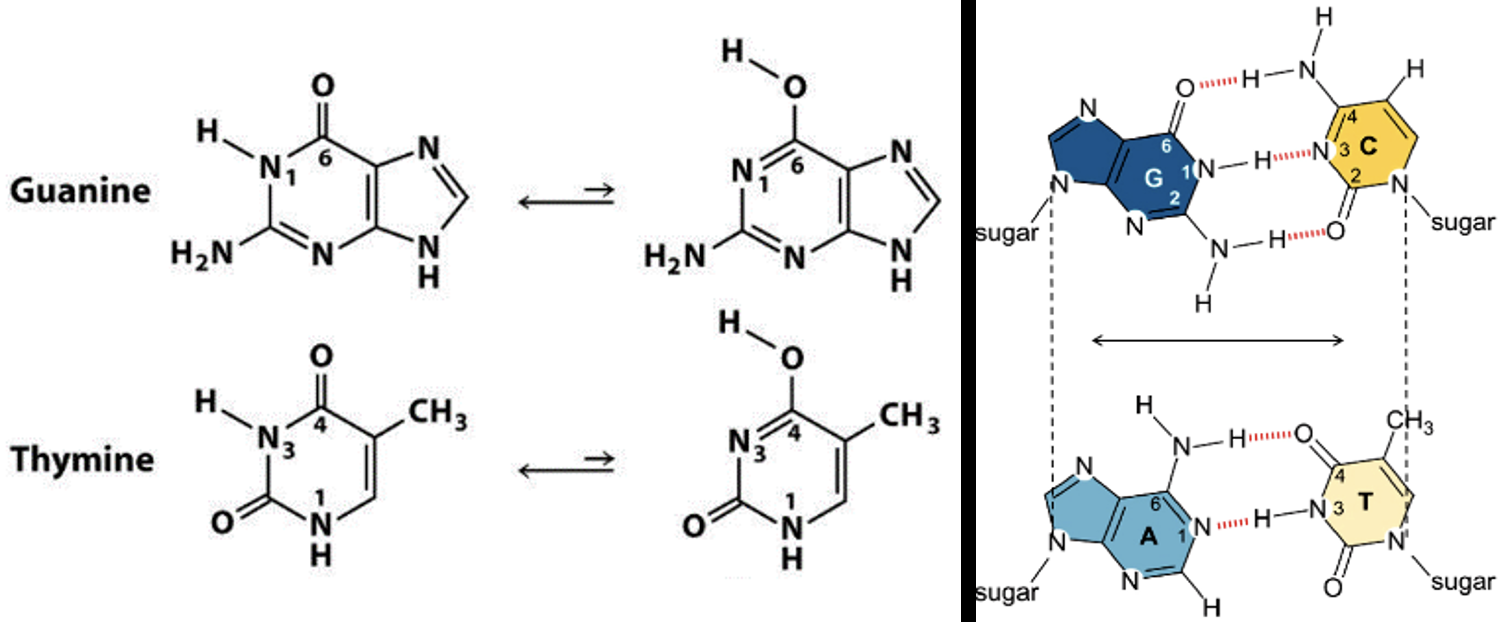
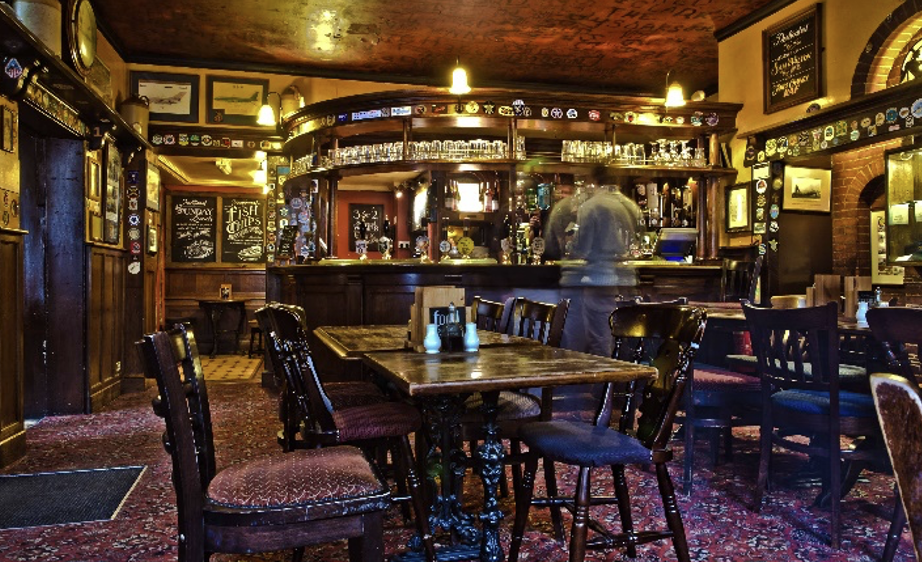
Knowing the results from Franklin, Gosling and Wilkins, Crick realized that the structure had to be a double helix with the bases on the inside. Also, because of the (C2) symmetry of the X-ray diffraction spacings, Crick concluded the structure had to be antiparallel, with the two deoxy polynucleotide chains having opposite, 5’-3’ orientations, which Franklin had not realized (see Crick's letter in the Postscript on the role of the C2 symmetry in building a model for the structure of DNA.) Meanwhile, Watson used model building with carboard cutouts to align the bases. He knew from the publications of Gulland and co-workers on acid and alkalai titration of DNA (see postscript at the end of Chapter 4) that the bases in DNA form hydrogen bonds with each other. But Watson was not trained in organic chemistry. He didn’t realize that guanine and thymine exist in two resonance states, with the keto state (on the left above) being strongly favored over the enol state, and he was using the disfavored enol state in his model building. Crucially, Pauling-trained chemist, Jerry Donahue, pointed out this error to Watson. Pushing around cardboard cutouts with the correct keto structures, Watson found that adenine would pair with thymine via hydrogen bonds and guanine with cytosine and that the two base pairs have the same dimensions along their long axes (on the right above). This discovery took place on Saturday, February 28th in 1953. Watson and Crick knew they had uncovered the correct structure. According to legend, they rushed off to the Eagle Pub in Cambridge where Crick is said to have exclaimed that they had “found the secret of life.”
The historic moment is fancifully captured in the video.
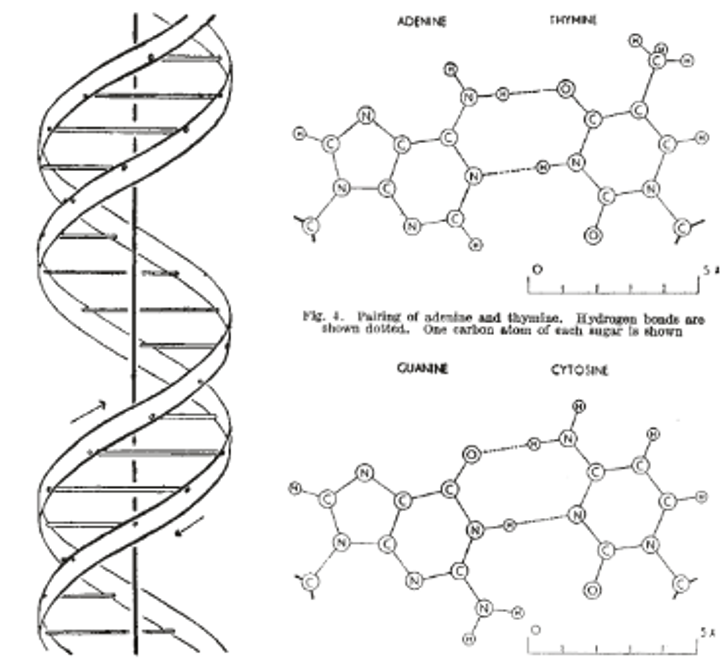
Watson and Crick reported their proposed model in a short paper with just one figure in Nature. It was the first of three back-to-back publications together with the publications of Wilkins and co-workers and Franklin and Gosling (as noted in chapter 6):- Watson, J. and Crick, F. (1953) “Molecular Structure of Nucleic Acids: A Structure for Deoxyribose Nucleic Acid” 171:737–738
- Wilkins, M. H.; Stokes, A. R. and Wilson, H. R. (1953) "Molecular structure of deoxypentose nucleic acids" 171:738–740
- Franklin, R. E. and Gosling, R. G. (1953) "Molecular Configuration in Sodium Thymonucleate" 171:740–741]
Watson and Crick ended their first publication with, perhaps, the most famous understatement in the history of science: “It has not escaped our notice that the specific pairing we have postulated immediately suggests a possible copying mechanism for the genetic material.” It is said that that they settled on this cautious statement as a compromise because Watson, for his part, was afraid the copying mechanism (semi-conservative replication as we come to in the next chapter) might be wrong, and Crick, meanwhile, was concerned that if they said nothing it would appear they had missed the enormous insight revealed by their model.
Not only had Watson and Crick solved the structure of the stuff of genes, but the structure revealed unexpected insights into how the genetic material works, how it is duplicated and how it could encode proteins as stated by Sydney Brenner, one of the giants of molecular biology who we will encounter shortly (video).
Surely, base pairing and the double helical model for DNA and the stunning implications of the model rank as one of the greatest discoveries in biology of the 20th century along with Avery and co-workers’ discovery that the genetic material is DNA.
In the acknowledgement to their report, they conveyed their indebtedness to Jerry Donohue and indicated that they were also “stimulated by a knowledge of the general nature of the unpublished experimental results and ideas of Dr. M.H. F. Wilkins, Dr. R. E. Franklin and their co-workers…” Many feel this statement seriously understated the contribution that Franklin’s X-ray images made to the elucidation of the anti-parallel double helix model, compounded by the fact that her results were shared with Watson and Crick without her knowledge. The Nobel Prize was awarded to Wilkins, Watson and Crick in 1962. One can only wonder what the Nobel Committee would have decided if she had not passed away prematurely (only three investigators can share the Prize, and they must all be alive). The controversy is elegantly laid out by Franklin’s colleague at Birbeck College and future Nobel Prize-winner Aaron Klug in the video below.
Finally, and as stated in the Preface, people are complex and can have good sides and less than admirable aspects to their behavior. Crick was said to have been a womanizer, and most distressingly, is accused of inappropriately touching a female undergraduate during a visit to Watson’s laboratory at Harvard. Meanwhile, Watson has made painful remarks about women, ethnic groups, and, most disturbingly, about Blacks as captured in the documentary “Decoding Watson.”
Postscript: Crick’s letter to Mark Bretscher on the use of the C2 symmetry in generating a model for the structure of DNA.