PaJoMo Header
1 2025-01-22T09:20:32-05:00 George Shaohua Qiao 78e5371050dd5c0e21d36bad469c70d8d4be5464 225 1 The header from "PaJoMo"'s 1959 publication, "The Genetic Control and Cytoplasmic Expression of Inducibility in the Synthesis of beta-galactosidase by E. Coli" plain 2025-01-22T09:20:32-05:00 George Shaohua Qiao 78e5371050dd5c0e21d36bad469c70d8d4be5464This page is referenced by:
-
1
2025-01-22T09:20:25-05:00
Chapter 12: The PaJaMo Experiment Reveals Negative Regulation
4
plain
2025-04-03T11:15:54-04:00
“…cells with the constitution z+i+ synthesize enzyme in the presence of inducer only, while z+i- cells synthesize enzyme without induction...”
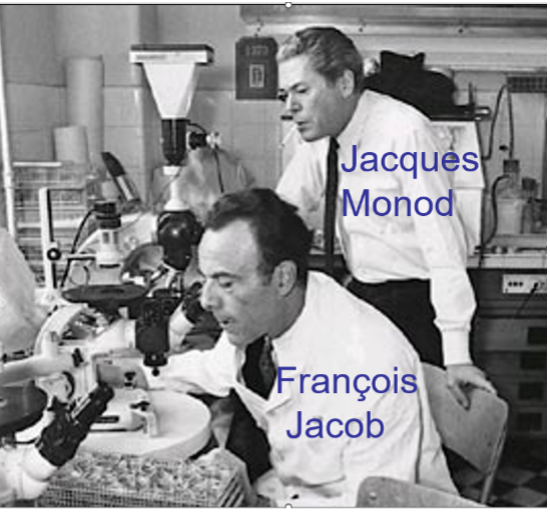
The human genome comprises more than 20,000 genes, and the human body comprises large numbers of different cell types and tissues that express different sets of genes at different times. How does this regulation work? The vast and still evolving story of our understanding of how genes are controlled began with the pioneering discoveries of the French microbiologists François Jacob, Jacques Monod and André Lwoff for which they would share the Nobel Prize in 1965.
André Lwoff (1902-1994) joined the Institut Pasteur in 1921 where he would create a division famously known as the “Attic.” He was later joined in the Attic first by Monod and then Jacob. Lwoff was responsible for the discovery that bacteria can become lysogenic; that is, they can harbor certain phage in a dormant state known as a prophage. He showed that the prophage can be induced to resume lytic growth.
Jacques Monod (1910-1976) spent a year (1936) before his Ph.D. working in the lab of the famous fly geneticist Thomas Hunt Morgan at CalTech on a grant from the Rockefeller Foundation. Monod obtained his PhD at the Faculty of Science in 1941. He served in the French underground, and after the liberation of France joined Lwoff in the Attic, eventually becoming Director of the Institut Pasteur (1971). Monod’s interest in the regulation of lactose utilization by E. coli stemmed from his Ph.D. thesis on the sequential utilization of sugars by E. coli. Monod liked to generalize and famously said, “What is true for E. coli is true for elephants.” Monod additionally made important contributions to the concept known as allostery that enzymes can exist in alternative conformational states. Monod was also a philosopher and was close to Albert Camus and the French Existentialists. While he could be obstinate, as we will see, Monod was charming as is evident in this video:
François Jacob (1920-2013) entered medical school in 1938 with an interest in surgery but left after two years to join the French resistance, becoming a member of the French 2nd Armored Division in 1940. He was injured in a German air attack in north Africa (Tunisia). He was subsequently severely wounded in Normandy in 1944, thwarting a career as a surgeon. Nonetheless, after the war, he returned to complete his medical degree. Finally, at age 30 he succeeded in joining Andre Lwoff. Jacob recalls repeatedly and unsuccessfully applying to join the Attic until at last Lwoff told him that he had just discovered induction of a prophage and asked him whether he would be interested in working on phage. Jacob did not know what a prophage was but said, “That’s just what I’d like to do.” In the Attic, Jacob began a collaboration with Monod studying the regulation of lactose utilization by the lac operon. Jacob spoke of “day science” and “night science.” He described day science as how we present our discoveries…as a linear progression of observations and scientific design to a “violà” conclusion. Night science is how the discovery process really happens, in its messy progressive, questioning progression, where we construct and then demolish hopeful hypotheses, “fighting a lot with yourself.” His life’s journey from the battlefield to the laboratory is breathtakingly told in his philosophical autobiography The Statue Within.
Here we will principally focus on a series of historic experiments carried out with postdoctoral fellow Arthur Pardee, famously known as the PaJaMo (Pardee, Jacob and Monod) experiments. The starting point for these experiments was the observation that the production of the enzyme for the utilization of lactose, -galactosidase, can be induced by the presence of lactose. Rather than use lactose they used artificial inducers (IPTG and TMG) that are not degraded by the enzyme.
The starting point for the PaJaMo experiments was a series of closely linked mutations that exhibited opposite phenotypes. Mutations of the z gene, z-, were blocked in production of β-galactosidase whereas mutations of the i gene, i-, produced the enzyme constitutively. The big question Pardee, Jacob and Monod wanted to answer was whether z- and i- were mutations in the same gene or two nearby genes: “The next and most critical problem is whether the z and i factors also belong to the same unit of function (gene or cistron) or not. Let us recall that cells with the constitution z+i+ synthesize enzyme in presence of inducer only, while z+i- cells synthesize enzyme without induction, and z-i+ or z-i- cells do not synthesize enzyme under any condition. The extremely close linkage of z and i mutations suggests that they may belong to the same unit. If this were so, they would not be able to interact through the cytoplasm, but could act together only when in cis position within the same genetic unit. The heterozygote, z+i+/z-i- would then be expected not to synthesize galactosidase constitutively.”
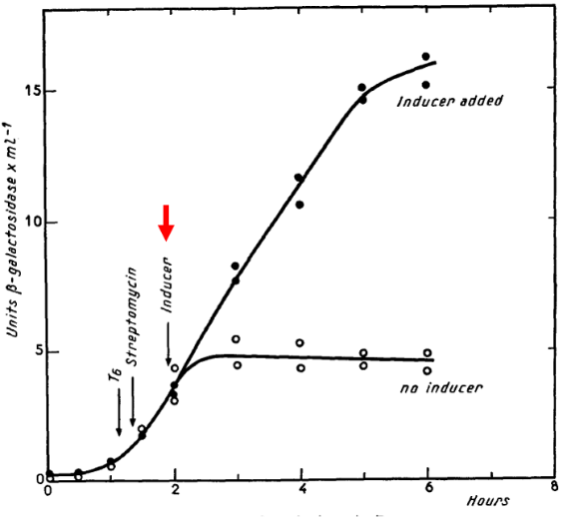
To address this question, they carried out a mating experiment in which they introduced the wildtype, z+i+, into a doubly mutant strain, z-i-, and asked whether the “heterozygote” would produce enzyme in the absence of inducer. On their own the wildtype z+i+ and the double mutant z-i- failed to produce β-galactosidase in the absence of inducer; the wildtype needs inducer and the doubly mutant strain is mutant for z. The striking result was that the heterozygote did synthesize β-galactosidase and did so in the absence of inducer. Furthermore, synthesis was transitory, lasting only for about two hours and then shutting off as seen in the figure. This was interpreted as indicating that the zygotes eventually become inducible as the i+ gene from the male becomes expressed following mating. Indeed, addition of inducer at hour 2 (highlighted in red) immediately triggered β-galactosidase synthesis. They concluded that, “The i gene in its active form controls the synthesis of a product which, when present in the cytoplasm, prevents the synthesis of β-galactosidase…” Hence i produces a “repressor,” but they end their historic publication by leaving two questions unanswered:
“(a) What is the chemical nature of the repressor? Should it be considered a primary or a secondary product of the gene?
(b) Does the repressor act at the level of the gene itself, or at the level of the cytoplasmic gene-product…?”
Pardee, Jacob and Monod went on to propose that the same basic mechanism operates for phage λ in its prophage state, that is, that a phage repressor blocks “synthesis of proteins determined by other genes of the phage…” This was based on the observation in earlier work that when a male bacterium lysogenic for phage λ was mated with a female bacterium lacking the prophage, induction of the phage was triggered. As engagingly described by Jacob, this phenomenon was “immediately baptized ‘erotic induction ’of the prophage; which for purposes of publication was to be changed to ‘zygotic induction’.”
Jacob tells the story that while Monod was on summer vacation, he realized that both the lac operon and Lwoff’s prophage are under negative control by repressors. “Both experiments, conjugation done… on the phage and the PA JA MA are the same! Same situation. Same result. Same conclusion. In both cases a gene governs the formation of a ….repressor blocking the expression of other genes…” Monod, who could be obstinate, pushed back against this idea upon his return from vacation but was eventually won over.
Later work would show that the lactose system is an operon that includes z and two other genes y and a that are all transcribed from a common promoter. This is known as the Lac operon. The repressor gene i is adjacent to the operon and is transcribed from its own promoter. Also, as we come to in the next chapter, work by Wally Gilbert for the Lac repressor and Mark Ptashne for the phage λ repressor answered the questions posed by Pardee, Jacob and Monod (above): Repressors are proteins that bind to sites called operators to block transcription of genes under their control- the gene for β-galactosidase in the case of the Lac repressor and phage λ genes in the case of the phage repressor. Furthermore, in the case of the lactose system, the inducer works by binding to the repressor, trapping it in a state in which it is unable to bind to the operator. In the case of phage λ, phage induction is triggered by ultraviolet light which destroys the repressor.
Monod was also famously obstinate in asserting that negative regulation could explain all gene control. Ironically, later work would show that the lactose system is itself a paradigm for positive control as well as negative control; transcription requires not only the absence of repressor but also the presence of an activator protein called CAP.
As we will revisit in chapter 14, the PaJaMo experiments set the stage for realizing that genetic information is transferred into protein by an unstable intermediate.“The conclusion seems, therefore, inescapable that upon transfer a genetic determinant can, within a few minutes and much before integration as a part of a complete genome, be expressed by the synthesis of a protein at a rate close to the expected maximum…One of the most remarkable features brought out by the preliminary experiments summarized in this paper is the rapidity with which β-galactosidase can be synthesized during conjugation. The time between the introduction into the cell of the genetic determinant controlling enzyme synthesis and the appearance of a detectable amount of β-galactosidase seems to be extremely short, not exceeding a few minutes. Such a lag is rather small for what could be expected a priori for the synthesis of stable macromolecular intermediates.”
We conclude with an excerpt from video interview (with Stanford Professor Lucy Shapiro) in which Jacob revisits the classic PaJaMo experiments: