Kornberg Enzymatic Synthesis
1 2025-01-22T09:20:31-05:00 George Shaohua Qiao 78e5371050dd5c0e21d36bad469c70d8d4be5464 225 1 "Enzymatic Synthesis of Deoxyribonucleic Acid" by Arthur Kornberg plain 2025-01-22T09:20:31-05:00 George Shaohua Qiao 78e5371050dd5c0e21d36bad469c70d8d4be5464This page is referenced by:
-
1
2025-01-22T09:20:25-05:00
Chapter 15: Grunberg-Manago, Ochoa and Kornberg discover enzymes that can synthesize polynucleotides
9
plain
2025-04-03T11:18:19-04:00
“I will never forget the day I saw the new UV spot. I was so excited that I wanted to tell everybody in the lab, but to my disappointment nobody was there as it was some kind of holiday.”
The next major challenge in molecular biology was elucidating the nature of the machinery that was responsible for the synthesis of polynucleotides. As we shall see the first enzymes that were discovered that were capable of synthesizing DNA and RNA turned out not to be responsible for the replication of DNA nor its transcription into messenger RNA. Nonetheless, both discoveries represented major advances in the history of molecular biology. We begin with the discovery of an enzyme that was capable of synthesizing polynucleotides, which unexpectedly played a pivotal role in deciphering the genetic code.
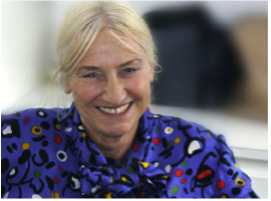
The unsung hero of this story is Marianne Grunberg-Manago (1921-2013). Born in Petrograd, Russia, she grew up in France, receiving her PhD at the University of Paris in 1947. She joined the laboratory of biochemist Severo Ochoa at NYU in 1954 where she made the transformative discovery of polynucleotide phosphorylase. She then returned to France, taking a position at the Institut de Biologie Physico-Chimique in 1956. Among her many honors, Grunberg-Manago was awarded the Charles Léopold-Mayer Prize and was elected to the French Academy of Sciences and became the first woman to be its president. She was also a member of the American Academy of Sciences and the Russian Academy of Sciences. She was the first woman to head the International Union of Biochemistry and Molecular Biology. And yet another distinction was the Federation of European Societies Diplôme d’Honneur. But what she didn’t win, and arguably should have, was the Nobel Prize.
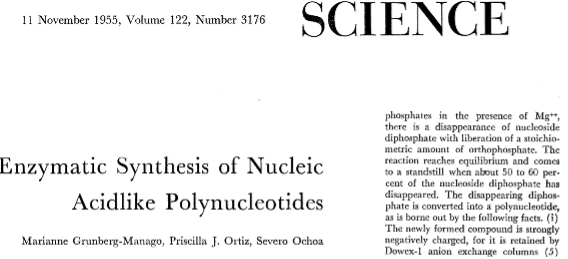
Her goal in Ochoa’s lab was to find new phosphorylated coenzymes by using an exchange reaction with ATP. She did observe such a reaction, but it turned out it was due to contaminating ADP in the ATP, as she later discovered. Also, the product of the reaction with ADP would not migrate from the origin during chromatography. Putting this altogether, she surmised that her enzyme was synthesizing a polynucleotide using ADP as substrate. Recalling her discovery she wrote, “I will never forget the day I saw the new UV spot. I was so excited that I wanted to tell everybody in the lab, but to my disappointment nobody was there as it was some kind of holiday.” The enzyme, which she named polynucleotide phosphorylase, was not restricted to ADP and used other nucleoside diphosphates and mixtures of nucleoside diphosphates as substrates.
The synthesis of polynucleotides from nucleoside diphosphates is not an energetically favorable reaction. And hence it turned out to be a degrative enzyme rather than a synthetic one. Nevertheless, as we shall see, it proved to be enormously useful in generating synthetic polynucleotides (homopolymers and copolymers) as templates for protein synthesis by running the reaction backwards (mass action). Indeed, as she wrote, “I was able to synthesize all kinds of homo- and copolymers and send them all over the world. When I was still at New York University, I recall giving to Jacques Fresco, who was working in the laboratory a floor below mine, some poly(A) and poly(U). Jacques mixed them and I was present at what I think was the first demonstration of the poly(A)-poly-(U) interaction: as if by magic, clear solutions of poly(A) and poly(U) were transformed into a solid gel. Jacques turned the tube upside down; not a drop came out.”
Grunberg-Manago’s mentor, Severo Ochoa (1905-1993) was a Spanish Physician and biochemist. He attended the University of Madrid Medical School where he hoped to work with the great neurobiologist Santiago Ramón y Cajal but Cajal retired. After completing his MD in 1931 he did postdoctoral work at the National Institute for Medical Research in London. The Spanish Civil War caused him to remain abroad, taking multiple positions in Europe and the United States. Finally, in 1942 he moved to the NYU School of Medicine, rising through the ranks to become Chair of Biochemistry. He became a US citizen in 1956 and won the Nobel Prize with Arthur Kornberg in 1959. He won the US Medal of Science in 1978 and returned to Spain in 1985. Notably absent from those being recognized was Grunberg-Manago, who discovered the enzyme for which Ochoa was being lauded.
Polynucleotide phosphorylase is an RNase, not a synthetic enzyme even though the reaction can be driven backwards to generate polynucleotides. The reason is that the reaction in the direction of polynucleotide synthesis is not energetically favorable (does not have a negative ΔGorxn):
where X is a ribonucleoside. The next major advance was the discovery of a true biosynthetic enzyme for (deoxy)polynucleotide synthesis by Arthur Kornberg.
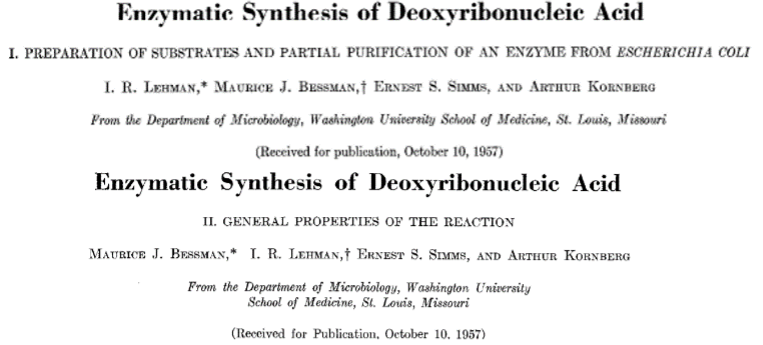
Arthur Kornberg (1918-2007) obtained his MD from University of Rochester in 1941. He worked in Ochoa’s laboratory in 1946, learning enzyme purification and then moved to the NIH from 1947 to 1953. He moved to Washington University where he became Professor and Head of Department of Microbiology from 1953 to 1959. It was at Washington University where he would discover DNA polymerase. His landmark discovery was reported in two back-to-back publications. Finally, Kornberg moved to Stanford in 1959 as Head of the Biochemistry Department where he remained for the rest of his career.
Kornberg’s DNA-synthesizing enzyme represented a major advance over polynucleotide phosphorylase in two respects. First, it was a true synthetic enzyme; the reaction was energetically favorable:
dXTP + (dXMP)n → (dXMP)n+1 + PPi .
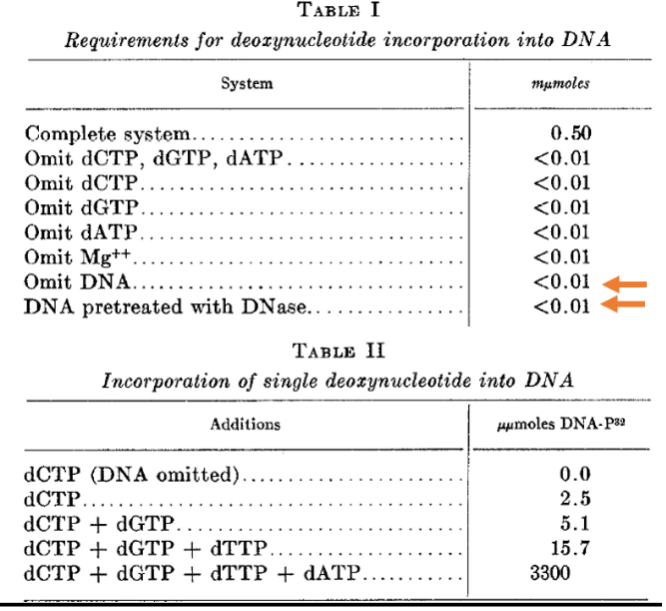
Also, in the cell, pyrophosphate (PPi) is hydrolyzed to inorganic phosphate in a second, favorable reaction, helping to further drive the reaction in the direction of synthesis. Second, the DNA polymerase reaction was dependent on DNA as a template. Some of the key properties of the enzyme are documented in Tables I and II. Both tables show that the reaction required all four deoxyribonucleoside triphosphates. Also, Table 1 shows that DNA synthesis was dependent on DNA (as highlighted by the red arrows).
As a postscript, Kornberg’s DNA polymerase is only one of several DNA polymerases in E. coli. Indeed, John Cairns succeeded in isolating a mutant of E. coli that lacked Kornberg’s enzyme and yet was viable. Instead, it had increased sensitivity to ultraviolet light. Thus, Kornberg’s DNA polymerase turned out not to be the enzyme responsible for DNA replication, but rather an enzyme that repaired damage to DNA. Nonetheless, it represented a major advance in molecular biology. In the video, Kornberg discusses the discovery of multiple DNA polymerases in E. coli, all using DNA as a template for DNA synthesis.
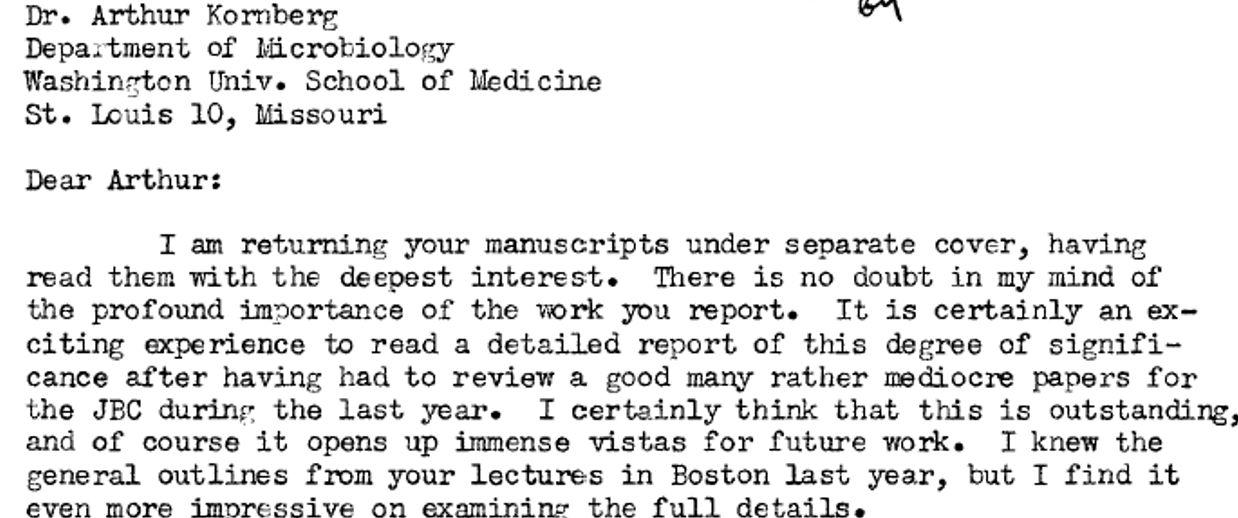
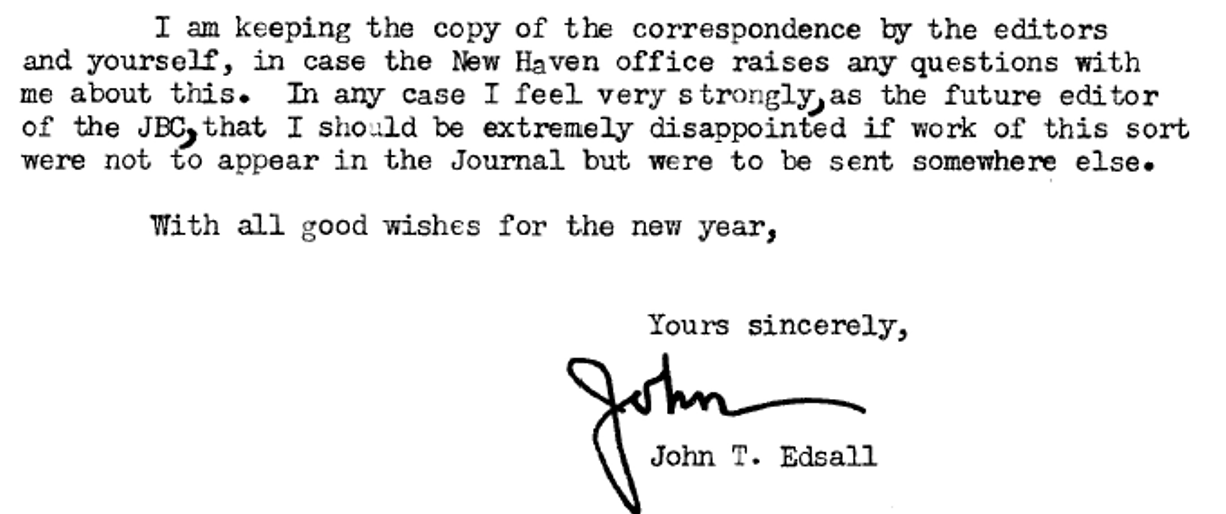
Kornberg had submitted his reports to the Journal of Biological Chemistry, which had assigned them to Erin Chargaff for review. As noted in Chapter 4, Chargaff could be difficult, and he wrote a scathing review of the papers, which led to their initial rejection. But a new editor, John Edsall, of Harvard University, was just stepping in as the new editor. Kornberg wrote to Edsall complaining about the reviewer for his papers. Edsall responded as follows
and concluded his letter to Kornberg by saying:
And the rest, so to speak, is history.