Esther Lederberg
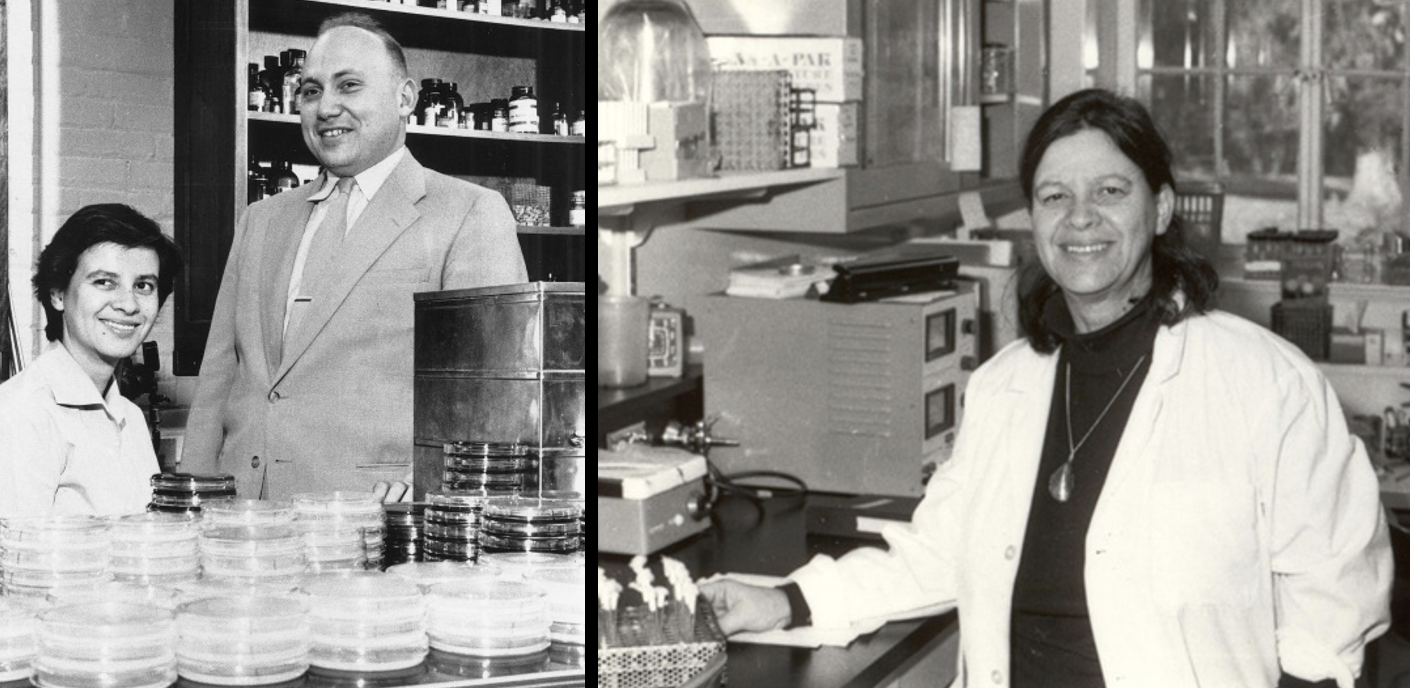
1 2025-01-22T09:20:29-05:00 George Shaohua Qiao 78e5371050dd5c0e21d36bad469c70d8d4be5464 225 1 At left, a young Esther Lederberg, in a white lab coat and short hair, sits next to a standing Joshua Lederberg, with several agar plates in the foreground. At right, an older Esther Lederberg, smiling, stands in a laboratory. plain 2025-01-22T09:20:29-05:00 George Shaohua Qiao 78e5371050dd5c0e21d36bad469c70d8d4be5464This page is referenced by:
-
1
2025-01-22T09:20:25-05:00
Chapter 2: Luria and Delbrűck show that bacteria are subject to Natural Selection
6
plain
2026-07-20T10:58:43-04:00
“Realizing the analogy between slot-machine returns and clusters of mutant bacteria was an exciting moment.”
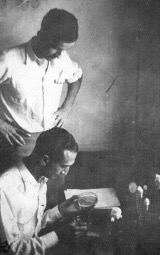
Salvador Luria (seated in this 1941 photo with Delbrűck standing) was born in Turin, Italy in 1912 (he died in 1991). Luria attended medical school at the University of Turin, studying under Giuseppe Levi, a professor of human anatomy. There, Luria met Rita Levi-Montalcini and Renato Dulbecco, who also studied under Levi. Remarkably, all three would go on to win Nobel Prizes, Levi-Montalcini for her discovery of nerve growth factor, Dulbecco for his contributions to oncoviruses, and Luria for the “fluctuation test” as we will come to. All three moved to the United States and Dulbecco worked on phage with Luria and later with Delbrűck.
Luria next studied Radiology in Rome where he read about Max Delbrück’s theories on the gene and met physicist and Nobel Laureate Enriko Fermi. He then won a fellowship to come to the United States but when Benito Mussolini came to power, his 1938 Manifesto of Race was implemented, banning Jews from academic fellowships and positions. Luria then left Italy for France and when the Nazis invaded France, he fled to the United States. With the help of Fermi, he won a fellowship from the Rockefeller Foundation to work at Columbia University. [Levi-Montalcini, who was also Jewish, similarly lost her position at the University of Turin, famously continuing her experiments with chicken embryos in her bedroom before moving to the United States.]
Luria met Delbrück in the United States and did experiments with him and Al Hershey (whom we discuss in Chapter V) at the Cold Spring Harbor Laboratory, the three of them founding the famous Phage Group. After Columbia, Luria took a position at Indiana University where he carried out the ground-breaking Luria-Delbrűck experiment (below) and later became a PhD mentor to his graduate student Jim Watson. Luria moved to University of Illinois Urbana–Champaign and then to MIT in 1959 where he remained until the end of his career.
Regarded as the father of Molecular Biology, Max Delbrűck was born in Berlin in 1906 (he died in 1981). He studied physics at the University of Göttingen. His family was active in the resistance to Nazism and some of them were executed by the Reich. Delbrűck left Germany, traveling to England, Denmark, and Switzerland. He met theoretical physicists and Nobel Laureates Wolfgang Pauli and Niels Bohr, who, ironically, interested him in biology. Delbrűck with another physicist and a geneticist wrote what came to be called the Three-Man Paper, which focused on mutations and the nature of the gene. Indeed, it influenced Schrödinger even though What is Life proved to be much more influential in engaging physicists in biology and biologists in the physical basis of life.
Delbrűck came to the United States in 1937 and won a fellowship from the Rockefeller Foundation, which helped place him at Vanderbilt University. He later moved to CalTech where he spent the rest of his career. Highly skeptical, dogmatic, and influential, he was the major driving force in the birth of molecular biology by dint of his personality and focus on bacteria and phage.
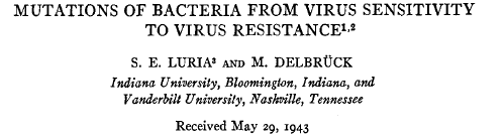
Luria's and Delbrűck’s seminal demonstration that bacteria acquire mutations stochastically was published in the journal Genetics in 1943 while Luria was at Indiana University and Delbrűck at Vanderbilt University:
Known as the fluctuation test, the demonstration was based on the appearance of mutants of the bacterium E. coli that exhibited resistance to the bacterial virus, phage T1. Luria tells the story in his heartwarming autobiography of how he came to devise the test at a party held at a gambling parlor while observing “A Slot Machine”:“Realizing the analogy between slot-machine returns and clusters of mutant bacteria was an exciting moment. I left the dance party as soon as I could (I had no car of my own). Next morning, I went early to my laboratory, a room I shared with two students and eighteen rabbits. I set up the experimental test of my idea ¬ several series of identical cultures of bacteria, each started with very few bacteria. It was a hard Sunday to live through, waiting for my cultures to grow. I still knew almost no one in Bloomington, so I spent most of the day in the library, unable to settle down with any book. Next day, Monday morning, each culture contained almost exactly one billion bacteria. The next step was to count the phage-resistant bacteria in each culture. I proceeded to mix each culture with phage on a single test plate. Then I had again a day of waiting-but at least I was busy teaching. Tuesday was the day of triumph. I found an average of ten resistant colonies per cul¬ture, with lots of zeros and, as I hoped to find, several jackpots. I had also set up my control: I had taken many individual cultures and pooled them all together, then divided the mixture again into small portions and counted the resistant colonies in each portion. Complete success: this time the average number of resistant colo¬nies was again about the same, but the individual numbers were distributed at random and there were no jackpots.… Delbrűck was the obvious resource. I dropped him a note explaining my idea and describing the first set of experiments. ….Four days later I received a postcard: "I believe you have something important. I am working out the mathematical theory."
[“A Broken Test Tube” in the title refers to another breakthrough he made by accident in which he discovered what came to be known as restriction and modification (chapter 18).]
The fluctuation test is based on three statistical concepts: mean or average, variance and Poisson distribution. The variance is a measure of the deviation (mean squared difference) of a variable from the mean. The Poisson distribution is the probability that a number of events will occur in a fixed time interval if the events occur stochastically with a constant mean rate. For example, if the mean number of customers entering a store is three per hour but the probability of any one customer entering has no effect on the likelihood of the next customer entering (the number of customers entering the store is stochastic), then the distribution of the numbers of customers entering will exhibit a Poisson distribution. Stated another way, the time intervals between customers entering the store will exhibit an exponential distribution. As a second example, radioactive decay is stochastic and exhibits a Poisson distribution. P32 has a mean half-life of ~two weeks but the time intervals between decays exhibit an exponential distribution. Finally, winnings from Luria’s slot machine would exhibit a Poisson distribution except that the gambling parlor biases the slot machine to favor the House!
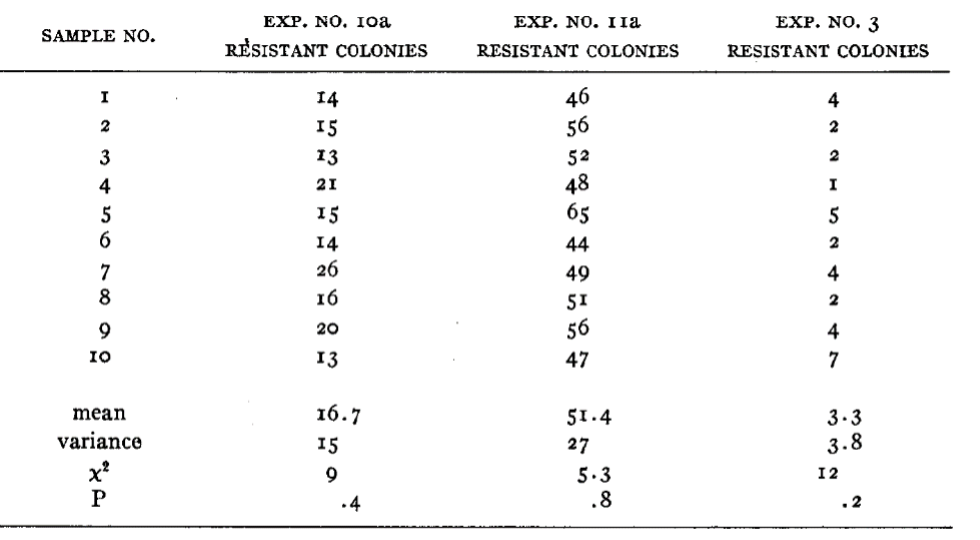
The fluctuation test was carried out by growing multiple, independent cultures of E. coli in a series of test tubes. Samples of bacteria from each test tube were then spread on agar plates upon which phage had been previously spread. Only mutants of E. coli that were resistant to the phage would be able to grow into colonies on the phage-containing plates. As a control, when bacteria from the same culture were spread on phage-containing agar plates, the observed mean and variance were similar to each other, as observed in Table I from the publication (below).
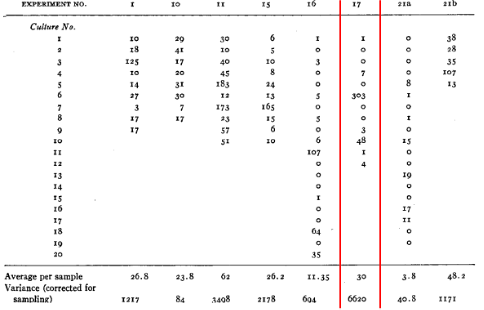
Now let’s turn to the results when the number of colonies of phage-resistant bacteria were measured for multiple, independent cultures. Consider experiment #17 (outlined in red) in Table II (below) in which 12 cultures were tested for the presence of phage-resistant bacteria. It is clear that the number of colonies of resistant bacteria displayed a wide variance as compared to the average (mean) for all of the cultures, indeed much wider than that had been seen in the control of Table 1.
Thus, if the resistance arose by adaptation to exposure to the phage (i.e., Lamarckism), then the variance should have been similar to the average. However, if mutants arose spontaneously prior to exposure to the phage, then a wide variance from culture to culture was to be expected. Test tubes in which resistant bacteria happen to arise early in the growth of the culture would be expected to exhibit many more colonies than cultures in which by chance resistant bacteria appeared late during growth. Since the variance was much greater than the average, Luria and Delbrűck concluded that resistant bacteria arose “by mutations of sensitive cells independently of the action of virus.” In other words, E. coli conformed to Natural Selection and could be used as a model for studying mutations and the nature of the genetic material. Indeed, the Luria/ Delbrűck experiment thereby unleashed a new era in the biological sciences.
The Luria/ Delbrűck experiment was breathtaking and impactful but future investigators showed that the same conclusions could be reached in a simpler and more direct manner. Thus, six years later (1949) Canadian microbiologist Howard Newcombe performed an experiment that did not need statistical analysis to test the hypothesis that resistance to phage arises prior to contact with the phage. He spread E. coli on agar plates, allowed the bacteria to grow for a few generations to make a thin lawn. Next, on some plates he spread the bacteria with a sterile bent glass rod but not on other plates. He then sprayed both the spread and unspread plates with phage, allowing both kinds of plates to grow until colonies of resistant bacteria appeared. If Luria and Delbruck were right, then the spread plates should have many more colonies than the unspread plates. These would arise from lineages of resistant bacteria that emerged shortly after plating and were re-distributed by spreading. If instead, resistance arose from adaptation as per Lamarck, then spread and unspread plates should have the same number of resistant colonies. Indeed, the former outcome was the case.
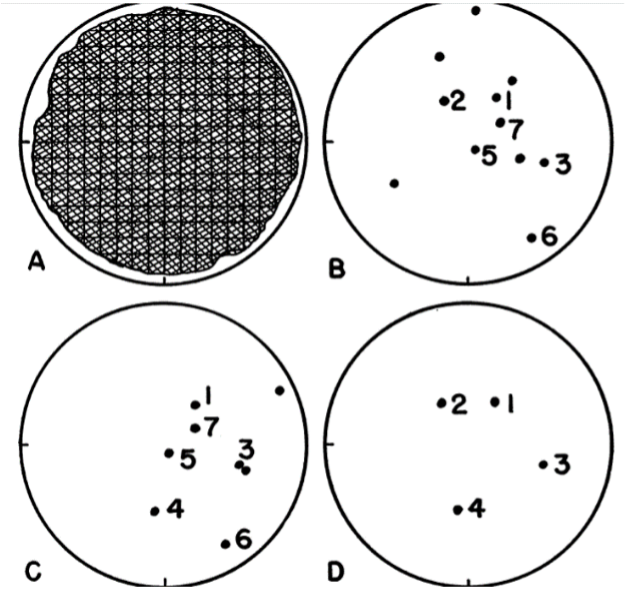
But the most direct demonstration of the spontaneous origin of mutations comes from the 1951 “replica plating” experiment carried out by Joshua Lederberg and Esther Lederberg at the University of Wisconsin (of whom we will have more to say). The replica plating experiment used a round block covered in sterile velvet (see photo) to make repeated imprints of dense arrays of colonies of E. coli growing on a master agar plate (plate A in the cartoon below). The imprints were stamped on to plates that had been coated with phage (plates B, C and D). Replica plating showed that resistant colonies appeared at superimposable positions as indicated by the numbering in plates B, C and D. Lederberg and Lederberg were able to conclude that the resistant colonies were derived from clones at corresponding sites in the master plate. Hence, resistant mutants were already present prior to, and independent of, exposure to the phage.
Both Joshua (1925-2008) and Esther Lederberg (1922-2006), who were married, were pioneers in molecular biology. Joshua won a Nobel Prize for the discovery that bacteria can mate and exchange genes (conjugation), which became a powerful tool in molecular genetics. He later became President of Rockefeller University. Esther is credited with discovering the fertility factor that mediates conjugation, with the discovery of phage λ, which became a transformative model system for understanding gene control, and, as we have seen, for her contributions to replica plating. But she didn’t share in the Nobel Prize for bacterial conjugation and didn’t achieve wide recognition. Later, after they divorced in 1968, she was largely ignored and unable to secure a tenured faculty position. Eventually, she was granted an untenured position at Stanford University.