Cold Spring Harbor Lab
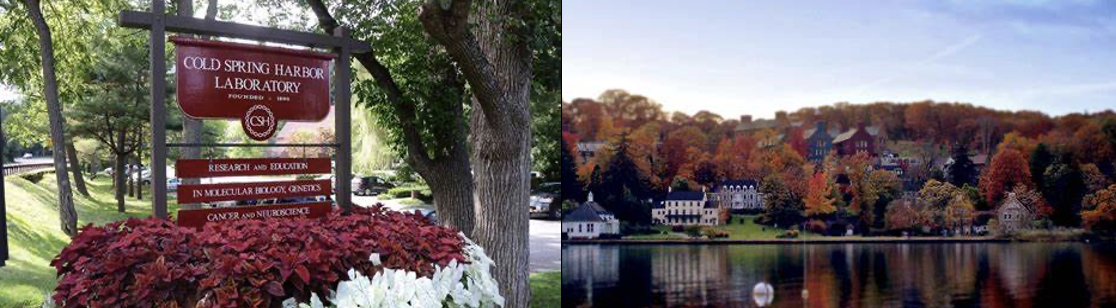
1 2025-01-22T09:20:28-05:00 George Shaohua Qiao 78e5371050dd5c0e21d36bad469c70d8d4be5464 225 1 On the left, a photo of a red sign reading "Cold Spring Harbor Laboratory". On the reight, a view of the laboratory campus, situated along a lake. plain 2025-01-22T09:20:28-05:00 George Shaohua Qiao 78e5371050dd5c0e21d36bad469c70d8d4be5464This page is referenced by:
-
1
2025-01-22T09:20:26-05:00
Chapter 5: The Hershey-Chase experiment generates wide acceptance that the genetic material is DNA
8
plain
2026-07-21T13:18:18-04:00
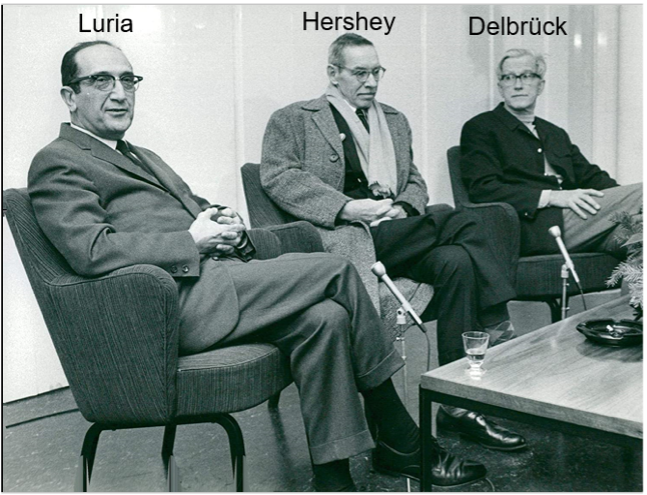
"The Phage Church [Group], as we were sometimes called, was led by the Trinity of Delbrück, Luria, and Hershey. Delbrück's status as founder and his ex cathedra manner made him the pope, of course, and Luria was the hard-working, socially sensitive priest-confessor. And Al (Hershey) was the saint."
We close out Part 1 by considering the famous experiment of Al Hershey and Martha Chase and by returning to the question of why the experiment of Avery, MacLeod, and McCarty, which was published eight years earlier, did not garner wide acceptance.
Of course, some prominent scientists did appreciate the discovery of Avery et al. As we have seen, Chargaff was one of those who did. And William Astbury, who as we will see was the first to use X-ray crystallography to study the structure of DNA, said “he considered the Avery group’s finding to be “one of the most remarkable discoveries of our time”….I wish I had a thousand hands and labs with which to get down to the problem of proteins and nucleic acids. Jointly those hold the physico-chemical secret of life, and quite apart from the war, we are living in a heroic age, if only more people could see it.” And Joshua Lederberg, the future president of Rockefeller University, wrote in his diary when he was 19: “I had the evening all to myself, and particularly the excruciating pleasure of reading Avery ’43 [sic] on the desoxyribose nucleic acid responsible for type transformation in Pneumococcus. Terrific and unlimited in its implications... I can see real case for excitement in this stuff.” Many years later Lederberg talked about Avery as recorded in this video. Note that he brings in Avery’s principal critic, Alfred Mirsky, to whom we now turn.
The villain of the story is Avery’s colleague at Rockefeller, Alfred Ezra Mirsky (1900– 1974), who wrote that “there can be little doubt in the mind of anyone who has prepared nucleic acid that traces of protein probably remain in even the best preparations” and that “as much as 1 or 2 percent of protein could be present in a preparation of ‘pure, protein-free’ nucleic acid”. Of course, this ignored Avery, McLeod, and McCarty’s demonstration that the transforming principle was insensitive to two different proteases and RNase but destroyed by DNase. In response, Rollin Hotchkiss in Avery’s laboratory showed that virtually all the detected nitrogen in the purified transforming principle arose from a breakdown product of one of the bases and concluded that protein contamination was no more than 0.02%. Lederberg in the video defends Mirsky’s right to challenge the conclusion that transformation was not due to contaminating protein. But Mirsky went to great lengths to sow doubts about Avery’s results and is said to have (successfully) urged the Karolinska Institute not to award Avery a Nobel Prize. To quote from prominent structural biologist, Gregory Petsko, who knew Maclyn “Mac” McCarty in his senior years: “Despite the powerful evidence in the paper, this conclusion was not accepted by many influential scientists. Chief among these was Avery’s Rockefeller colleague Alfred Mirsky, a biochemist, who lobbied for years to deny Avery and his team the recognition their work deserved. Mirsky was convinced that proteins had to comprise the genetic material and believed Avery’s DNA samples had to be contaminated with them. He seems to have persuaded the Nobel Committee, because although Avery and his associates were nominated repeatedly in the years following their discovery, they never won the Nobel Prize. Avery died in 1955, age 76... the assertion that he didn’t live long enough for his work to be appreciated is nonsense: by 1952 it was generally accepted that genes were composed of DNA and that the Avery paper was the work that had proven it. (To be fair, Avery himself did not help matters. He had a quiet and self-effacing personality, presented his work in a low key manner, and was averse to any sort of speculation. His presentations were few, and when invited to speak at international meetings he usually sent his younger collaborators.)” Avery did receive the prestigious Lasker Award in 1947 but not for the discovery that the transforming principle is DNA. Instead, the Lasker Foundation cited "Dr. Avery’s many brilliant contributions to scientific knowledge, none has been more outstanding than his studies on the antigenic constitution of bacteria."
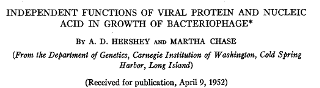
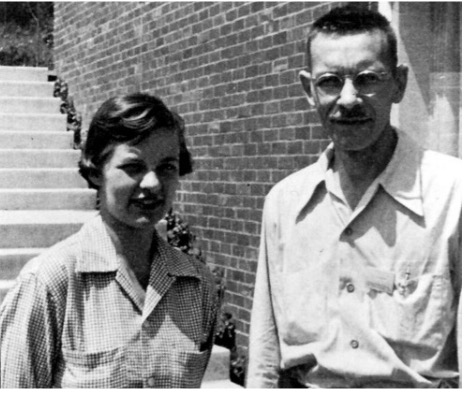
What finally turned the tide and won over the Karolinska Institute was the famous experiment of Alfred Hershey (1908-1997) and his research partner Martha Chase (1927-2003), which was published eight years after the report of Avery, McLeod, and McCarty. After obtaining his Ph.D. in bacteriology, Hershey took a position at Washington University and then in 1950 joined the Department of Genetics of the Carnegie Institution of Washington, which was located in Cold Spring Harbor, New York and would later become part of the Cold Spring Harbor Laboratory. Chase joined Hershey at Cold Spring Harbor and together they carried out their famous experiment. She left Cold Spring Harbor in 1953 but returned annually to participate in meetings of the Phage Group. Chase obtained a Ph.D. in 1959 but sadly suffered personal setbacks and eventually succumbed to dementia.
As home to the Phage Group, the Cold Spring Harbor Laboratory is sometimes referred to as the Holy Land for Molecular Biology. One of the pioneers of molecular biology, Frank Stahl, wrote: "The Phage Church [Group], as we were sometimes called, was led by the Trinity of Delbrück, Luria, and Hershey. Delbrück's status as founder and his ex cathedra manner made him the pope, of course, and Luria was the hard-working, socially sensitive priest-confessor. And Al (Hershey) was the saint." The Department of Genetics/Cold Spring Harbor Laboratory has a troubled past (1910-1939) as it served as the home to the Eugenics Record Office. (Eugenics aims to improve the genetic quality of the human population by selective breeding.) The Carnegie closed the Eugenics Record Office in 1939, and the Cold Spring Harbor Laboratory has continued to flourish as a center for research, international meetings, and courses.
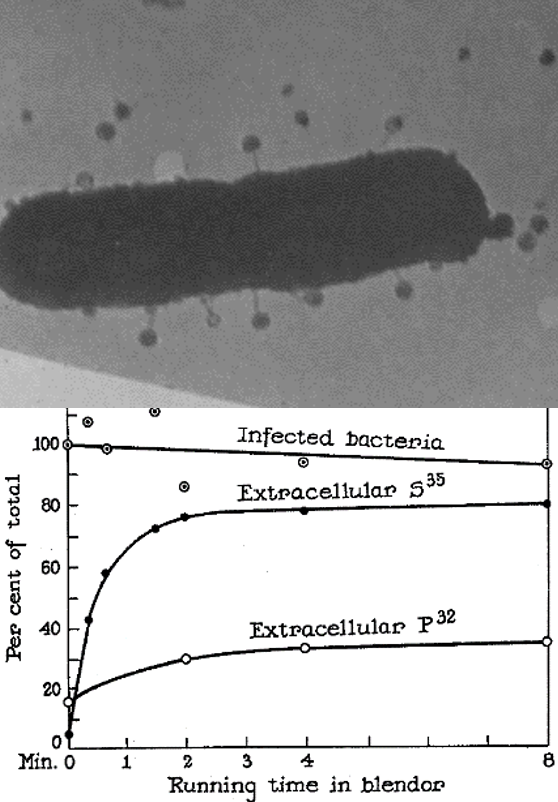
As background to the Hershey-Chase experiment, Thomas Anderson of the University of Pennsylvania had shown by electron microscopy that phage consist of DNA surrounded by a protein head and tail. Using a phage of E. coli called T2, Hershey and Chase investigated whether the DNA is the genetic material by asking whether only the DNA enters infected cells. To address this question, they prepared phage that were labeled with the radioactive isotope P32, which is largely specific to DNA, and S35, which is specific to protein. The radioactive phage were then used to infect cells of E. coli. As seen in the upper figure, phage attach to the surface of bacteria. Accordingly, they subjected infected bacteria to a Waring blender (a device with a rotating metal blade) to strip off the heads and tails. They then asked how much of the two radioactive labels had been removed form the infected bacteria. The results (see the lower figure) show that as much as 80% of the S35 was removed but only 30 percent of the P32 with little loss of survival of the infected bacteria from the blending.
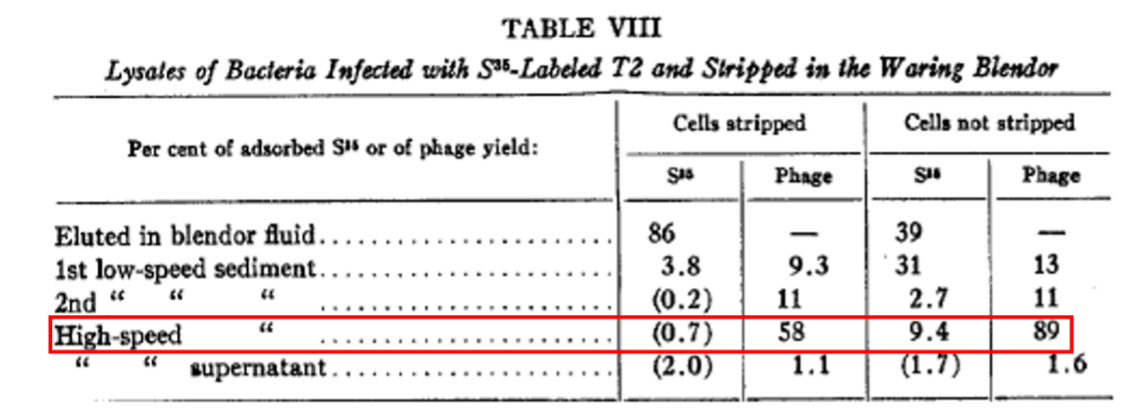
But this meant that as much as 20% of the phage protein had been introduced into the infected cells. So, they went a step further by purifying phage from the infection. First, they infected cells with S35-labeled phage, stripped off phage heads and tails in a blender and collected the phage from the infection. Next, they isolated the phage from the infection by high-speed centrifugation. As highlighted in red in the Table, 0.7% of the S35 from the infection was retained (with only modest loss of phage from the blending). From this the authors conclude that the “phage progeny yielded by bacteria infected with phage labeled with radioactive sulfur contain less than 1 per cent of the parental radioactivity” and that the “protective coat that is responsible for the adsorption to bacteria, and functions as an instrument for the injection of the phage DNA into the cell. This protein probably has no function in the growth of intracelIular phage. The DNA has some function.”
According to the criticism of Mirsky (above), only “1 or 2 percent” of protein could have been present in the purified transforming principle. We note that this value is not much higher than the 0.7% of S35-labled protein that was retained by phage in the Hershey and Chase experiment carried out eight years later. We also note that Hotchkiss was able to reduce the protein in transforming principle to no more than 0.02%. Also, of course, Avery, MacLeod and McCarty showed that their transforming principle was unaffected by two different, purified proteases. In sum, it is difficult to argue that the Hershey-Chase experiment was more compelling than the earlier work of Avery et al. Nevertheless, Hershey joined Luria and Delbrück in winning a Nobel Prize for “a discovery that confirmed DNA as the bearer of genetic information.”
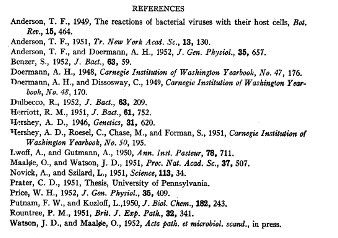
Not only did the Nobel Committee ignore Avery, Hershey and Chase did as well. We note that the references to the Hershey-Chase publication fail to cite the Avery, MacLeod and McCarty publication. Fifteen years after the Hershey-Chase experiment, and 23 years after Avery et al., Hershey does mention the pneumococcus transformation experiments in the final sentence of his chapter in a Cold Spring Harbor book, Phage and the Origins of Molecular Biology (1966): “..the historical record itself since Avery, MacLeod and McCarty (1944) shows that some redundancy of evidence was needed to be convincing, and that diversity of experimental materials was often crucial to discovery.”
In closing, we return to the question of why the concept that DNA is the genetic material did not gain wide acceptance until eight years after the Avery, MacCleod and McCarty publication. We offer the following explanations. First, the genetic material was believed to be protein. Proteins are complex, being composed of 20 amino acids whereas DNA contains just four bases. And Phoebus Levene had suggested that DNA was a monotonous tetranucleotide repeat. Hence, DNA is too simple to encode genetic information, and the Transforming Principle must have been contaminated with protein as argued by Mirsky. Second, the Phage Group (Luria, Delbrück, Hershey) and the nucleic acid biochemists (Avery, MacLeod, McCarty, Hotchkiss, Taylor, Chargaff) lived in different intellectual worlds. The Father of Molecular Biology, Max Delbruck, said “you really did not know what to do with it.” He later said, “It just meant that genetic specificity was carried by some goddamn other macromolecule, instead of proteins.” And Luria wrote that “People like Delbrück and myself, not only were we not thinking biochemically, but we were somehow-and probably partly unconsciously-reacting negative to biochemistry. And biochemists as such.”
Perhaps, then, the demonstration that the transforming principle was DNA was simply ahead of its time. Nonetheless, and looking back, we can say it represents one of the greatest discoveries in biology of the last century.