Chapter 4 Gulland Chains
1 2025-08-11T09:55:48-04:00 George Shaohua Qiao 78e5371050dd5c0e21d36bad469c70d8d4be5464 225 1 plain 2025-08-11T09:55:48-04:00 George Shaohua Qiao 78e5371050dd5c0e21d36bad469c70d8d4be5464This page is referenced by:
-
1
2025-01-22T09:20:26-05:00
Chapter 4: Chargaff measures the relative abundance of the four bases in DNA and upends the tetranucleotide hypothesis
16
plain
2026-01-27T10:07:08-05:00
“That in our day such pygmies throw such giant shadows only shows how late in the day it has become.”
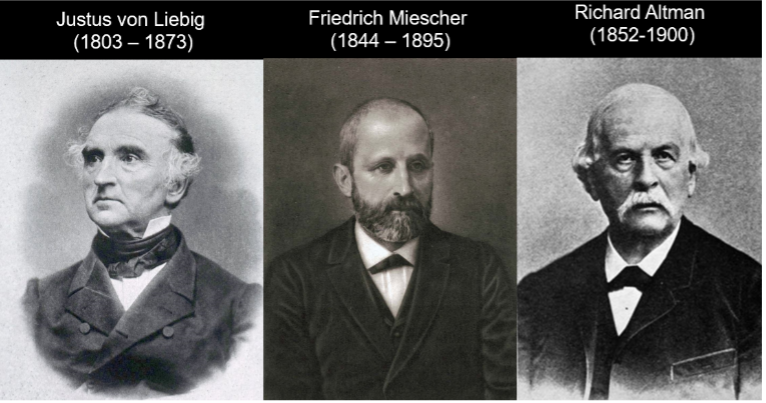
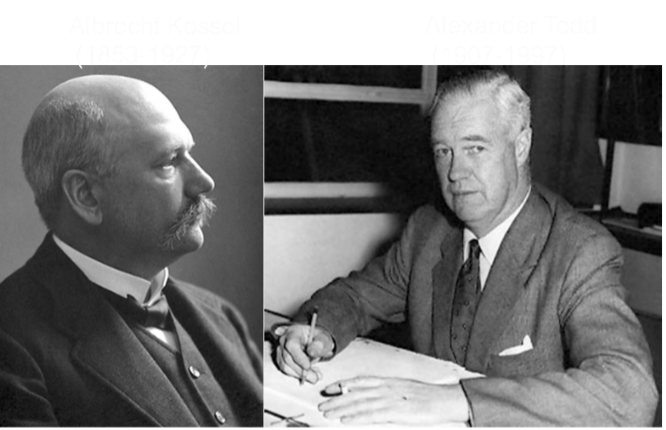
The discovery of nucleic acids and the elucidation of its chemical composition is a long journey that began well before its significance as the genetic material was appreciated. The story starts in 1847 with the discovery of acidic material in muscle fibers by the German chemist Justus van Liebig. He named this material inosinic acid from the Greek word for muscle fiber. Next, in 1869, Friedrich Miescher uncovered a phosphorus-rich substance in the nuclei of white blood cells (leukocytes), which was resistant to protein digestion and which he called nuclein. This was followed in 1889 by Richard Altman who purified Miescher’s nuclein away from protein and coined the term nucleic acid. In a major advance, Albrecht Kossel at the University of Berlin during the period from 1885-1905 identified the bases in nucleic acids, work for which he was awarded the Nobel Prize. As reported in the New York Times, Kossel presciently stated in a lecture at Johns Hopkins University in 1911 that “the further he got the more he was struck with the fact that the constituent elements of life everywhere, whether in a cabbage or in a poet, were very much the same.” Also contributing to our understanding of DNA was Scottish chemist Alexander Todd, who would also win a Nobel Prize. Todd helped determine the structure of nucleosides and nucleotides by chemical synthesis, famously synthesizing ATP.
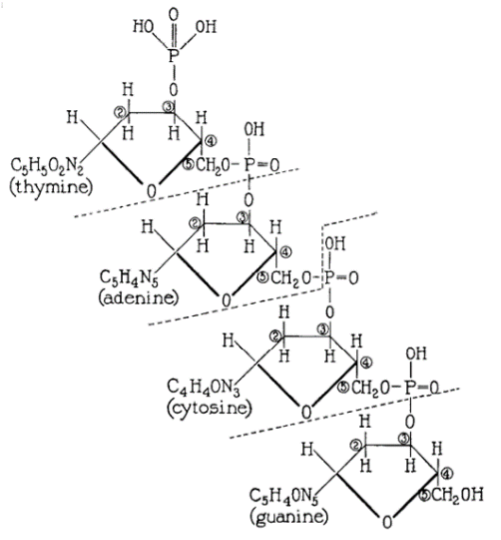
One more chemist helped pioneer our understanding of the chemistry of DNA, but in this case, he is rarely mentioned. This unsung hero is Phoebus Levene (1869-1940), who despite his fundamental contributions made one unfortunate mistake. Levene grew up in Lithuania and emigrated to US to escape the pogroms. He studied at Columbia University and also worked with Albrecht Kossel in Germany. Levene eventually won a position as head of a laboratory at the Rockefeller Institute. Among his contributions, Levene determined that the sugar component of DNA is 2’-deoxyribose and that of RNA is ribose, he coined the terms nucleosides, nucleotides and polynucleotides, and he showed that nucleotides are linked together in phosphate-sugar-base units via 3’-5’ linkages.
Shown is his depiction of DNA (“desoxy-ribose nucleic acid) from his 1935 publication in the Journal of Biological Chemistry. Despite these pioneering contributions, Levene assumed that DNA contained a simple repeat of the four bases. This came to be known as the “tetranucleotide hypothesis,” which reinforced the widespread view that DNA was too simple to encode genetic information. The tetranucleotide hypothesis has been referred to as a “scientific catastrophe” [Glass, B. (1965) Proc. Am. Phil. Soc 109: 229] that delayed our appreciation of DNA as the carrier of genetic information and reinforced the mistaken view that the hereditary material is protein. As a consequence, and despite his pioneering contributions (we still use the terms nucleoside, nucleotide and polynucleotide), Levene is largely forgotten in historical accounts of DNA. Ironically, Levene carried out his pioneering work at the Rockefeller Institute, the very institution where, as we have seen, Avery and co-workers would discover three years after Levene’s passing that Griffith’s transforming principle is DNA. The tetranucleotide hypothesis undoubtedly contributed to the failure of the seminal work of Avery, Macleod and McCarty to gain wide acceptance.
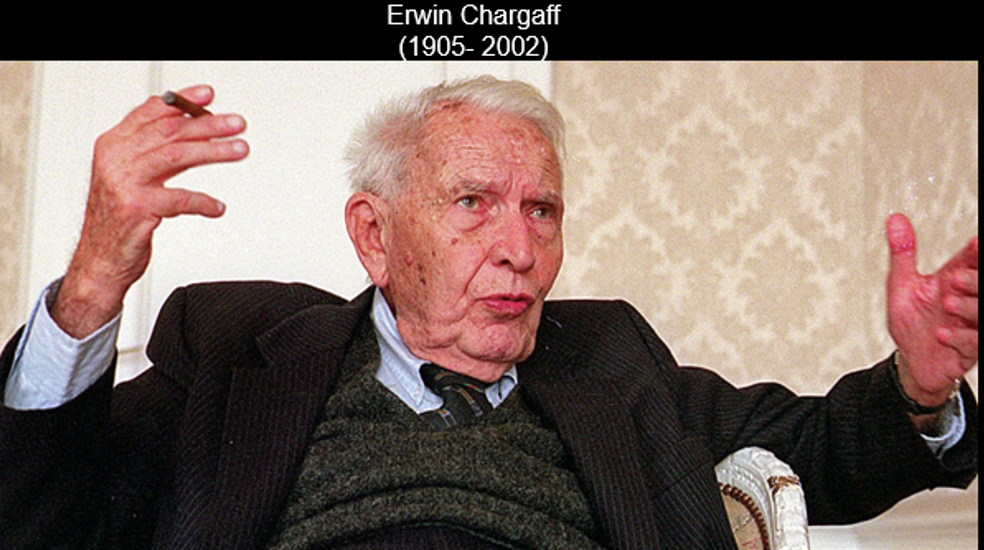
The stage is now set to introduce the central character in this chapter, Erwin Chargaff.
Chargaff’s contributions were impactful but his most important discovery went unappreciated by Chargaff himself and he alienated himself from molecular biology. Born to a Jewish family in what is now part of Ukraine, he eventually acquired a position as a chemist at the University of Berlin. But he forced to resign and leave Germany in 1935 after the rise of Hitler, going first to France and then to the United States where he joined the Department of Biochemistry at Columbia University. While at Columbia, Chargaff learned of the findings of Oswald Avery, indicating that the hereditary material is DNA. Though Avery’s findings were not widely appreciated, they were embraced by Chargaff. He wrote “…as appears probable [citing Avery’s 1944 publication], certain nucleic acids are endowed with a specific biological activity, a search for chemical differences in nucleic acids derived from taxonomically different species should be conducted,” as indeed he did.
Chargaff’s discoveries from searching for “chemical differences” are summarized in two rules, known as Chargaff’s Rules, concerning the ratios of the four bases in DNA, adenine (A), thymine (T), guanine (G) and cytosine (C).- Rule 1 holds that the ratios of A to T and of G to C is 1:1. In other words, A = T and G = C in all DNAs.
- Rule 2 holds that the ratio of A +T to G + C is not 1 and varies.
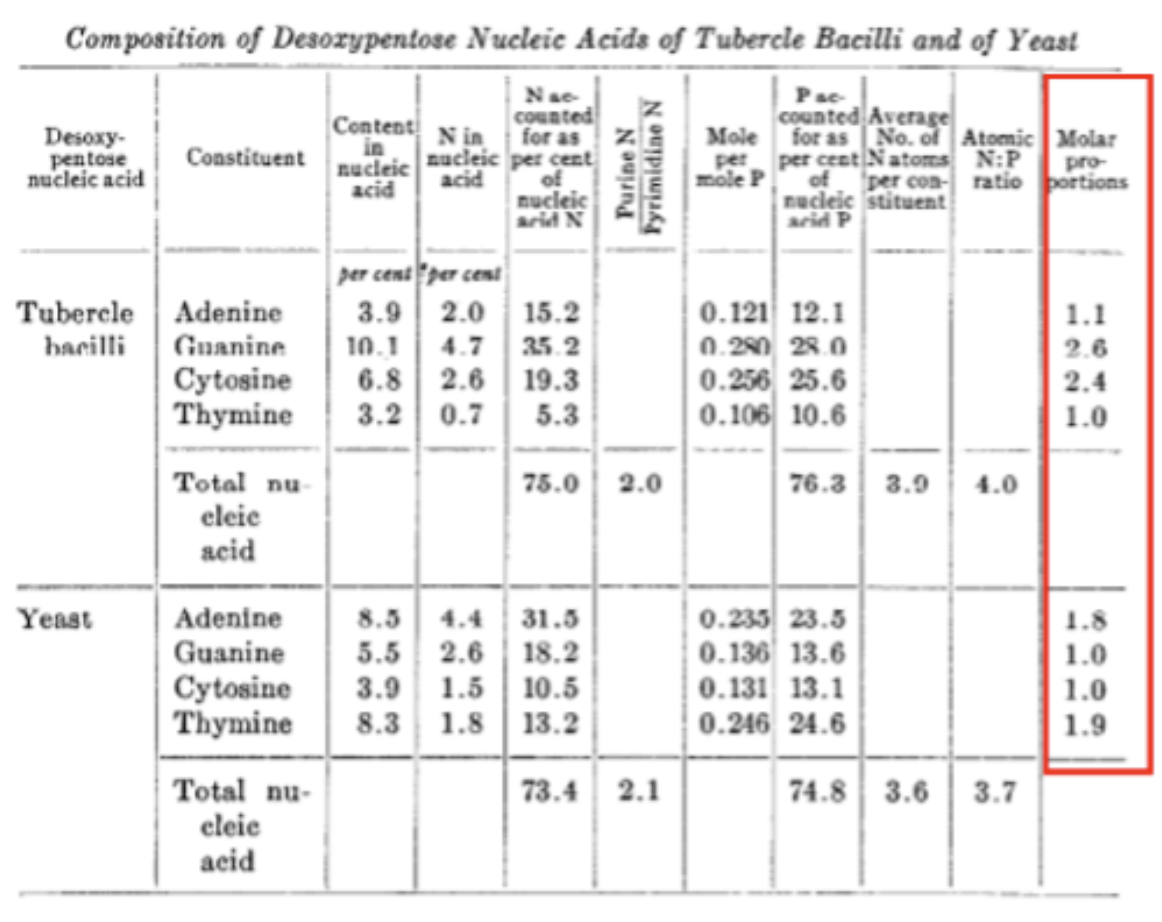
As one example from his many reports, Chargaff’s publication in 1949 compared the molar ratios of the bases between yeast and a bacterium (avian tubercle bacilli). It can be seen in the column highlighted in red that the molar proportions of A to T and of G to C are close to 1 in DNA from both organisms (1.1 vs 1.0 for A to T and 2.6 vs 2.4 for G to C in bacilli DNA and 1.8 vs 1.9 and 1.0 vs 1.0 in yeast DNA). But the molar proportion of A + T to G + C differs decidedly between the two (1.1 + 1.0 vs 2.6 + 2.4 for bacilli DNA compared to 1.8 + 1. 9 vs 1.0 + 1.0 for yeast DNA). The later result (Rule 2) “was not in accord with the expected derived from the tetranucleotide hypothesis.” And as a consequence, Chargaff rarely cited Levene. The former result (Rule 1) is of course the basis for one of the biggest missed opportunities in the early history of molecular biology. That the ratios of A to T and of G to C across DNAs from many organisms were close to 1 should have been a clue that adenine interacts with thymine and guanine with cytosine in the structure of DNA. But Chargaff missed the significance of his own Rule 1.
One of the pioneers of molecular biology, Seymour Benzer, wrote that “he had the structure of DNA under his nose. He discovered the base composition of DNA but didn’t have the flash of insight to understand what it meant.. Resented that Watson and Crick came up with the model when he had done the basic biochemistry.” And Francis Crick in the video below points out “… what anyone who is familiar with the history of science ought to realize - that when you have one-to-one ratios, it means things go to together. And how on Earth no one pointed out this simple fact in those years, I don't know.”
Perhaps as a consequence of missing the significance of his own Rule 1, Chargaff became bitter. He regarded the double helical model for DNA as “an absurd instance of oversimplification.” For example, he argued that “the scheme is incomplete in some essential features, at least insofar as substitution in position 5 of pyrimidine is concerned. If 5-methylcytosine or analogues could take the place of cytosine and vice versa without restriction, the 5-amino pyrimidines should be able to replace each other at random. This is obviously not the case…” (In fact, the 5 position projects into the major groove of the double helix and methylation at that position does not interfere with base pairing.) He famously wrote of molecular biologists: “That in our day such pygmies throw such giant shadows only shows how late in the day it has become.” And “I feel I am at some convention of Druids where not one person has failed to turn lead into gold.” Also, noteworthy is that in 1957 Chargaff argued as a reviewer for rejection of Arthur Kornberg’s two papers that had been submitted to the Journal of Biological Chemistry on the synthesis of DNA, reports that would later win Kornberg a Nobel Prize (chapter 15). A new editor at the Journal in 1958 reversed the decision and published the papers. Despite all this, Chargaff should be regarded as a pioneer; he helped open the door to heterogeneity in the composition of DNA and he provided important evidence in support of what would come to be understood as A:T and G:C base pairing.
Postscript: a prescient insight that went largely unappreciated
We end this chapter with the remarkable discovery in 1947 of the Scottish chemist John Masson Gulland and his co-workers that went largely unrecognized. Gulland et al. observed hysteresis in titration experiments in which the effect of varying pH on the viscosity of DNA was measured. They interpreted their results to indicate that “hydrogen bonds exist between the amino- and hydroxyl-groups of nucleotides.” In other words, nucleobases interact with each other via hydrogen bonds. The authors could not distinguish whether this bonding was between neighboring polynucleotide chains or between nucleotides in the same chain. Gulland tragically died in a train accident in 1947, but his student Michael Creeth explicitly proposed in his PhD Thesis in 1947 that “chains are united down their common length by hydrogen bonding between the amino groups of one chain and the hydroxyl groups of the other, and vice versa, as indicated in the diagram.”
One can only wonder what the impact would have been if Gulland had not died prematurely in an accident. What if Gulland had become aware of Chargaff’s Rules, which were published in subsequent years? Would he have discovered base pairing between G and C and A and T?