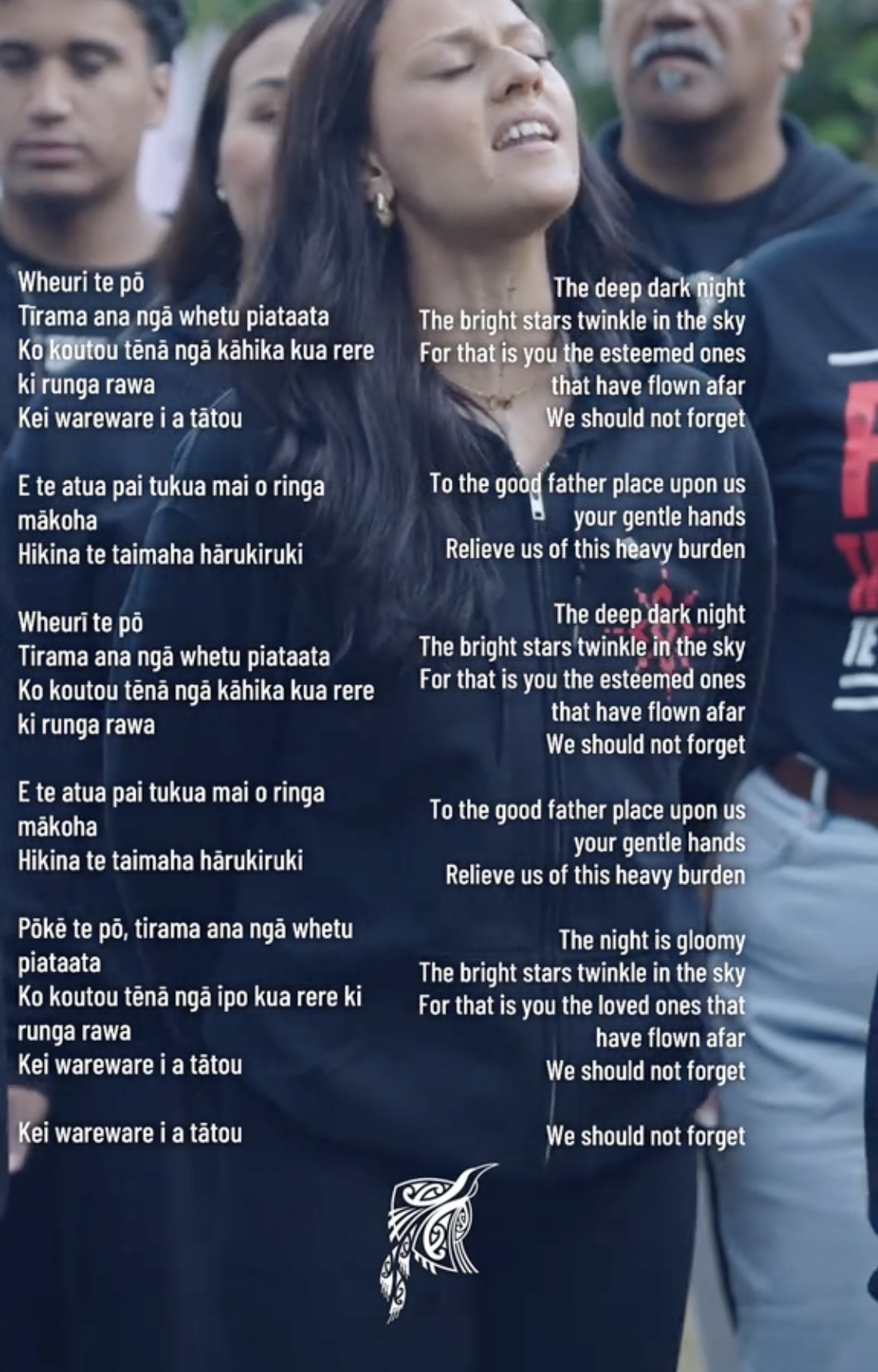
The deep dark night
1 2025-06-26T10:36:17-04:00 Louis Zweig d4b7846919334954a94c81b04cdd8934e7e64539 73 1 plain 2025-06-26T10:36:17-04:00 Louis Zweig d4b7846919334954a94c81b04cdd8934e7e64539This page is referenced by:
-
1
2025-06-26T10:35:17-04:00
"The Journey" by Karlo Mila, contributed by Kiani Akina (2025)
2
plain
2025-06-26T10:36:38-04:00
For my contribution to the scalar platform, I would like to include Karlo Mila's Malaga: The Journey (from Goddess Muscle, 2020). The poem is part of her larger collection of creative work in Goddess Muscle, and the excerpt can be found on her website by scrolling down past her last book mentioned on this page, "Dream Fish Floating" (https://www.karlomila.com/books).
Malaga: The Journey (from Goddess Muscle, 2020)
I chose this poem as it serves as a ceremonial a hui hou (Hawaiian expression for "until we meet again," as opposed to a "farewell"), guiding the spirit/soul from this physical realm into the ancestral realm. This poem honors the physical body as a `vessel` and expresses gratitude for life, memory, culture, and relationality. This poem profoundly touched me because it centers around Indigenous Pacific beliefs around death, pulotu, and the afterlife through the journey of the spirit, through sacred places like Rerenga Wairua, and ancestral ocean routes. This meditation on grief, transition, and ancestral relations has provided me with deep comfort after the suicide of my younger cousin last summer. In a Pasifika worldview, death is not nearly the end of life. It is a part of a larger journey, one bigger than the individual, and a passage binding and connecting kūpuna (ancestors), community, and individuals.
(for Alice Suisana Hunt)
It is a spindrift
that rises from the body.
Our final exhale
beyond the breath,
where we give ourselves up
in completion
to life.
Where everything that you are
leaves behind
everything that you were.
Departing
that faithful friend
of the body.
Its soft limbs.
Its forgiving flesh.
Muscles, skin, sinews ‒
all that held you together ‒
so gently,
for so long.
A song
of water, blood,
breath and bone.
We acknowledge all that you have left behind.
All that you have given.
And what a life you have seen,
and what a life you have been
and how we have loved you.
We stay here,
with that precious vessel
that carried you
through this life,
but cannot carry you
into the next.
And may we who loved you,
holding the song, blood and bone vessel of your being,
may we carry the meaning
of your life forward
into the world of light,
so that it will reach
those who come after.
He waka herehere ngā waka.
The vessel that binds us
to the great moving fleet.
We know that it’s your time to depart,
to embark on an ancient route of return,
along the terrestrial contours of this land
that has birthed and fed you,
this land on which we stand,
towards a celestial flight-path
beyond the wingspan of birds,
into the stars,
towards the warmer weather of our dreams,
towards islands we have held gently in our memories,
where we once belonged.
At Te Rerenga Wairua,
where two oceans meet,
a pōhutukawa tree still holds,
waiting for you
with a fragrant, green-leaved,
red-crowned,
farewell.
The whole earth heaves
a sigh of release.
And from here,
wreathed in red and green,
you will bid us farewell
and begin to travel the ocean roads.
The sea path traced by star walkers,
past Tongatapu, to ‘Uvea and Futuna,
where with the splitting of rocks, it all began.
You will enter the deep, blue channels
of ocean and night
and move between worlds
of underwater darkness and celestial light.
You will take flight.
Until you reach Savai’i
and follow the black lava fields
towards the last rites.
Here, you will be cleansed
in the waters of Falealupo.
The final farewell at the seashore.
It is here we face that truth,
that you are westward-bound.
Ia Manuia Lou Malaga.
Blessed be your journey.
Follow the shining trail
of the setting sun
towards the great mystery
beyond all of our knowing.
We must trust then,
in all we cannot understand,
and like the land,
heave a heavy sigh of release.
O le mavaega nai le tai e fetaia'i i i'u a gafa.
The farewell at the seashore,
with the promise
to meet again in the children.
After sleeping on it, I’ve been reflecting more on the depth and importance of Karlo Mila’s Malaga: The Journey, and I believe it would be beautifully complemented by the Māori waiata "Kei Wareware i a Tātou" by Te Kuru Marutea. The song’s theme of remembrance and collective mourning aligns closely with the poem’s meditation on grief and ancestral connection. I think it might comfort anyone who comes in contact with these pieces.