Omar_Shareef_Final_Pic
1 2023-05-04T23:53:59-04:00 Omar Shareef b2251a875dd2cfcefa6d1caf2032ed35d7a4f264 198 1 Part B of Final plain 2023-05-04T23:53:59-04:00 Omar Shareef b2251a875dd2cfcefa6d1caf2032ed35d7a4f264This page is referenced by:
-
1
2023-01-29T20:11:05-05:00
Omar Shareef
4
plain
2023-05-04T23:55:32-04:00
Final Exam Parts B & C
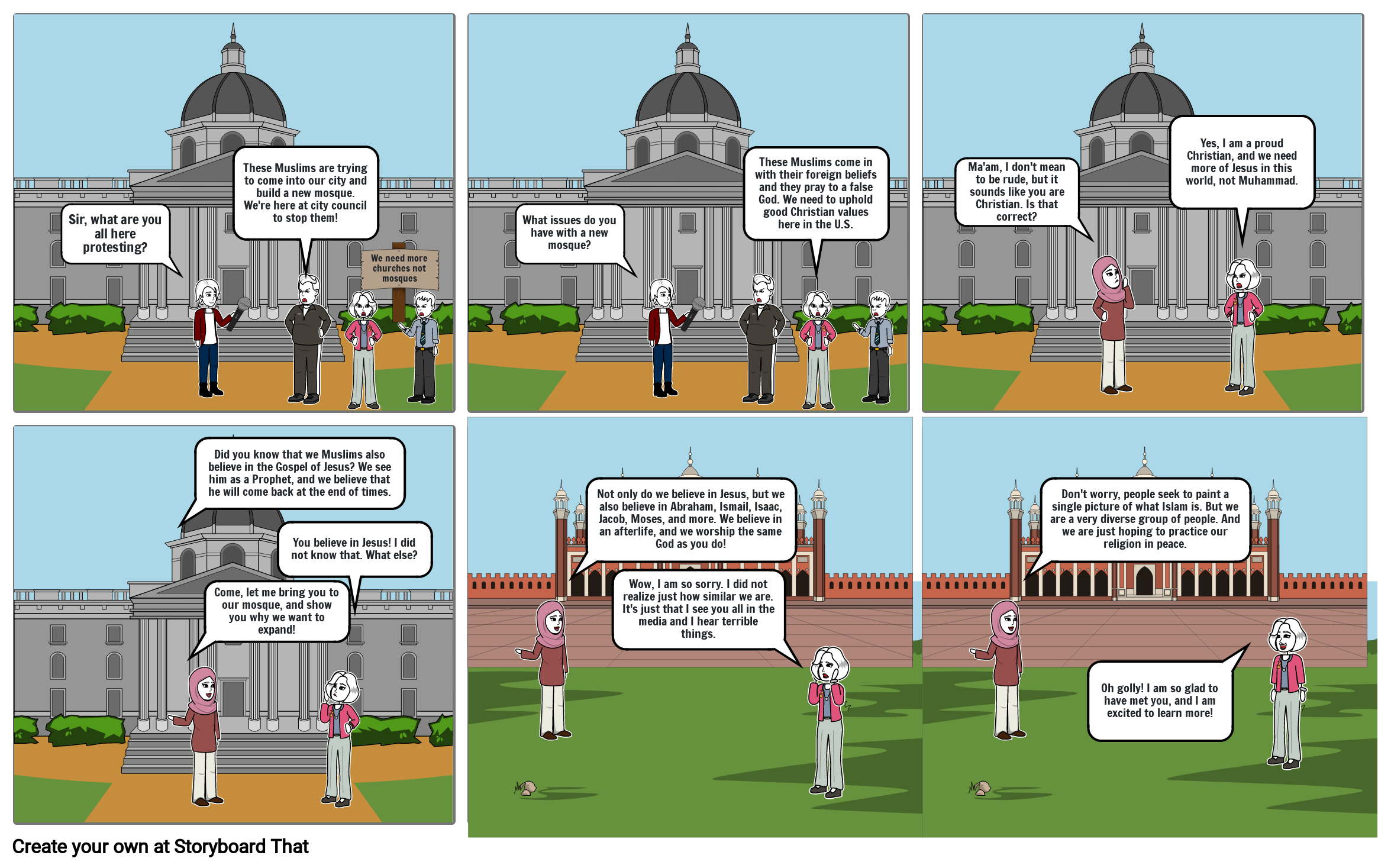
I chose to use a comic strip since I thought that a visual representation would be very easily digestible and could hit the point home more easily. I personally prefer visual and pictorial representations as opposed to lengthy descriptions or written work, so I wanted to use this medium. Furthermore, sometimes it can be difficult to engage in difficult discussion orally or textually, and throwing in some lightheartedness through a comic representation allows us to convey topics that can often be tough to talk about in a less serious manner.
This comic strip is mainly meant for Christian adults and teenagers but can apply to all people. More specifically it is rooted in an experience that I had personally. Our community was trying to build a new mosque, and we were met with opposition at our local city council when we were trying to obtain zoning and building permits. Many who came out in opposition considered themselves devout Christians and thought that Islam was a foreign and infectious disease that would destroy the community. However, as soon as we spoke to many of them, it became clear that the Islam they knew of was the one that was shared through right wing media sources rather than through authentic knowledge and understanding.
Another experience comes to mind, where I can still recall sitting down eating my lunch with some friends in Annenberg. Not having grown up around many Muslims, they were curious to learn more. I remember after a few questions in, I heard the comment, “I just don’t understand how you all can pray to a false God.” Not only was this comment disrespectful in my opinion, but it also just outright didn’t make sense to me coming from a Catholic. I sat there dumbfounded, thinking to myself “We pray to the same God. If I am praying to a false God, then so are you.” And I cannot think of another interaction that better exemplifies the lack of knowledge that many of my Christian peers have about my religion, Islam. My goal with this comic strip was to fight against this ignorance in a fun and easily digestible manner. It is meant for those individuals who may not know much about Islam in order to demonstrate that the religion is not very different from other Abrahamic faiths which are widely accepted.
My desire was to show that whether it be Jews, Christians, or Muslims, they are all “People of the Book” (Ahl al-Kitab). This was the first concept I outlined in Section A. Through the comic, I try to demonstrate that there are many similarities between Islam and Christianity such as the shared belief in Jesus and key Prophetic figures. Our similarities vastly outweigh our differences, and it is important that we keep this in mind as we move forward in order to build communities of kindness, tolerance, and understanding.
Calligram Project
During the course, I was particularly interested in the different characteristics of God especially as they are expressed through the 99 names of God. One of the names of God which particularly stood out to me was Al-Khaaliq (The Creator). In verse 7, line 54, the Qur’an says, "Allah created the heavens and the earth, and all that is between them, in six days”. This line reminded me that, under the Islamic perspective, it is God who is the underlying creator and facilitator of all things.
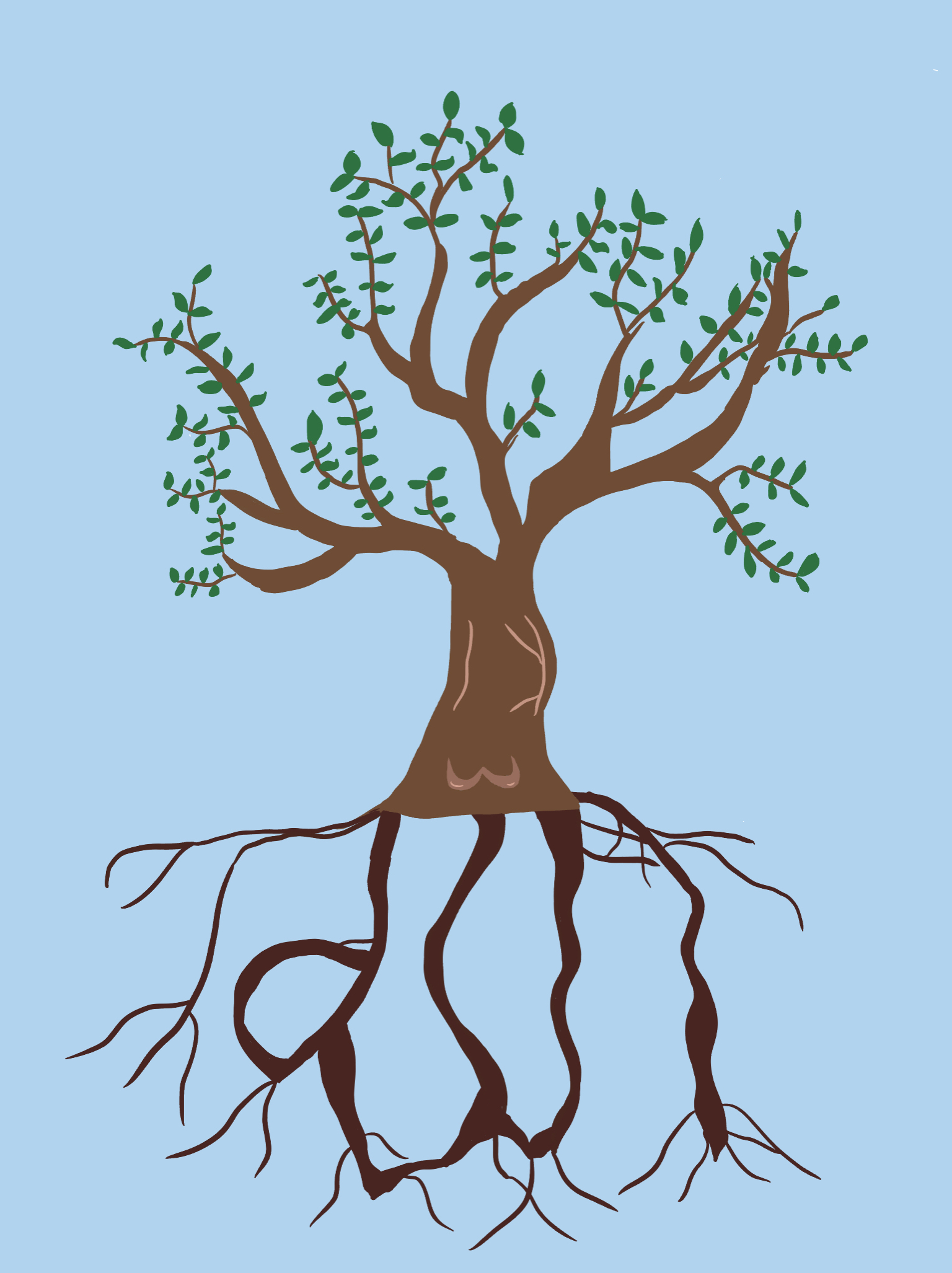
To me, nature is a stark example of the beauty and the complexity of God’s creation. A tree, which starts as a simple seed, can grow to be of massive size. However, in order to grow, a tree must be rooted into the ground. It is these roots which anchor the tree in the soil, keeping it straight and stable, and absorbing nutrients from the surroundings that allow it to grow. In a similar vein, it is Allah, The Creator who is the anchor which provides the platform for all things to be created and facilitates growth. Without Allah, as without the roots, there is no way for things to grow or for creation to subsist.
As such, the picture above depicts a tree, and the roots of the tree are meant to spell out Allah in Arabic. This is meant to demonstrate how God (Allah) is the root of life for all things. The Qur’an repeatedly emphasizes Allah's role as the Creator (Al-Khaaliq), describing how He brought everything into being and sustains it through His divine power, and the calligram above is meant to represent that. The tree above is supposed to represent all of creation, and Allah is the foundation for its occurrence.