Calligram (Front)
1 2023-02-23T20:32:30-05:00 Suraiya Jannat Jemima 2c0784e22f8a4a5dbb186609beaca653da1dc275 198 1 plain 2023-02-23T20:32:30-05:00 Suraiya Jannat Jemima 2c0784e22f8a4a5dbb186609beaca653da1dc275This page is referenced by:
-
1
2023-02-23T20:33:47-05:00
Suraiya Jannat Jemima: Basmallah Scented Candle Jar
11
Scented Candle in Glass Jar with Calligrams: “Bismillahir Rahmanir Raheem” and “Allah”
gallery
2023-04-30T18:26:15-04:00
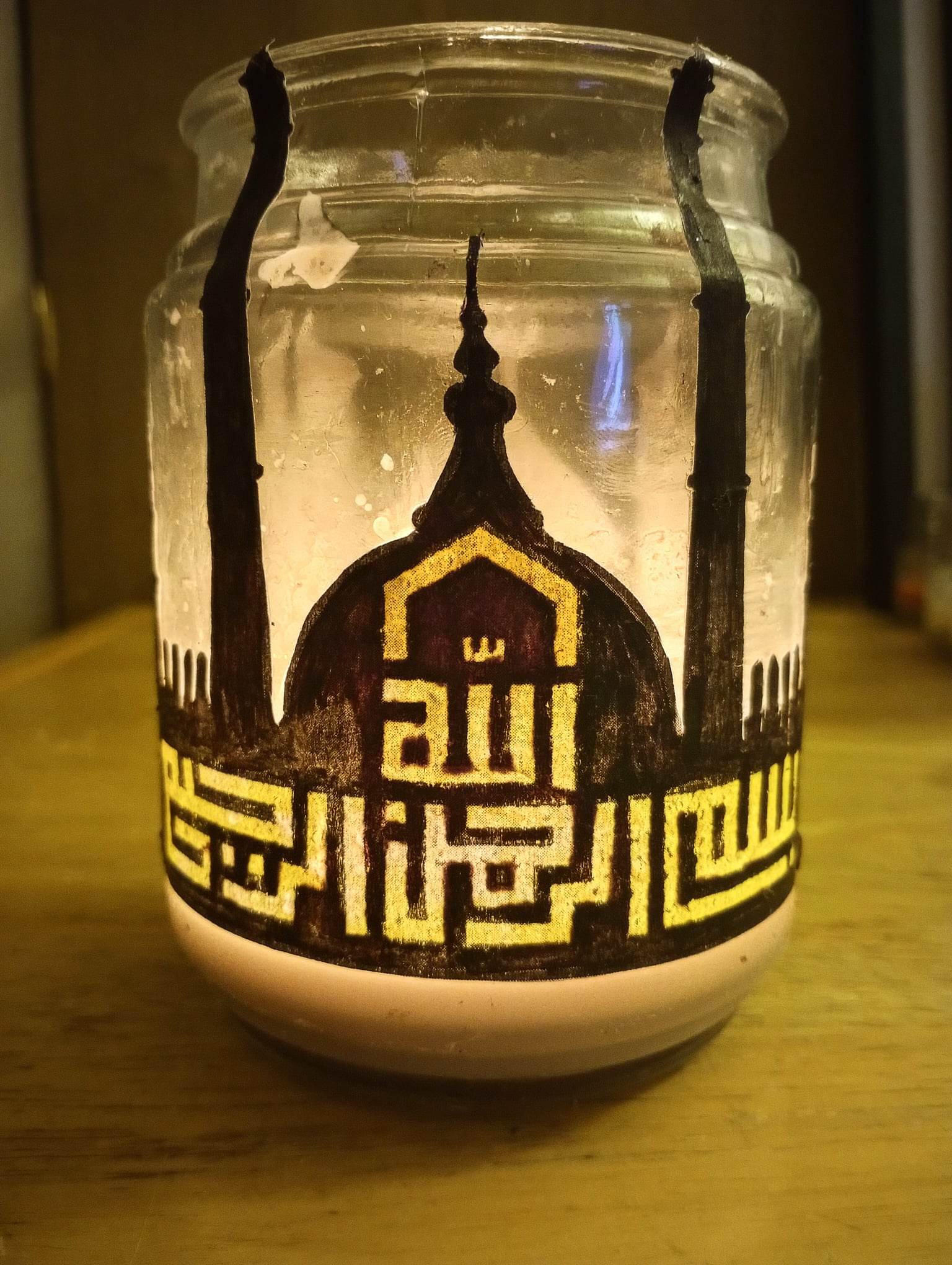
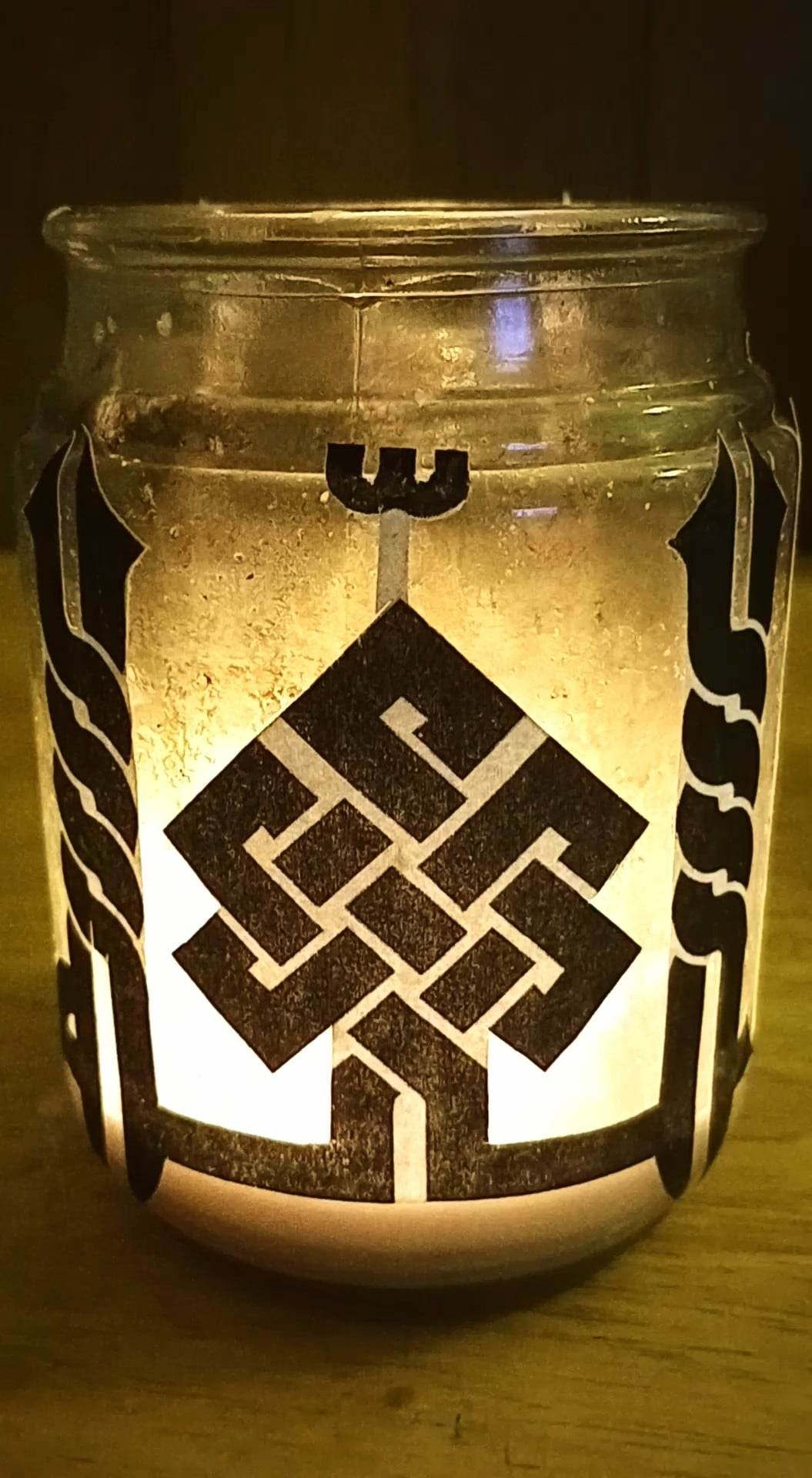
I have created a scented candle in a glass jar that is embellished with two pieces of conjoined calligrams. The first piece of the calligram, which is contained within the image of a mosque, says “Bismillahir Rahmanir Raheem” ('بِسْمِ ٱللَّٰهِ ٱلرَّحْمَٰنِ ٱلرَّحِيمِ) that means “In the name of Allah, the Merciful, the Compassionate” (Recorded Lecture 2). The second piece of the calligram says “Allah” (الله), which is the generic name in Arabic for God (Recorded Lecture 2). Both pieces of the calligram are in the Kufic Arabic script and utilize geographic patterns.
When the candle is lit (as shown in the video), the calligraphic script of “Bismillahir Rahmanir Raheem” (the basmalah) illuminates, as it is inked with a luminescent marker on paper that is pasted over transparent glass. The script depicting “Allah”, on the other hand, is embossed in black ink on paper that is pasted over the glass jar in order to create a silhouette of the script on a luminescent screen. Therefore, the two sides of the candle, although conjoined, are opposites in terms of artistic depiction: while one piece is luminescent and transparent on the black background of the mosque, the other piece is black and opaque on the luminescent backdrop of the candlelight. The contradiction between the artistic effects of the calligram is intended to reflect the meaning of the Arabic word, “Allah”, the roots of which are “bewilderment” or “that which cannot be understood” (Recorded Lecture 2).
According to Cragg and Speight in “Islam from Within”, the last verse of the Surah Al-Isra commands “Magnify [God] greatly” or “Make Him greatly great” or “Give to God a praiseful praise” (Cragg and Speight, 153). Accordingly, the basmalah praises God as “The Compassionate” and “The Merciful” and is the most popular praise of God uttered by Muslims. I have connected this script (physically, on the jar) with the script of “Allah” so that the calligram forms one whole (instead of two separate pieces), in order to insinuate the oneness of God, which is a major theme in the Qur’an (Recorded Lecture 3). Gratitude to God and remembrance of God as signs of faith are also predominant themes in the Qur’an, and I have included the basmallah and “Allah” for my calligram, in particular, as they are the simplest, most commonly used phrases to remember God.
Moreover, I utilized the Kufi script because it is “the earliest and severest style in calligraphy” according to Cragg and Speight in “Islam from Within” (Cragg and Speight, 152). Moreover, this script is usually very difficult to read, so that the calligram can only be understood if the viewer recalls the embossed verse or phrase from memory. This is important because the Qur’an, which means “recitation”, was initially meant to be “fluid and performed” like an oral recitation rather than to be read (Recorded Lecture 3). Accordingly, the Kufic script encourages the viewer to extract the recitation of the embossed Qur’anic verse from memory—necessarily causing them to perform an act of “zikr” or remembrance of God.
Furthermore, my calligram is imprinted on glass jar that contains a lighted wick in a candle, which reflects the Light Verse from the Qur’an that says: “God is the Light of the heavens and the earth; the likeness of His light is as a niche wherein is a lamp – the lamp in a glass as if it were a glittering star” (Qur’an 24:35, Recorded Lecture 3). Accordingly, the fire of the candle represents God as Light and the glass jar with the calligram in His praise implies that His reflections too “Magnify Him greatly” as the lamp in the glass magnifies the light like “a glittering star”. The candle is scented as a minor detail for when it is lit the fragrance of the candle permeates the surrounding area so that anywhere one turns, they find the fragrance, referring to the verse: “To God belongs the East and the West, so wherever you turn, there will be the face of God” (Qur’an 2:115, Recorded Lecture 2).
-
1
2023-01-29T20:13:21-05:00
Suraiya Jannat Jemima
8
Scented Candle in Glass Jar with Calligrams: “Bismillahir Rahmanir Raheem” and “Allah”
gallery
2023-05-02T16:58:16-04:00
Scented Candle in Glass Jar with Calligrams: “Bismillahir Rahmanir Raheem” and “Allah”
I have created a scented candle in a glass jar that is embellished with two pieces of conjoined calligrams. The first piece of the calligram, which is contained within the image of a mosque, says “Bismillahir Rahmanir Raheem” ('بِسْمِ ٱللَّٰهِ ٱلرَّحْمَٰنِ ٱلرَّحِيمِ) that means “In the name of Allah, the Merciful, the Compassionate” (Recorded Lecture 2). The second piece of the calligram says “Allah” (الله), which is the generic name in Arabic for God (Recorded Lecture 2). Both pieces of the calligram are in the Kufic Arabic script and utilize geographic patterns.
When the candle is lit (as shown in the video), the calligraphic script of “Bismillahir Rahmanir Raheem” (the basmalah) illuminates, as it is inked with a luminescent marker on paper that is pasted over transparent glass. The script depicting “Allah”, on the other hand, is embossed in black ink on paper that is pasted over the glass jar in order to create a silhouette of the script on a luminescent screen. Therefore, the two sides of the candle, although conjoined, are opposites in terms of artistic depiction: while one piece is luminescent and transparent on the black background of the mosque, the other piece is black and opaque on the luminescent backdrop of the candlelight. The contradiction between the artistic effects of the calligram is intended to reflect the meaning of the Arabic word, “Allah”, the roots of which are “bewilderment” or “that which cannot be understood” (Recorded Lecture 2).
According to Cragg and Speight in “Islam from Within”, the last verse of the Surah Al-Isra commands “Magnify [God] greatly” or “Make Him greatly great” or “Give to God a praiseful praise” (Cragg and Speight, 153). Accordingly, the basmalah praises God as “The Compassionate” and “The Merciful” and is the most popular praise of God uttered by Muslims. I have connected this script (physically, on the jar) with the script of “Allah” so that the calligram forms one whole (instead of two separate pieces), in order to insinuate the oneness of God, which is a major theme in the Qur’an (Recorded Lecture 3). Gratitude to God and remembrance of God as signs of faith are also predominant themes in the Qur’an, and I have included the basmallah and “Allah” for my calligram, in particular, as they are the simplest, most commonly used phrases to remember God.
Moreover, I utilized the Kufi script because it is “the earliest and severest style in calligraphy” according to Cragg and Speight in “Islam from Within” (Cragg and Speight, 152). Moreover, this script is usually very difficult to read, so that the calligram can only be understood if the viewer recalls the embossed verse or phrase from memory. This is important because the Qur’an, which means “recitation”, was initially meant to be “fluid and performed” like an oral recitation rather than to be read (Recorded Lecture 3). Accordingly, the Kufic script encourages the viewer to extract the recitation of the embossed Qur’anic verse from memory—necessarily causing them to perform an act of “zikr” or remembrance of God.
Furthermore, my calligram is imprinted on glass jar that contains a lighted wick in a candle, which reflects the Light Verse from the Qur’an that says: “God is the Light of the heavens and the earth; the likeness of His light is as a niche wherein is a lamp – the lamp in a glass as if it were a glittering star” (Qur’an 24:35, Recorded Lecture 3). Accordingly, the fire of the candle represents God as Light and the glass jar with the calligram in His praise implies that His reflections too “Magnify Him greatly” as the lamp in the glass magnifies the light like “a glittering star”. The candle is scented as a minor detail for when it is lit the fragrance of the candle permeates the surrounding area so that anywhere one turns, they find the fragrance, referring to the verse: “To God belongs the East and the West, so wherever you turn, there will be the face of God” (Qur’an 2:115, Recorded Lecture 2).
Works Cited:
1. Professor Asani, A. (2023). Understanding Islam and Contemporary Muslim Societies: Lectures.
2. Cragg, K., & Speight, M. (1980). Islam from Within. Routledge & Kegan Paul.
Final Exam Answers to Sections B and C
Section B (700 words)
OP-ED for Online “The New York Times” (Hijab)
“Unveiling the Complexity of the Hijab: Moving Beyond Simplistic Symbolism”
The hijab has been a source of political debate for decades, with Western governments banning it in public places and Muslim countries mandating it as a religious requirement. However, reducing the hijab to a simplistic analysis of its symbolism overlooks women’s diverse experiences and interpretations of the veil and Islam.
The hijab is not an unchanging symbol of Islam but rather a product of complex historical and cultural contexts. As Leila Ahmed describes in her book, “Women and Gender in Islam,” the significance of the veil has evolved through interpretations influenced by social, political, and religious factors (Ahmed, 144-168).
In pre-Islamic Arabia, the veil was a symbol of status for women (Professor Asani, Lecture 8 Slides). Over time, the cultural connotations of hair evolved in Arabic society, associating it with sexual allure and prompting the adoption of headscarves as a form of modest clothing (Professor Asani, Lecture 8 Slides). National and temporal contexts also shaped the meaning of the veil, as it was worn during Qur’anic recitation, adhan, and prayer (Professor Asani, Lecture 8 Slides).
In contemporary times the hijab became a tool for political power struggles in Muslim societies (Ahmed, 164). At the same time, in the West, the hijab was framed as a symbol of oppression and a threat to women’s rights (Ahmed, 164); this completely disregarded the diversity of experiences and interpretations of Muslim women, many of whom perceived it as a choice and a way to assert their identity and faith.
In fact, the Western fixation on the hijab dates back to the colonial era, where it was used as a moral pretext for imperialism (Ahmed, 154). The Western powers framed their efforts as a mission to rescue Muslim women from their oppressive societies, completely ignoring the agency of the women and their efforts to fight for their rights (Ahmed, 154; Professor Asani, Lecture 8 Slides).
The veil has also been a politically contentious issue in Islamic societies for a considerable period. For example, former President of Turkey, Mustafa Kemal Ataturk, repeatedly denounced the veil during the 1920s, while introducing westernizing reforms that affected women (Ahmed, 164). Similarly, Reza Shah, the Iranian ruler who was also an active westernizer and reformer, issued a proclamation banning the veil around the same time (Ahmed, 164).
In response, the veil was reappropriated to resist cultural imperialism from the West and to assert Muslim identity (Ahmed, 164). For example, in Tunisia during the 1920s, Habib Bourguiba opposed unveiling as a means of protecting Tunisian identity from French colonialism (Professor Asani, Lecture 8 Slides). Surprisingly, however, later as President of Tunisia, Bourguiba promoted unveiling in an attempt to modernize the country (Professor Asani, Lecture 8 Slides).
Additionally, certain Muslim revivalist movements stressed the importance of the hijab. These factions saw women as the source of “un-Islamic” practices in Muslim communities (Professor Asani, Lecture 8 Slides). Since women were responsible for transmitting the tradition to future generations, ensuring that they became “good” Muslims was integral to their efforts to redefine Islam (Professor Asani, Lecture 8 Slides).
Despite the variations in political interpretations and rationales regarding the veil discussed above, a common feature among them is that they were all driven by male-dominated institutions and imposed on women. Iranian Nobel Laureate, Shirin Ebadi rightly points out that “The problem that women face in Muslim societies is not because of religion. It is a result of patriarchal culture” (Professor Asani, Lecture 8 Slides).
In fact, at the time of its revelation, the Qur’an played a significant role in protecting and liberating women, outlawing female infanticide and granting women unprecedented rights in divorce, inheritance, and property management (Professor Asani, Lecture 8 Slides). The Qur’an also underscored the fundamental equality of men and women in the eyes of God and the equitable distribution of rewards based on merit, regardless of gender (Qur’an, 16:97; Professor Asani, Lecture 8 Slides).
Hence, oversimplifying the hijab as a symbol of oppression not only neglects the vast historical and cultural significance of the veil, but completely ignores the elemental role that Islam has played in empowering Muslim women. It also unfairly excuses patriarchal institutions and cultural drivers of gender-based problems in Muslim societies. Finally, it distracts attention from more pressing concerns facing Muslim women today, including education, healthcare, and economic opportunities.
To honor the agency and complexity of Muslim women, we must engage in respectful dialogue which goes beyond the stereotypical representations imposed upon them and acknowledges their diverse experiences and interpretations of Islam. This requires empowering women to make their own choices, promoting gender equality, and challenging discrimination. Through these efforts, we can cultivate greater understanding and acceptance across religious and cultural boundaries.
Words = Total Words – Citations = 773 – 73 = 700
Works Cited:- Ahmed, L. (1992). The Discourse of the Veil. In Women and Gender in Islam (pp. 144-168). Yale University Press.
- Professor Ali Asani. (2023). Lecture Slides and Recorded Lectures. In Understanding Islam and Contemporary Muslim Societies.
Section C (500 words)
I opted to deliver my message through an op-ed piece for the online version of a national newspaper, “The New York Times”. I selected this medium, in particular, for two reasons. Firstly, I wanted to present the multifaceted historical and cultural contexts that have influenced the significance of the hijab and highlight its political exploitation both in Muslim societies and in the West. Writing an op-ed allowed me to include specific historical events, such as Ataturk’s modernization of Turkey, and to cite authoritative scholars in the field, such as Leila Ahmed and Shirin Ebadi. This lent greater credibility to my piece. Shared, instead, as a blog-post or speech to the public, my message could be easily discredited as “hearsay” or “merely an opinion”, but through an op-ed published in a national newspaper, I would be able to proliferate my message with the added credibility of appropriate and verifiable references to historical accounts, esteemed scholars, and academic research. Secondly, I chose to write an op-ed for a national newspaper, like “The New York Times”, to reach the widest possible audience. An online op-ed is easily accessible and widely read, making it a better choice than a speech or blog post, which may only be encountered by those already familiar with the author. I also decided against a visual or artistic method to deliver my message, as these can be interpreted differently by different readers and fail to convey the same message to all readers; moreover, it was crucial for me to base my views on historical records and expert opinions to lend credibility and authority to my argument, which could not be achieved through a visual or artistic approach.
My audience are the readers of online “The New York Times,” which consists of about 1.6 million readers and is the most popular newspaper for digital-news consumers in the United States (Pengue, 2023). The majority of these readers are under the age of fifty (Pengue, 2023). I selected this audience for my focus for two reasons. Firstly, I aimed to disseminate my message to as many people as possible, and this is the largest audience I could reach. Secondly, this demographic is most exposed to US and World News, so they are likely to have been exposed to predominantly one-sided views—due to the propensity of news agencies to publish on provocative topics, and so I wanted to expose this demographic to different interpretations and significances of the veil and Islam.
My op-ed piece presents and substantiates a refined understanding of the hijab, acknowledging its complex historical and cultural context, diverse interpretations and experiences, and its political instrumentalization, both in Muslim societies and the West. It emphasizes the dominance of patriarchal institutions in these efforts and the, contrasting, lack of autonomy that women have with regard to these policies that are aimed directly at them. Finally, it highlights the more important issues facing Muslim women today, which require greater attention, and calls for respectful dialogue and understanding of the diverse experiences and interpretations of Muslim women.
Words = Total Words – Citations = 504 – 4 = 500
Works Cited:
Pengue, M. (2023, March 13). 25 New York Times Readership Statistics [The 2023 Edition] | letter.ly. letter.ly. https://letter.ly/new-york-times-readership-statistics/