Laiba Khan's Final: Sections B & C
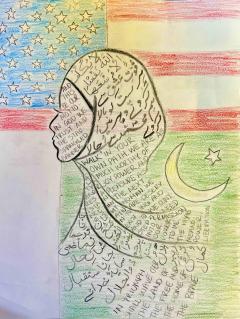
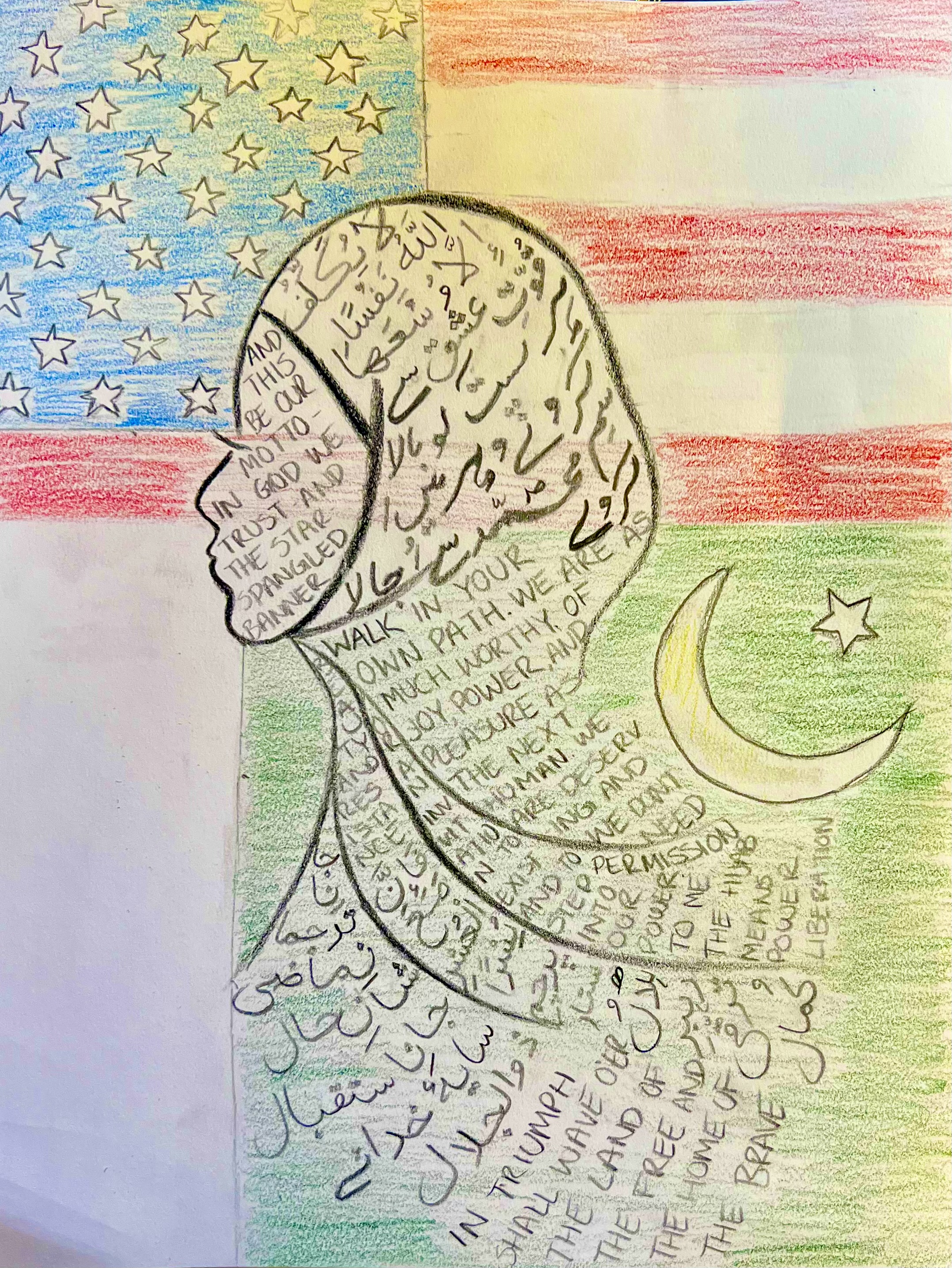
Description- Writing within the silhouette includes: ARABIC
My favorite Quranic verses (mentioned in the Opera):
Indeed with hardship comes ease (94:6)
Allah does not burden a soul beyond that it can bear (2:256)
URDU
Allama Iqbal’s Jawab-e-Shikwa
Raise you, through Love, all humble to greatness and to fame;
Enlighten you the groping world with dear Muhammad’s Name
Pakistan’s National Anthem's Last Stanza:
The flag of the crescent and star,
Leads the way to progress and perfection,
Interpreter of our past, glory of our present,
inspiration for our future!
Shade of God, the Glorious and Mighty.
ENGLISH
America’s anthem: (Francis Scott Key poem)
And this be our motto - “In God is our trust,”
And the star-spangled banner in triumph shall wave
O’er the land of the free and the home of the brave.
Ilhan Omar, first Hijabi Congress woman
“To me, the hijab means power, liberation, beauty, and resistance,”
“Walk in your own path. We are as much worthy of joy, power, and pleasure as the next human. We are deserving and we don’t need permission or an invitation to exist and to step into our power.”
REFLECTION
I highlighted the importance of language in understanding one’s experience with Islam through a cultural context. A quote that made me choose this idea was from the autobiography of Omar ibn Said, he apologizes to Sheikh Hunter by saying “You asked me to write my life. I am not able to do this because I have much forgotten my own, as well as the Arabic language.”To reflect on this, I decided to utilize this idea and did drawing that included writing as my version of calligraphy, a powerful form since God first created a pen (Lecture 3b slide). I included the languages that help me understand the word of God and the stories of the Prophet: Arabic, Urdu, and English. The quotes used are explained in the caption, all I used them purposefully as they are forms of each that express my identity in relation to being a Muslim as a Pakistani American and a hijabi and how they are a part of history. The Quranic verses that Omar Ibn Sayyid wrote about I recite today, Ilhan Omar’s success is inspiration I used to be proud of my hijab, Pakistan and America’s anthem attests to my proud heritage to both lands-specifically verses that talk about the same God for me.
My audience is everyone who attempts to define what a typical Muslim is or what hijab means. I specifically chose this target because often as a hijabi and child of an immigrant, our identities are not spoken about nor acknowledged enough, and balancing the politicized notion of being an American and Pakistani. Lecture 8 discussed the contextual interpretations of the hijab, the “veil,” as either oppressive or liberating, and how the process of globalization and equating modernization with Westernization has promoted the use of the hijab as a symbol of resistance and Lecture 13 highlighted the troublesome experiences with assimilation in the U.S; I wanted to reclaim the narrative, to state the hijab is a symbol of what the person wears it wants it to be but recognize all these aspects play a role in how I identify as Muslim.
So by using the power of language, I wrote within the outline of a hijabi and the background consists of flags from my identity to portray how a Muslim can look different to everyone. I want to express an answer to “Who’s Islam” by demonstrating my version, where I learned Arabic because it was the language of the Quran, Urdu to understand the poetry that praises the Prophet and qawwali about Ali, and English to translate and comprehend.
This can teach people to understand how language is the key to one’s story, and for the audience to understand situatedness when confronting religion, respect everyone’s personal constructions of religion, and provide insight into how complex it is.