Basmala-Allah Calligram Candle
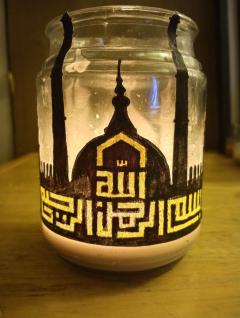
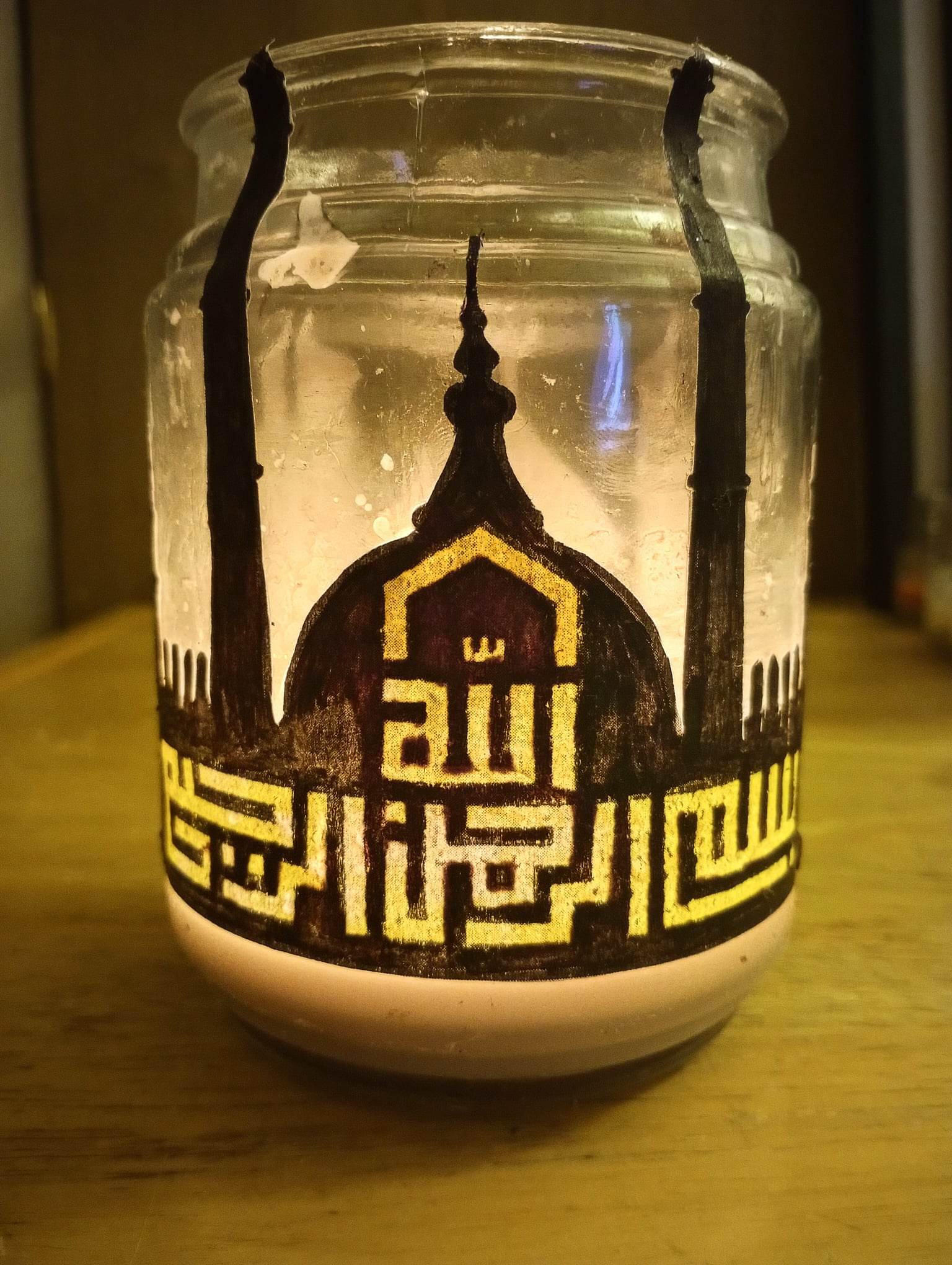
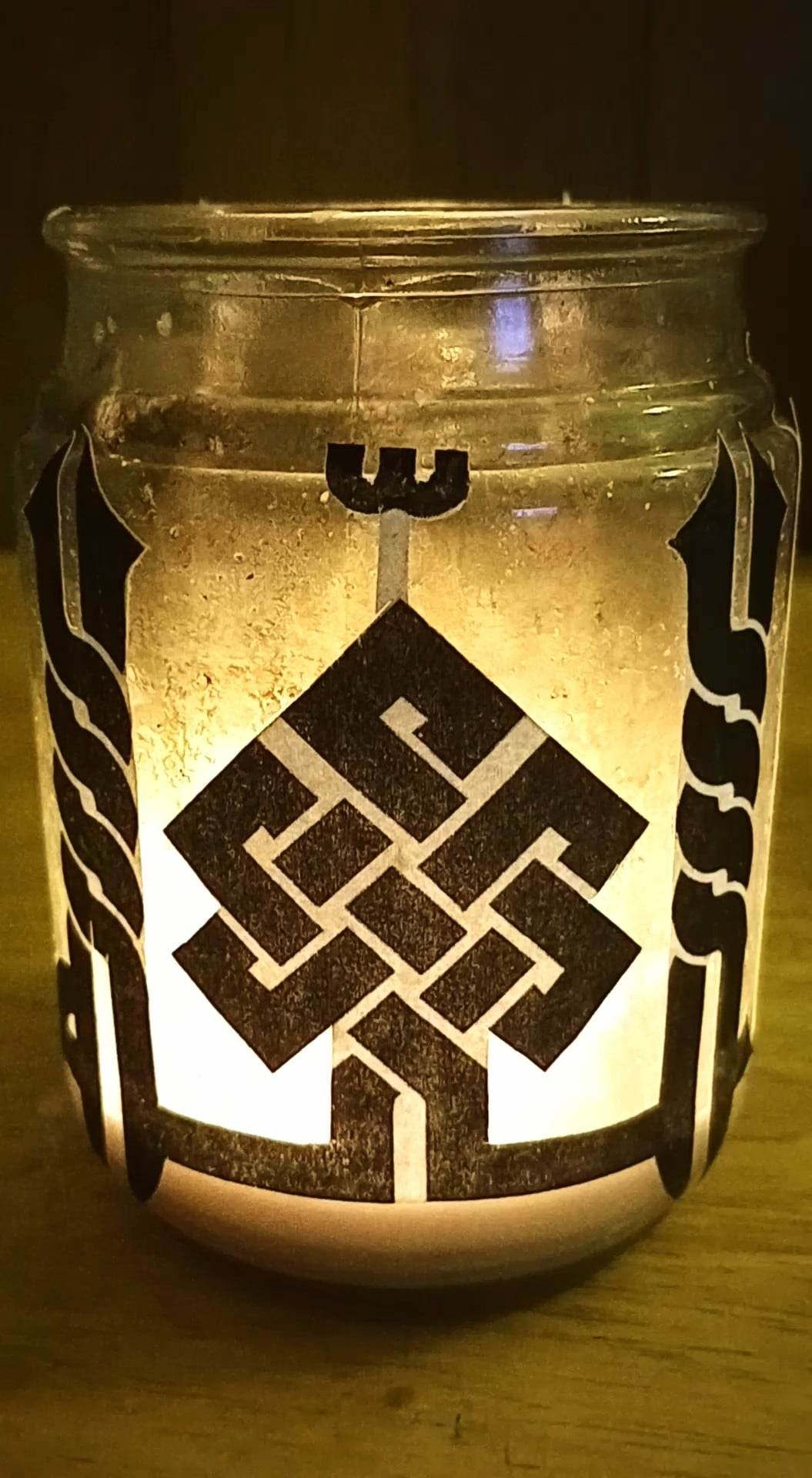
When the candle is lit (as shown in the video), the calligraphic script of “Bismillahir Rahmanir Raheem” (the basmalah) illuminates, as it is inked with a luminescent marker on paper that is pasted over transparent glass. The script depicting “Allah”, on the other hand, is embossed in black ink on paper that is pasted over the glass jar in order to create a silhouette of the script on a luminescent screen. Therefore, the two sides of the candle, although conjoined, are opposites in terms of artistic depiction: while one piece is luminescent and transparent on the black background of the mosque, the other piece is black and opaque on the luminescent backdrop of the candlelight. The contradiction between the artistic effects of the calligram is intended to reflect the meaning of the Arabic word, “Allah”, the roots of which are “bewilderment” or “that which cannot be understood” (Recorded Lecture 2).
According to Cragg and Speight in “Islam from Within”, the last verse of the Surah Al-Isra commands “Magnify [God] greatly” or “Make Him greatly great” or “Give to God a praiseful praise” (Cragg and Speight, 153). Accordingly, the basmalah praises God as “The Compassionate” and “The Merciful” and is the most popular praise of God uttered by Muslims. I have connected this script (physically, on the jar) with the script of “Allah” so that the calligram forms one whole (instead of two separate pieces), in order to insinuate the oneness of God, which is a major theme in the Qur’an (Recorded Lecture 3). Gratitude to God and remembrance of God as signs of faith are also predominant themes in the Qur’an, and I have included the basmallah and “Allah” for my calligram, in particular, as they are the simplest, most commonly used phrases to remember God.
Moreover, I utilized the Kufi script because it is “the earliest and severest style in calligraphy” according to Cragg and Speight in “Islam from Within” (Cragg and Speight, 152). Moreover, this script is usually very difficult to read, so that the calligram can only be understood if the viewer recalls the embossed verse or phrase from memory. This is important because the Qur’an, which means “recitation”, was initially meant to be “fluid and performed” like an oral recitation rather than to be read (Recorded Lecture 3). Accordingly, the Kufic script encourages the viewer to extract the recitation of the embossed Qur’anic verse from memory—necessarily causing them to perform an act of “zikr” or remembrance of God.
Furthermore, my calligram is imprinted on glass jar that contains a lighted wick in a candle, which reflects the Light Verse from the Qur’an that says: “God is the Light of the heavens and the earth; the likeness of His light is as a niche wherein is a lamp – the lamp in a glass as if it were a glittering star” (Qur’an 24:35, Recorded Lecture 3). Accordingly, the fire of the candle represents God as Light and the glass jar with the calligram in His praise implies that His reflections too “Magnify Him greatly” as the lamp in the glass magnifies the light like “a glittering star”. The candle is scented as a minor detail for when it is lit the fragrance of the candle permeates the surrounding area so that anywhere one turns, they find the fragrance, referring to the verse: “To God belongs the East and the West, so wherever you turn, there will be the face of God” (Qur’an 2:115, Recorded Lecture 2).