Ordinary playing cards
1 2020-08-24T08:24:33-04:00 Kelly O'Neill dc20b45f1d74122ba0d654d19961d826c5a557f5 9 7 plain 2020-09-12T09:38:18-04:00 Kelly O'Neill dc20b45f1d74122ba0d654d19961d826c5a557f5Page
| resource | rdf:resource | https://scalar.fas.harvard.edu/imperiia/ordinary-playing-cards |
| type | rdf:type | http://scalar.usc.edu/2012/01/scalar-ns#Composite |
| is live | scalar:isLive | 1 |
| was attributed to | prov:wasAttributedTo | https://scalar.fas.harvard.edu/imperiia/users/34 |
| created | dcterms:created | 2020-08-24T08:24:33-04:00 |
Version 7
| resource | rdf:resource | https://scalar.fas.harvard.edu/imperiia/ordinary-playing-cards.7 |
| versionnumber | ov:versionnumber | 7 |
| title | dcterms:title | Ordinary playing cards |
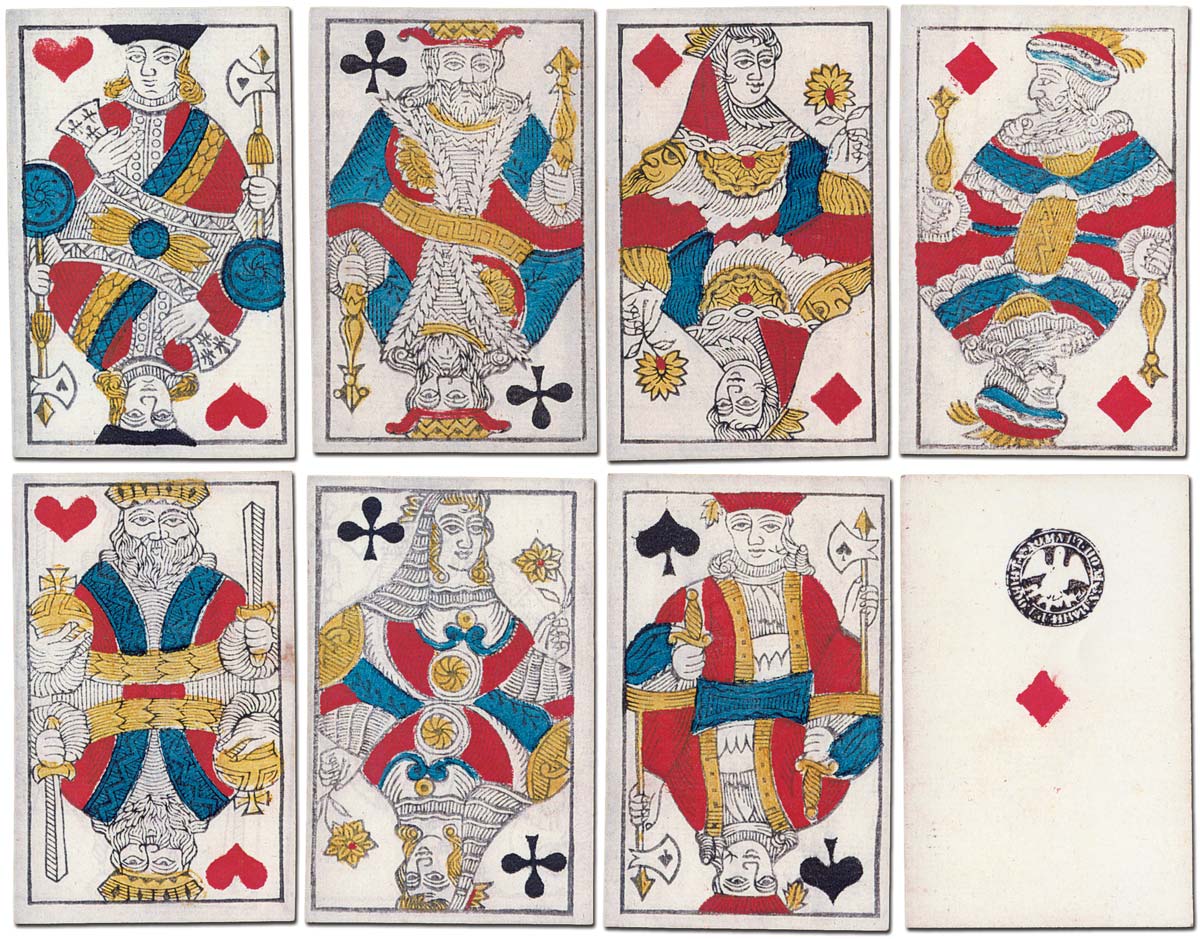
| content | sioc:content | Card playing was wildly popular among the Russian nobility. The Imperial Playing Card Factory was established in St. Petersburg in 1817, but most playing cards were imported (and most of those from England) for decades. By the late 1840s, Russian production had skyrocketed and millions of packs were used each year. Even a quick glance at these cards from the 1820s will give you a sense of how different the geographic playing cards are - both in purpose and design. These are based on the Paris design, which featured double-ended designs. Other than the Russian Imperial tax stamp on the ace of diamonds, you would hardly know that this deck was made in St. Petersburg (rather than any other European city at the time). Playing card production was a thriving business, however, and there was an appetite for diversity, luxury, and national themes. The geographic playing cards at the center of "Deal" are only one example. Here is another, from the late imperial period. This deck plays on the "Russian" national style championed in art and architecture during the reign of Tsar Alexander III (1881-1894). |
| default view | scalar:defaultView | plain |
| was attributed to | prov:wasAttributedTo | https://scalar.fas.harvard.edu/imperiia/users/34 |
| created | dcterms:created | 2020-09-12T09:38:18-04:00 |
| type | rdf:type | http://scalar.usc.edu/2012/01/scalar-ns#Version |
_Russian_style_1911_original.jpg)
This page is referenced by:
-
1
2020-08-17T01:12:00-04:00
Deal: History through Playing Cards
47
charts, maps, and a handy set of tags
image_header
2025-10-01T08:24:48-04:00
In 1856, a hot new item hit the shelves in Russia: a set of playing cards. Created by Konstantin Matveevich Gribanov, the set had an impressive title:
Album of Geographical Playing Cards of Russia, arranged on 80 cards according to maritime basin (A wonderful and instructive child's game of patience)
As you can imagine, these were not ordinary playing cards. They were elaborately illustrated, beautifully-produced, and laden with pedagogical and ideological value. If you had money to spare and fancied yourself an educated, elite, or prestige-hungry subject of the tsar, you no doubt found a way to get your hands on a set.
Playing cards of this kind were popular teaching tools in the nineteenth century. Imagine standing in your parlor (if you had the money to purchase the playing cards, you most likely had a parlor), thumbing through the set of texts and images describing the culture, history, economy, and geography of the provinces. It was like holding the empire in the palm of your hand.
Despite the fact that you are (most likely) not a wealthy inhabitant of the Russian Empire, you too can play cards. You can look through the gallery, explore one of the "card sorts" (each of which has a thematic focus), do some filtering of your own on a series of interactive visualizations, play a game, or sit back and enjoy a quick flipbook.
Everything you are about to learn about the history of the Russian Empire comes solely from a deck of cards. We have resisted the urge to explain and expound at every turn. Instead, we hope you will feel compelled to do that work. Our job is to fire up your sense of curiosity... and provide a bit of entertainment.
Note: The cards were digitized as the "Geographic Card Set of the Russian Empire" by the Meeting of Frontiers project: a collaboration between the Library of Congress and the Russian National Library. They are available for noncommercial educational use.


This page references:
- 1 2020-08-24T08:47:47-04:00 Russian style playing cards 2 Russian playing card deck called "Russian style" (face cards), designed in 1911 by "Dondorf GmbH" (Germany), original print. plain 2022-05-06T15:05:38-04:00
- 1 2020-08-24T08:25:22-04:00 Standard pack of playing cards, 1820s 1 plain 2020-08-24T08:25:22-04:00
_Russian_style_1911_original_thumb.jpg)
_Russian_style_1911_original.jpg)
